















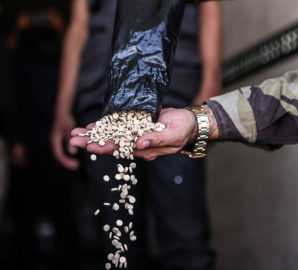
As Syria’s transitional government dismantles the Assad regime’s drug trade legacy, it must also remedy another crisis alongside it.
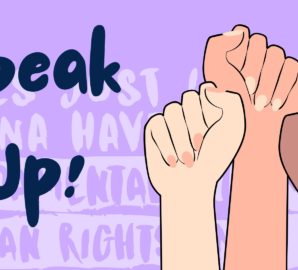
When Egyptian feminist group Speak Up announced a partnership with Pornhub—the world’s largest website for adult content—to rapidly identify and remove non-consensual content, it received immediate backlash. Are its efforts meeting the reality of sextortion in the country, or normalizing a platform that has often hosted non-consensual and illegal content?

Last November, Libya’s interior minister Emad al-Trabelsi announced a series of measures posed as a return to “society’s traditions,” but for many onlookers inside and beyond the country, they signaled a crackdown on individual freedoms — particularly for women.

While women’s inheritance and property ownership are protected by the Lebanese Constitution, inheritance laws differ based on religion and sect, leaving disputes to religious courts and personal interpretations — and biases — of those laws

Since the collapse of the Lebanese Pound in 2019, social workers in Beirut say that migrants and Lebanese alike have turned to the sex trade to cope with the increased costs of living.

Around 70 percent of those killed in Gaza the last few months have been women and children, with two mothers killed every hour, and one child estimated to be killed every 10 minutes, according to UN sources.
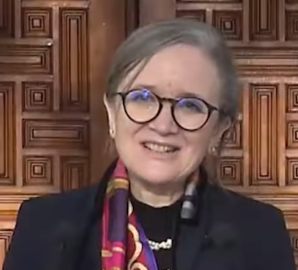
Bouden’s mere presence in one of the highest political offices in Tunisia has led to a genuine shift in national attitudes about women leaders, and that must not be overlooked.
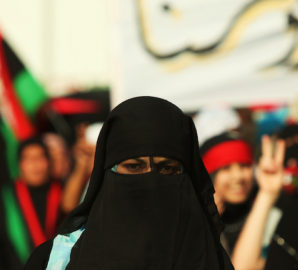
In a world plagued by oppressive social norms, pervasive violence, and unjust laws, the plight of women all over the world demands our unwavering attention.

“The Postcard Women’s Imaginarium” is a project that uses women's artwork to offer an alternative narrative to colonial-era postcards that framed MENA women as “exotic.”

A look back on 10 years of a revolution centered on the liberation of women.

In her upcoming memoir “This Arab Life: A Generation’s Journey into Silence,” Amal Ghandour weaves personal history to offer a thoughtful meditation on the veil's place within a modern Middle East.

The legal challenge against Turkey’s largest women’s rights group is suspected of having political motivations, appealing to Turkish President Recep Tayyip Erdoğan’s conservative voter base while distracting from the country’s economic challenges.

On March 25, the Islamic Republic of Iran began its four-year term as a new member of the United Nations’ Commission on the Status of Women (CSW) — “the principal global intergovernmental body dedicated to promoting gender equality and women’s empowerment” — after being elected by secret ballot last year.

In Lebanon, where childbirth care is highly medicalized and dominated by obstetricians in private hospitals, women are often persuaded to have cesarean sections, the revenue for which procedure is key for hospitals struggling to survive amid economic collapse.

As Saudi Arabia’s film industry expands, women see new opportunities.

With an ongoing civil war that’s worsening a dire humanitarian crisis, women in Yemen are challenging societal rules in order to provide for their families.

The first-of-its-kind show highlights the experiences of women in West Asia, North Africa, and South Asia while examining the intersectionalities of race, migration, and class.

Given entrenched cultural norms, the U.S. and the international community should demand that the new Taliban regime uphold the basic rights of Afghan women as defined by the Afghan constitution.

The exhibit coincides with the #LanAsket (“I will not be silenced”) movement against gender-based violence and harassment.

Iran is on the verge of passing a landmark law that will take action to outlaw sexual violence against women.

Salman’s hypocrisy has been apparent all along.

Zayed’s documentary, Lift Like a Girl, is set to make its U.S. premiere at the DOC NYC film festival on November 11.

A new movement has sparked public discourse among Iranian women as they take to social media with their own #MeTooIran moments.

On June 7, Iran passed a new law criminalizing the emotional and/or physical abuse of a child — the first of its kind in the nation.
According to Quartz, any woman under the age of 45 seeking a hajj visa must travel with a mahram, or a male guardian, usually someone related to the woman by blood.