















Fighting Sextortion in Egypt: A Feminist Group’s Controversial Partnership with Pornhub
CAIRO—Basant Khaled was only 17 when she died by suicide in 2021 after ingesting a “grain pill,” a cheap pesticide and fumigant widely available in rural Egypt. The pill, also known as “rice tablet” or “pest pill,” has an incredibly high mortality rate, which perhaps accounts for why it is the cheapest and most prevalent method of suicide among young people in rural Egypt today. Khaled’s family had found her unconscious and rushed her to Tanta University Hospital, where she died soon after.
A week earlier, a man had contacted Khaled saying that he was going to circulate doctored “obscene photos” of her online in an attempt to blackmail her. Out of fear and shame, Khaled took her own life. She left behind a note pleading with her mother not to believe that the photos were real.
Khaled’s story is one of many in Egypt, as sextortion—the abuse of intimate images to blackmail and extort victims—fast becomes a growing crisis in the Arab world’s most populous country, impacting thousands of women, oftentimes with devastating consequences.
Some victims, like Khaled, take their own lives. Others face brutal retaliation from their families, and even violence. Many more suffer in silence, trapped between blackmailers threatening to expose them and a society that often blames them instead of their abusers.
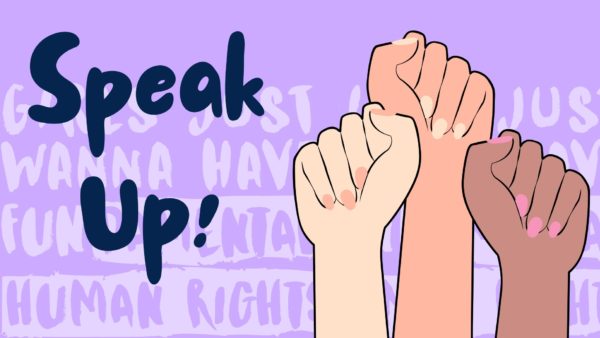
Seeking solutions to protect women from this growing threat, feminist initiatives have turned to unconventional strategies. Earlier this year, one approach sparked intense debate: Speak Up, an Egyptian feminist group advocating against gender-based violence, announced a partnership with Pornhub, the world’s largest website for adult content.
Through the platform’s “Trusted Flagger” program, Speak Up can now rapidly identify and remove non-consensual content. As soon as the initiative is notified by a victim about non-consensual content on the platform, Speak Up has a direct reporting mechanism with the platform to address it.
The partnership received immediate backlash from opponents on moral and reputational grounds, claiming that by publicly partnering with a pornography site—which has been accused of hosting non-consensual and illegal content—Speak Up risked normalizing the platform, if not outright endorsing it.
A radical move
Founded in 2020 by Gehad Hamdy, Speak Up began as a Facebook page where women could share their experiences with harassment and abuse. It has since grown to scale as a national feminist initiative.
“Speak Up is dedicated to supporting victims of all forms of violence,” Hamdy told WMC Women Under Siege. “We provide awareness campaigns, psychological and legal assistance, and rapid response services through our helpline.”
According to Hamdy, the decision to partner with Pornhub was practical rather than ideological. It was a way to provide immediate relief to victims who often struggle with lengthy removal processes, explaining that the partnership allows them to request content removals from the adult website with minimal
explanation.
Hamdy explained that the Speak Up team receives the reports, reviews them, then filters them. And for content not deemed harmful, Speak Up can request deletion anyway (with appropriate justification). After every report, the complainant is informed of the actions taken.
Feminist writer and translator Jana Adel, a critic of the partnership, questioned whether Speak Up’s involvement was necessary, noting that Pornhub already has its own internal reporting procedures non-consensual content.
“This makes it look like Speak Up is providing free labor to a platform that already has its own complaint mechanisms,” she said.
Adel also stressed that deleting content from Pornhub alone doesn’t guarantee women’s safety. “It can be reuploaded onto Telegram, social media platforms, or sent directly to the victim’s family.”
But Hamdy argued that the Pornhub partnership is only one of several avenues Speak Up has pursued to protect women, including collaborations with Meta, TikTok, YouTube, and Pinterest.
A deepening crisis
Sextortion in Egypt has escalated in recent years.
Two recent studies (including one by Speak Up) found that most victims of online blackmail are young women between the ages of 18 and 25, with nearly half of the cases involving sextortion. And most victims don’t — or can’t — seek help. Many are unaware of their legal rights, and an overwhelming 90 percent never report their cases, according to both reports.
But while legal solutions exist — such as reporting to the country’s General Directorate for Combating Cybercrime — victims often hesitate to go to the authorities, either due to stigma or the long and uncertain legal process. For those who do come forward, according to the reports, nearly half see their cases dismissed without action, either due to lack of evidence, legal ambiguity, bias from prosecutors and judges, or the victim’s decision to withdraw (due to social, cultural, or familial pressure).
Most of these stories remain hidden, known only to the victims and their blackmailers. But when they do surface, the consequences can be devastating.
In February 2024, a 19-year-old university student took her own life after her roommates leaked private photos of her. Two years earlier, another young woman in Alexandria also died by suicide after being targeted online by blackmailers.
While there are no available statistics on the prevalence of revenge porn in Egypt, activists providing support to victims of sextortion say they receive reports of hundreds of cases each day, a rate their team of volunteers are grappling to manage.
So far, said Hamdy, “We’ve received over 10,700 reports, which we reviewed and verified. As a result, we had 5,410 complaints that we sent to the platform, and 4,925 of them were deleted — a rate of about 91 percent.”
“Victims aren’t just threatened with exposure. They face direct threats against themselves or their families,” Moataz Abou Zeid, a legal expert and human rights legislative consultant, told WMC Women Under Siege. “In some cases, perpetrators even manipulate content to obscure victims’ identities, allowing them to maintain its market value rather than removing it entirely.”
According to Abou Zeid, sextortion cases can sometimes fall under human trafficking.
For Hamdy, the scale and implications of such crimes are enough reason for Speak Up to partner with all platforms that can lend a hand in helping victims.
A feminist divide
While some viewed Speak Up’s partnership with Pornhub as a necessary move to protect victims, others condemned it as a betrayal of feminist principles.
Dr. Mirette Ramsis, a human rights activist, strongly opposed the partnership, calling it “normalization with a vile industry” that sells sexual enslavement online, while feminist writer Adel said that it only serves to provide “moral cover” for a predatory platform.
Others defended the decision, arguing that the partnership actually provided immediate recourse for victims. “If this partnership helps women get their content removed faster, then it’s worth it,” said Aya Mounir, founder of the Superwoman initiative, which promotes equality and non-discrimination.
Mounir explained that without this collaboration, victims would have to engage with such platforms through third-party content removal services, which is often a long and uncertain process, making the case for direct intervention all the more urgent.
Egyptian feminism navigates the complex interplay of religion, patriarchal structures, and legal inequalities within the country’s unique cultural context. While sharing broader goals with global feminist movements, Egyptian feminists confront unique challenges rooted in societal norms and traditions, advocating for women’s rights and gender equality within a multifaceted but no less restrictive framework.
Some feminists believe that the ethical debate actually distracts from the real issue. Omaima Emad, a member of the Egyptian feminist nonprofit New Woman Foundation, argued that while concerns about partnering with the adult industry are valid, the priority should be ensuring women’s safety.
“This is a win,” said Emad. “Debating it without considering the context seems like a luxury when you think about the violence women endure due to revenge porn.”
“These platforms exist whether we like it or not, and they have millions of users,” said Hamdy, insisting that the initiative does not endorse Pornhub or its business model. “Our priority is providing support to victims in urgent need.”
This piece was published in collaboration with Egab.
More articles by Category: Gender-based violence, International, Misogyny, Online harassment, Violence against women
More articles by Tag: Middle East and North Africa, Sexualized violence, Sexual harassment, Sex Trafficking, Sexual assault, Trafficking


