















The Fight for Women's Inheritance Rights in Lebanon
BEIRUT — In 2020, Ouloum Audi’s father passed away, leaving his farmland in Lebanon’s northern Bekaa Valley to his six daughters and three sons. But a year later, Audi, 48, found herself in the throes of a vicious legal battle with one brother. With the other male siblings securing their share, the third contested he was the heir of his sisters’ share based on social norms and traditions, refusing his sisters their rightful share. He then sold the land without their consent.
While women’s inheritance and property ownership are protected by the Lebanese Constitution, inheritance laws differ based on religion and sect, leaving disputes to religious courts and personal interpretations — and biases — of those laws. In practice, as elsewhere in the Arab world, women’s right to inheritance remains significantly constrained by gender discrimination.
“Muslim women suffer more from inheritance injustice because under Islamic law, their share is half of men’s,” said Fatima Zeiter, an attorney who specializes in disputes centering the rights of women and men in family matters. “For Christians, women and men have equal inheritance shares, but Christian women lose that right if they marry outside their religion.”
Only 13 percent of agricultural land in Lebanon was owned by women in 2021. Farming accounts for only about five percent of Lebanon’s economy, employing around 8 percent of the effective labor force, but agricultural land in the Bekaa Valley makes up 49 percent of the country’s agrarian land. And since land ownership is largely regarded as a sign of higher social status, women’s economic security and social standing are directly hindered.
“The absence of laws that criminalize and penalize anyone who deprives women of their inheritance also allows men to manipulate inheritance shares against the best interests of women,” added Zeiter.
As much was the case for Audi, who had long been vocal against inheritance injustice in her country — and the deep-rooted legal and social inequities that have perpetuated it — before she was directly impacted herself. In the yearslong battle that followed between her and her brother, Audi relentlessly pursued her inheritance through the Lebanese court system, suffering emotional abuse from her relatives — including her brother — along the way.
This systemic inequality can also breed violence. Women have been physically assaulted to compel them to give up their demands, as was the case of Zahraa Al-Tashm, a professor of philosophy who was allegedly beaten by her brothers after their father left her the family home in his will.
Audi and her sisters managed to suspend their brother’s unauthorized construction on their father’s land through a court order, but the legal battle for their rightful shares continues.
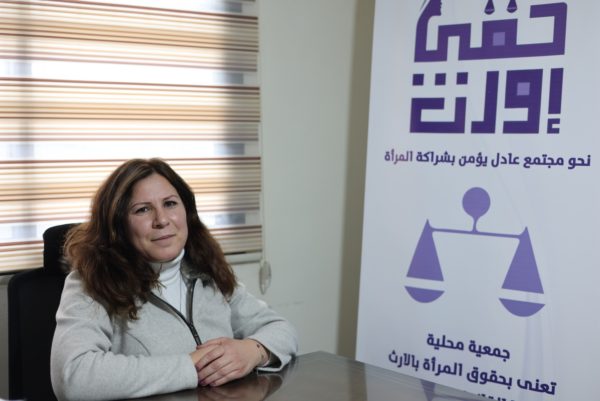
Audi’s pursuit of her inheritance revealed a knowledge gap among women about the laws that can protect their rights and the mechanisms they can pursue to obtain them. In 2021, when Audi’s legal fight was only beginning, she founded Haqi Awrath, a nonprofit offering local women legal support and capacity building to fight for their inheritance — particularly those in the Bekaa, where traditional patriarchal structures and norms govern.
“I wanted to fight for my rights and the rights of countless women who are silenced by shame and fear,” she said.
Since its launch, Haqi Awrath has assisted more than 400 women through free legal counseling and workshops to educate women on their inheritance rights.
“At first, only a few signed up,” said Audi. But the country’s economic collapse has left women in increasingly dire financial straits, despite legally owning valuable bonds in the form of inheritance. Now, she said, women are actively seeking support.
“The foundation has turned into a refuge for legal guidance.”
Fatima Houwaithani, 53, a widow and mother of six children from the town of Al Khedr in the Bekaa, was denied her inheritance by her brother after their father’s death 28 years ago. Held back by traditional norms, she never sought to fight for her share of their property until the economic slump and declining value of her deceased husband’s pension left her nearly destitute. The widow then tried again to claim her inheritance in order to meet her children’s needs. After she was summarily denied — again — she sought guidance elsewhere.
Houwaithani’s daughter heard about Haqi Awrath’s work from others in the town and started following their work on social media, encouraging her mother to eventually enroll in a workshop.
“After attending the workshop, I knew that the law was on my side, and I knew where to start,” said Houwaithani. “I have now filed a lawsuit and am following up on the case with the help of lawyers.”
Ranim Awdeh, 31, a mother of three, also enrolled in a workshop to preemptively protect her inheritance in case of her father’s death.
“These training sessions were my light to avoid mistakes,” she said. “I asked my father to repeat his will verbally in front of witnesses, and then legally document our inheritance in order to protect my rights.”
Haqi Awrath hopes to expand its services and reach but still faces funding challenges, even with the support of the Canadian Embassy and UN Women.
“One of our main challenges is that we cannot hire lawyers to help women file lawsuits and follow up with them,” said Audi. “Our services are limited to training and legal consultations.”
While such community-based initiatives can offer support to women, more needs to be done to protect their rights, said the attorney Zeiter, including a unified inheritance law for all Lebanese citizens, which remains in the very early stages of formation.
Audi agrees, and wants the government to go further by addressing loopholes. Laws should mandate notary validation for family sales and fingerprinting in the presence of witnesses and local officials, she said, while family records could be electronically stored to ensure accuracy and further prevent tampering.
But perhaps the most urgent need is the culture change that could facilitate this new norm, she said. “The biggest challenge [is] establishing the concept of women’s right to their own property and inheritance as an issue of equality, respect, and demanding our rightful place in society — not as a favor from anyone.”
This article was published in collaboration with Egab.
More articles by Category: Gender-based violence, International, Religion, Violence against women
More articles by Tag: Equality, Middle East and North Africa


