















New Report Maps Gains, Losses for Women in Film
Progress for women in the movie industry has been an uneven dance of steps forward and steps backward. Some good news, for example, is an increase in the number of women of color directors of the IMDbPro Top 100 Films of 2025, compiled by the Internet Movie Database (IMDb), an online resource for movies and television. The bad news is a decrease in the total number of women directors of these movies, according to a recently released report from ReFrame, a gender equity coalition founded by the nonprofit advocacy groups Women in Film and Sundance Institute.
Things could get worse for women filmmakers in 2026 and beyond because of a reduction in the number of movies being made and cutbacks in diversity initiatives, according to ReFrame Director Erica Fishman, who co-wrote the ReFrame Report on Gender and Hiring in Film 2025. She spoke to Women’s Media Center in an exclusive interview.
“There are fewer projects being made, which also means that people are more risk-averse,” Fishman says of the reasons behind hiring decisions for movie jobs such as directing, writing, and producing. “In many cases, it means you’re leaning toward people with the longest résumés. And people with the longest résumés tend to be white and cis male candidates.”
Released annually since 2017, the ReFrame Report on Gender and Hiring in Film is a collaboration between Women in Film, the Sundance Institute, and IMDbPro, which is IMDb’s subscription section for professional industry resources. One of the report’s main goals is to identify IMDbPro’s Top 100 most popular releases that meet ReFrame Stamp criteria for gender-balanced productions.
Movies eligible to be included in the ReFrame Report on Gender and Hiring in Film are feature-length scripted fiction films that are produced in the U.S. and had U.S. distribution in the year that is the focus of the report. For the ReFrame Stamp, productions are evaluated on their hiring of “qualifying candidates” in on-camera and off-camera jobs, with “qualifying candidates” defined as women, trans people of all genders, nonbinary people, or other gender-nonconforming people. Racial identities and ethnicities of hired individuals are also part of these evaluations.
Movies that can earn a ReFrame Stamp are those that have directors, writers, producers, leading/co-leading cast members, and crew members who are “qualifying candidates” or are people of color. For crew members, more than 50% must consist of “qualifying candidates,” or more than 25% must consist of people of color.
Gains, Losses, and Standout Women-Directed Movies
The ReFrame Report on Gender and Hiring in Film 2025 reveals that the movies that were part of this study had the lowest number of gender-balanced projects in a given year since 2019. “Only 11 women directed films on the 2025 Top 100 list, down nearly half [from] a peak of 20 in 2023,” according to a finding in the report. By comparison, 14 women directors were on this list in 2024, and 12 women directors were on this list in 2019. In 2025, six of the 11 women directors (54.5%) on the list were women of color. That’s an increase compared to 2024, when there were five women of color (36%) among the 14 women directors on the list.
Among the women-directed movies that are part of the 2025 ReFrame report are Universal Pictures’ horror sequel Five Nights at Freddy’s 2, directed by Emma Tammi; Netflix’s animated musical KPop Demon Hunters, whose two directors include Maggie Kang; Walt Disney Pictures’ comedy sequel Freakier Friday, directed by Nisha Ganatra; Walt Disney Pictures’ animated adventure Elio, whose three directors included Madeline Sharafian and Domee Shi; and A24’s romantic dramedy Materialists, directed by Celine Song.
Among the women-directed movies on the IMDbPro Top 100 List of 2025 that earned ReFrame stamps are KPop Demon Hunters; Elio; Freakier Friday; Materialists; Focus Features’ drama Hamnet, directed by Chloe Zhao; Sony Pictures’ horror reboot I Know What You Did Last Summer, directed by Jennifer Kaytin Robinson; Netflix’s action sequel The Old Guard 2, directed by Victoria Mahoney; and MUBI’s drama Die My Love, directed by Lynne Ramsay.
According to the ReFrame report, the number of women writers increased on the 2025 IMDbPro list. Of the 27 women writers on the list, six (22%) are women of color. By comparison, 23 women writers were on the list in 2024, with three (13%) being women of color.
Transgender, nonbinary, or gender-nonconforming representation continued to be nonexistent in almost all behind-the-scenes jobs in the movies that were part of the 2025 ReFrame report. The report says that of approximately 1,500 job positions, only three (or 0.2%) were filled by gender-diverse (not cisgender) people, and they were all in intimacy coordinator positions. There were no transgender, nonbinary, or gender-nonconforming people in leading or co-leading on-camera roles for these movies in 2025.
Fewer Movies Equal Fewer Jobs
In terms of the numbers of movies released every year in theaters, the industry hasn’t fully bounced back to pre-pandemic levels. According to Box Office Mojo, an IMDb-affiliated website that tracks worldwide box-office revenue, there were 901 theatrically released movies in the U.S. in 2019, with U.S. box-office revenues totaling $11.4 billion. In 2020, when the majority of U.S. movie theaters were shut down for most of the year because of the pandemic, those numbers plummeted to 456 theatrically released movies in the U.S., with U.S. box-office revenue totaling $2.1 billion. In 2025, there were 670 theatrically released movies in the U.S., with U.S. box-office revenues totaling $8.7 billion.
Corporate media consolidations and shutdowns of smaller companies are two other crucial reasons why fewer movies are being made. Paramount Skydance and Warner Bros. Discovery are expected to merge before the end of 2026. Fishman comments on how this merger will affect the movie industry: “The big concern there is the merger will also contribute to … less content being made, which generally tends to lead to fewer opportunities for women. Based on our data for ReFrame, Paramount and Warner Bros. are not particularly inclusive companies.”
Netflix and KPop Demon Hunters as Diversity Leaders
The 2025 ReFrame report also ranks movie distributors based on ReFrame Stamp criteria. Paramount Pictures and Warner Bros. Discovery (which includes Warner Bros. Pictures) ranked among the lowest of the major corporate movie distributors for Stamped films in the Top 100. According to the report, Paramount Pictures had 20% Stamped films, while Warner Bros. Discovery had 11% Stamped Films. Also low in the rankings was NBCUniversal (which includes Universal Pictures and Focus Features), which tied with Paramount at having 20% Stamped films. The only major movie distributor to rank even lower was Apple, which had zero Stamped films on the report’s list.
One company stood out above the others for having the most diverse hirings for movies: “This year, Netflix was the only company meeting 50% in its volume of Stamped films in the Top 100,” the report noted. “Though a slight decrease from the 56.25% it held in 2024, Netflix is a consistent leader year-over-year for inclusive hiring and gender-balanced projects. It is followed by Lionsgate, which holds the ReFrame Stamp for 40% of its projects this year, its highest volume since 2020.” However, Lionsgate movies did not have any movies directed by women on the list.
Fishman comments on why Netflix has been a success in diverse hirings for movies: “[Netflix CEO] Ted Sarandos has instilled really diverse leadership there, with [Netflix Chief Content Officer] Bela Bajaria, [Netflix Chairman of Film] Dan Lin, and [Netflix Head of Feature Animation and Family Film] Hannah Minghella. Company by company, you consistently see that when the leadership is diverse, they make more inclusive choices.”
Fishman says that whereas other movie distributors have been dismantling diversity, equity, and inclusion (DEI) programs, Netflix has maintained DEI initiatives. “Netflix has created an equity fund … for underrepresented artists all across the field, which I think is an incredible commitment to development of talent,” Fishman adds. “We’ve heard emerging directors and writers say that there are fewer and fewer of those programs provided by the studios. And we’ve heard that when they’re participating in those programs, they’re less able to wind up being staffed — more so for directors than for writers.”
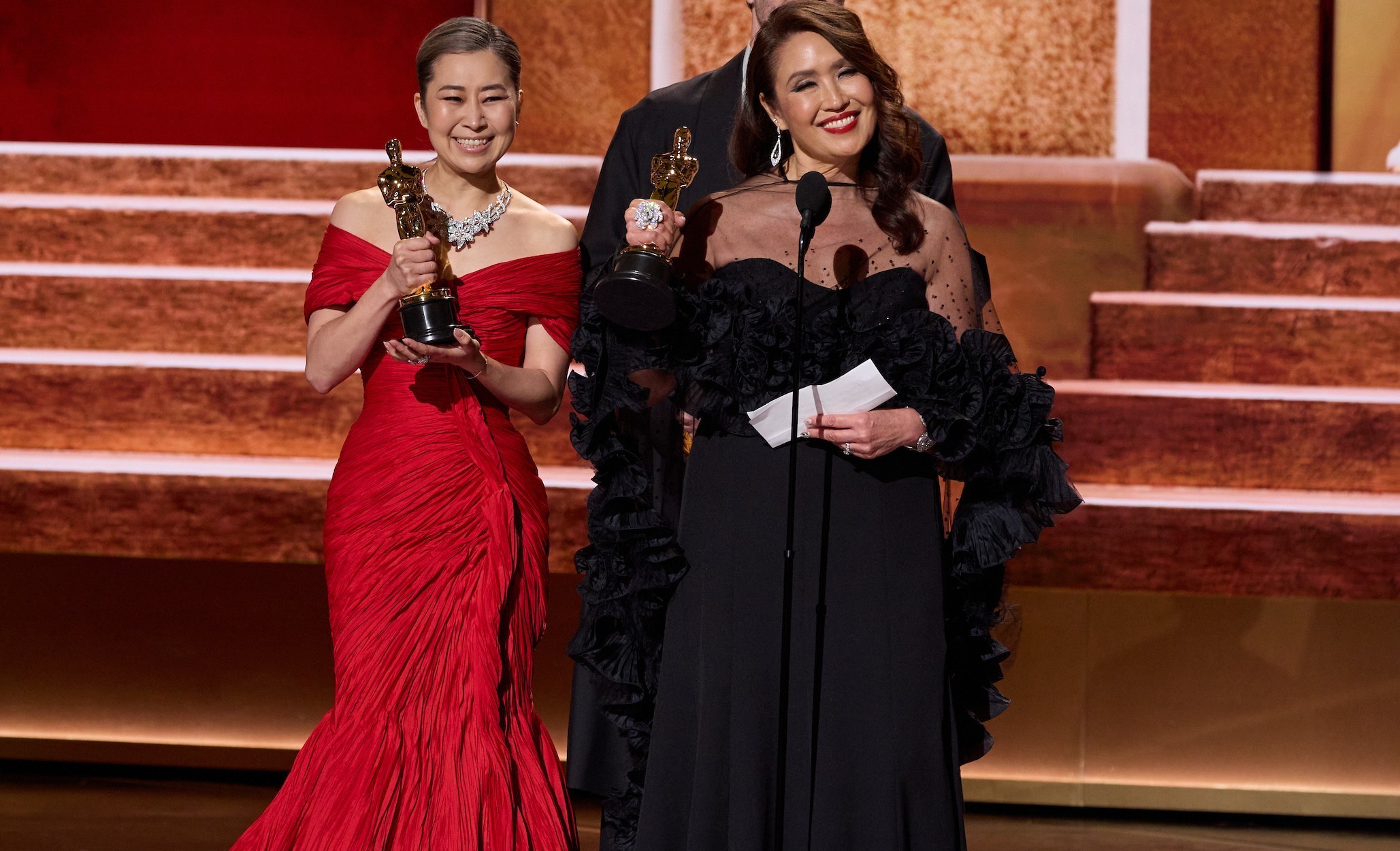
Netflix’s Oscar-winning KPop Demon Hunters (based on an original story created by director Kang) is one of the few movies on the IMDbPro Top 100 List of 2025 that has ReFrame Stamps in all the categories. Women are the majority of the above-the-line creatives on KPop Demon Hunters, including Kang, producer Michelle Wong, and screenwriters Kang, Danya Jimenez, and Hannah McMechan, who co-wrote the film with male writer/director Chris Appelhans.
KPop Demon Hunters — which centers on a South Korean female pop trio fighting demons — became a pop culture phenomenon after it was released on Netflix on June 20, 2025. It has become the most-watched movie in Netflix history, with more than 560 million views as of January 2026. When it was released in U.S. theaters for a limited period of August 23 and August 24, 2025, the movie debuted at No. 1 for the weekend, with ticket sales totaling $18 million, according to Box Office Mojo. Netflix’s three-day rerelease (beginning on October 31, 2025) of KPop Demon Hunters in U.S. theaters brought an additional $6 million to the movie’s box-office totals.
In a May 2026 interview with Deadline, Kang (who was born in Seoul and raised in Toronto) revealed her motivation to create this original movie: “I felt there were things that I hadn’t seen yet, not just for representation and Korean culture, but also the type of female characters that I hadn’t seen in animation or movies in general. I felt like I hadn’t seen female characters portrayed in the most real way for me, especially in the superhero category.”
Pushing Back Against the DEI Backlash
In the #MeToo movement resurgence of the late 2010s, many high-profile people in the movie industry (including actress Frances McDormand in her 2018 Academy Awards acceptance speech) advocated for inclusion riders in movie contracts — provisions that would mandate diversity in hiring cast and crew for a project. In 2026, public discussions of inclusion riders have almost disappeared among high-profile people who still identify as activists for diversity.
“It’s very much in line with our political climate as a country,” Fishman says. “What we’re hearing in this political climate is that your business could be in jeopardy for appearing to be ‘woke’ or ‘inclusive.’ People are concerned about punitive retribution.”
Despite this backlash, diversity can be seen in some movies releasing in 2026 and beyond. Some of the women-directed movies of 2026 that are expected to rank in the top 100 of the year — in terms of box-office revenue and IMDbPro rankings — are Warner Bros. Pictures’ drama remake Wuthering Heights, directed by Emerald Fennell; Universal Pictures’ drama Reminders of Him, directed by Vanessa Caswill; Warner Bros. Pictures’ fantasy sequel Practical Magic 2, directed by Susanne Bier; Sony Pictures’ horror sequel 28 Years Later: The Bone Temple, directed by Nia DaCosta; and A24’s comedy The Invite, directed by Olivia Wilde. McKenna Harris, the co-director of Pixar Animation/Disney’s Toy Story 5, has made history as the first nonbinary person to direct or co-direct a feature-length movie from a major American animation studio. “We’re so excited to see a nonbinary person in a role like that,” comments ReFrame’s Fishman.
Several women, including many prominent actresses, have taken gender diversity issues into their own hands by starting their own production companies and following through on promises to produce movies that have women directors and women in other important roles. Reese Witherspoon, Margot Robbie, Viola Davis, Nicole Kidman, and Eva Longoria are among the well-known actresses who have founded production companies with strong and recent track records of hiring women as directors and in other top-level positions.
“It’s an amazing way to exert control over what’s being made,” Fishman says of women starting their own production companies. “Emerald Fennell’s [directing] career has been built from working with Margot Robbie [who has produced movies directed by Fennell]. That’s a very strong position to take. I admire and respect the people who are willing to go about it consistently.”
The success of KPop Demon Hunters is an example of how there’s a massive audience for movies that have diversity on-screen and off-screen. Fishman concludes: “Parity is leveling the playing field. Parity is giving an equal opportunity to win the job — and let people win it on their talents. What we’ve been supporting is to get people to keep showing up to see movies made by women, nonbinary people, and trans people. … That’s the best way to guarantee that more of those films are made.”
More articles by Category: Arts and culture, Media
More articles by Tag: Film, Women, Media


