















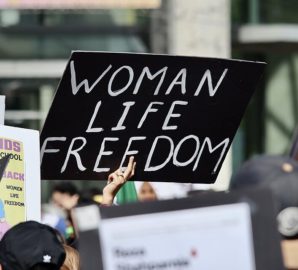
Violent crackdowns on dissent and activism have increased within Iran in recent months, as hardliners reassert dominance amid U.S. attacks.
Since the U.S. and Israel launched their joint assault on the Islamic Republic of Iran, feminist voices in the “Zan, Zendegi, Azadi” movement (or the “Woman, Life, Freedom” movement) have been diverse, with contradictory and dispersed reactions to war, foreign intervention, and even the future of the movement itself.

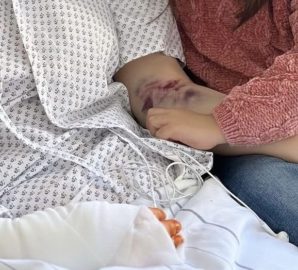
War has been raging for 11 months in Sudan. Amid the horrific wave of violence that has led many people to flee West Darfur, women and girls have described being raped, beaten, detained, and forced to witness the killings of loved ones by groups of armed men.

After nearly two years since the Russian invasion of Ukraine, the unchecked exploitation of Ukrainian women abroad — who are still displaced in different European countries, as well as internally, in Ukraine — is poised to create a crisis of sexual abuse and sex trafficking.

Women Under Siege spoke with American anti-war activist Jody Williams, Yemeni human rights activist Tawakkol Karman, and Liberian peace activist Leymah Gbowee about their trip with Nobel Women's Initiative to Ukraine, the stories they heard there, and how Ukrainian women are fighting for peace in their country.
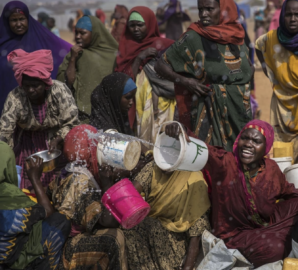
Among the horrors of the climate crisis is drought. In Somalia, in particular, it’s become too dry to grow crops, sustain livestock, or find fresh drinking water.

A small number of organizations offer help for refugees’ psychosocial well-being — an often-overlooked but crucial service.

Putin promotes traditional masculine tropes but fails to realize that performative masculinity is not a strength but a vulnerability.

Russia is at war with Ukraine, displacing millions of women and children, and the experience has brought my grandmother’s trauma to the fore in my own family.

In a landmark case for justice in Guatemala, five former paramilitary soldiers were convicted by a special tribunal of crimes against humanity for sexualized violence committed against five indigenous Maya Achí women during the country’s 36-year internal armed conflict.

Sexualized violence is widespread throughout the world. This is true even in times of peace and stability, but it escalates during humanitarian crises. In conflicts, women’s bodies can become battlegrounds, with rape used to humiliate and dominate. Protection systems also collapse during natural disasters, leaving women and girls vulnerable. And child marriage, a form of gender-based violence, is often seen as a coping mechanism among crisis-affected families.

Emerging from a crowd of around a dozen women, Farida, a 32-year-old Syrian refugee living in Istanbul, stood in front of a cabinet full of bright and colorful threads and beads. Looking at the materials with friends, she mused what color she should use for her next earring project. “Let’s not use orange and pink this time,” she murmured to one of her friends, another Syrian refugee.

In the languages of the former Yugoslavia “suza” means “tear.” And in the more than 20 years that have passed since the end of the wars that dismantled the country in the 1990s, it seems that there is one, very last tear that many mothers, wives, daughters, and sisters cannot shed until the mortal remains of their closest kin are found, identified, and properly buried.

Earlier this month, Amnesty released a report detailing allegations of government-sanctioned abuses in the two buildings of Saydnaya military prison outside of Damascus, between 2011 and 2015. The findings show a systematic policy of mass executions, torture and deprivation of food, water, medicine and medical care, which could amount to war crimes and crimes against humanity.

Wars fought because of ethnic hatred often seem to be more brutal than others. This is just a personal observation, having studied many. Just look at Rwanda, whose 1994 war saw between 250,000 and half a million women raped, often with objects and often publicly, in order to spread maximum humiliation and terror.
The recent Lancet Series on Maternal Health confirms a well-established reality: The majority of preventable maternal deaths continue to occur in areas affected by humanitarian crisis, largely as a result of poor maternal care. But this reminder is also accompanied by a chronic offense. Contraception is not given the spotlight it deserves.


Mary Elias, of Laje village in Malawi’s southern Zomba district, speaks in metaphors. “We are carrying both water cans,” she says of the situation for single mothers in drought-ridden Malawi—meaning that women with children but without partners are solely responsible for feeding, clothing, and educating their progeny. Already a Sisyphean task in a country the United Nations Development Program regularly ranks in the top 20 poorest on earth, this has become nearly impossible in the past few years.


Refugees. Srebrenica. The siege of Sarajevo. Burning villages such as Ahmići and Stupni Do. The Omarska camp. Captured in these words are some of the most powerful and lasting images of the 1992-1995 Bosnian war. The media captured many of the crimes committed in this conflict, while one particular set of crimes typically occurred behind closed doors.

The Honorable Mary Robinson is the founder and president of the Mary Robinson Foundation – Climate Justice and serves as the UN Secretary-General’s Special Envoy on Climate Change. She was the first female president of Ireland from 1990-1997 and the United Nations High Commissioner for Human Rights from 1997-2002, and is a global leader on issues of women’s empowerment and human rights. In July 2013, I sat down with her to discuss climate justice and the role of women in the fight for peace.

Colonel Magistrate Freddy Mukendi is an imposing man who speaks from behind darkly shaded eyeglasses. He takes up the full space of a lounge chair, giving off a breezy, if formal, comfort in his own skin. Considering his high-level position in the DRC, this may not be entirely unexpected.