















Morality Policing Comes for Women's Rights in Libya
Last November, Libya’s interior minister Emad al-Trabelsi announced a series of measures posed as a return to “society’s traditions,” but for many onlookers inside and beyond the country, they signaled a crackdown on individual freedoms — particularly for women.
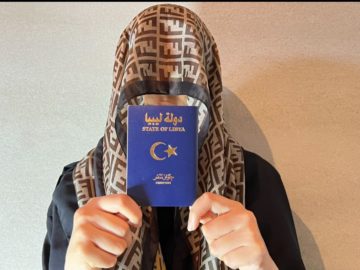
Among the alarming measures were restrictions on women’s clothing — including mandatory hijabs — on their ability to travel without a male guardian, and on gender mixing in public spaces.
And, to enforce these new restrictions, al-Trabelsi announced the introduction of a “morality police” to the country, which would threaten arrest or expulsion for violators and opponents alike.
The minister went further to say that there was “no space for personal freedom in Libya” and that those looking for it “should go to Europe.”
The measures were interpreted as part of a broader and ongoing state repression campaign masked as protecting morals and public decency, a pretext long used under the late President Muammar Gaddafi’s rule to suppress civic activities and quell dissent.
Libya has imposed different forms of morality policing in its recent past: Under Gaddafi’s reign (from 1969 until his overthrow in 2011), women were also subjected to conservative dress codes, albeit without an institutionalized enforcement body. But after Gaddafi’s fall paved the way for Islamist militias and other groups to assume power — including the Government of National Unity (GNU), under which al-Trabelsi serves as minister — sources said that strict moral codes were imposed in areas under their control regardless, even without a formal mandate.
The announcement of a morality police as law enforcement indicates that the GNU intends to establish its legitimacy through patriarchal authority, according to Enas Mzaini, an investigative journalist in the country. And women’s rights, she said, are its first platform.
“The government wants to play the role of a father figure, who wants [to act in] the best interest of his children, thus allowing him to interfere in their lives and decide for them,” said Mzaini.
The state’s new mandate of girls covering their bodies from Grade 4 (around nine to 10 years old) onward as part of the school dress code is one prime example. The mandate, coupled with the mandatory hijab for women, exemplifies the sustained infantilization of women under this government’s authority, she said.
Meanwhile, al-Trabelsi hadn’t kept his promises in 2024 to address security issues related to armed groups operating in the capital, instead attacking women, Mzaini said, because they’re “the weakest link.”
“It’s one of the government’s ways to distract people from the issues they have, and show that the government is protecting Libyan values,” said Asma Khalifa, co-founder of the Tamazight Women's Movement — which focuses on gender equality and research on indigenous women in Libya and North Africa — and researcher at the GIGA Institute of Middle East Studies in Hamburg, Germany.
She noted the GNU’s recruitment of prominent religious allies — such as the Salafists (who follow an ultra-conservative intellectual current of Sunni Islam) and the muftis (Islamic jurists and highly-respected religious authorities) — “for more credibility,” especially in the capital, a city under GNU control that has a “widespread” ultra-conservative mindset.
The new “morality” measures echo those imposed by Iran’s morality police, which enforces the Islamic Republic’s strict interpretation of Islamic laws relating mostly to modesty and morality, such as Islamic dress, alcohol consumption, and mixed-gender social gatherings between non-family members.
“This has nothing to do with morality or with policing,” Hadi Ghaemi, executive director of New-York based Center for Human Rights in Iran, told TIME. “These are state security forces who are assigned… to harass and subjugate women and thereby show a constant demonstration of force.”
“I fear that a similar approach may be adopted in Libya as well,” said Mzaini.
The new measures have divided Libyan public opinion. While Mzaini and women’s rights activists have decried them as a tactic of political repression and a blatant distraction from the government’s inability to address the more pressing — and existential — issues Libya faces, others have welcomed them.
Wafaa Boujouari, another journalist, told The New Arab that the policy protects cultural norms and “Libyan and Islamic values” against behaviors “imported from Europe,” a position that Khalifa laments.
“It’s heartbreaking that there are still women who not only deny their rights but also sympathize with their oppressor.”
At present, Khalifa said, “there isn’t any clear allocated budget or any recruitment for this government’s project; there are only two decrees.” But just because the government appears to be bluffing, she said, it doesn’t mean that the announcement is toothless. Already, Libyan society has responded to the new measures in a tangible way.
“Many men felt emboldened by such rhetoric,” said Khalifa, who said that she has friends in the country who have been sexually harassed and/or followed for not wearing their hijab and threatened with death for not covering their hair.
“The only perceived consequences harming women’s rights are from conservative misogynist men, who felt encouraged by the minister’s announcement,” she said.
It’s all the more reason to resist, said Mzaini, who called on the international community to respond with outrage and pressure the government to reverse course. International organizations, such as Amnesty International, Human Rights Watch, and International Commission of Jurists, have already condemned the minister’s announcement, but more must be done, she said.
“[Libyan women’s] future could mirror that of Iranian women if [we] allow the ambitions of the interior minister to go unchecked.”
More articles by Category: Gender-based violence, International, Misogyny, Violence against women
More articles by Tag: women's rights, Middle East and North Africa


