
















While Greece has slowly begun to reopen, overcrowded refugee camps on the Greek island of Lesbos are still under lockdown. And without government intervention, experts and activists say that residents there are just sitting ducks waiting for an outbreak of the coronavirus to sweep through the camps like wildfire.

As climate change and the pandemic inflate food sales, families in Kenya's slums, already sunken into poverty, are resorting to marrying off their young daughters.

Equal parenting has benefits for everyone involved. But to make these changes last, we need a cultural shift — and better family-friendly policies.
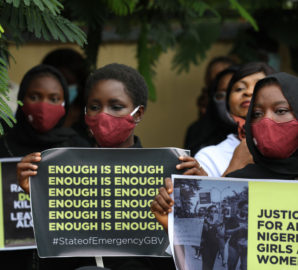
As reports of domestic and sexualized violence surge under lockdown in Nigeria, NGOs and government agencies must adapt their responses to meet the challenge.

Longstanding environmental policies are a factor in the disproportionate impact of COVID-19 on communities of color.

During the pandemic, governments have been curtailing rights—but activists are fighting back.
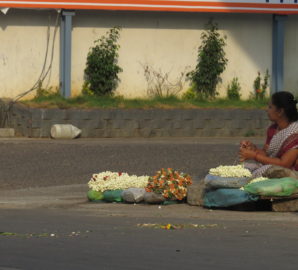
Since India went under a strict countrywide lockdown, the mostly women who make their living selling flowers, fruits, and fish every day on thoroughfares and platforms don’t know how they’ll feed their families.

There is a long history of anti-Asian bigotry—and resistance—in the U.S.

Anti-choice protests were staged at clinics in North Carolina; Louisiana; Washington, D.C.; and Michigan, at which protesters similarly disregarded social distancing guidelines.

Despite their disproportionate vulnerability, the Indian government has largely ignored commercially sexually exploited people in its response to the coronavirus pandemic.
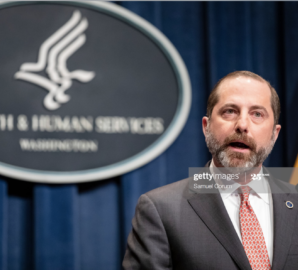
The Health and Human Services department is continuing plans to undo antidiscrimination provisions of the Affordable Care Act.

Of the many astonishing developments to come from COVID-19, the angry assemblies of Americans in many states requesting that the government reopen the country rank high.

Pandemic-related lockdowns disproportionally burden women. By asking the right questions, policymakers can create policies that alleviate that burden.

As men have increased their research while home these past couple months, women have lowered their submissions to academic journals, indicating that women are less able to do their research while in stuck in the house.

The many unnecessary barriers to abortion access in the U.S. have grown exponentially during the pandemic, forcing providers and patients to adapt.

Countries like Spain, France, the UK, Argentina, and Norway have devised schemes that allow women to seek help without alerting their partners.

Nurses, nursing home employees, domestic workers, and caregivers have long been industries dominated by women, who have long been underpaid.

The loss of resources, support systems, and general safety puts survivors at risk of further abuse.

Among those who are most affected by this virus aren’t just people who have COVID-19, but the nation’s domestic workers, the vast majority of whom are women.

The coronavirus pandemic has led to a massive surge in child abuse material being uploaded, according to a story from the Fuller Project for International Reporting co-published with the UK Telegraph.

Despite composing less than 7% of world leaders, women have been spearheading some of the most effective policies in response to the rapid, global spread of the novel coronavirus.

The COVID-19 shutdown is wreaking havoc on child visitations and family reunification.

Six Republican-led states are attempting to ban abortions amid the coronavirus pandemic by claiming that abortions are nonessential medical procedures.

The disparate impact of the coronavirus on Black women is revealing and deepening existing inequalities. Fighting it requires an intersectional approach.

Recently, five teenagers in Afghanistan who make up an all-female robotics team developed a cost-effective ventilator that runs using the motor of a Toyota Corolla.