















India’s women hawkers and platform vendors are left bereft of livelihood during lockdown
Chennai, India — Every evening, Selvi goes door to door and sells flowers to her regulars, women who buy strings of jasmine to adorn their hair, and yellow chrysanthemum as an offering to deities in their homes, a custom in the southern Indian state of Tamil Nadu. This tradition helps many women like Selvi supplement their household income.
She was even selling on the evening of March 24, hours before India’s countrywide lockdown was set to begin.

In her early thirties, Selvi has two small children, both of whom are under the age of ten. Selvi’s husband stopped working nearly eight years ago due to severe health issues, so she supports her family as a domestic worker most days, earning about Rs 10,000 (USD $130) a month, which barely covers all of her household needs. Sometimes, she borrows money from clients to pay for medical expenses or school fees for her children, repaying them in installments.
Selling flowers, she earns at least an additional Rs 4,500 (USD $59) a month. “In the months that we have festivals, I earn a bit more,” she said.
Women typically occupy the informal sector as vendors selling vegetables, flowers, fruits, greens, and fish outside railway stations or near bus stops — usually, anywhere with a high footfall.
But since India went under a strict countrywide lockdown, these women, with their livelihoods severed, don’t know how they’ll feed their families.
Indian Prime Minister Narendra Modi announced a countrywide lockdown beginning midnight on March 24 — which has subsequently been extended four times — to contain the spread of SARS-CoV2, also known as the novel coronavirus. Despite the measure, the number of positive COVID-19 cases, which stood at 519 at the start of lockdown, has increased to 153,106 as of June 15. Notwithstanding the increase in cases, the livelihoods of millions have been drastically affected.
Immediately after lockdown, when migrant workers were stranded, unable to reach their villages — and with limited to no access to food and water — non-governmental organizations were quick to arrange food and shelter for them in schools or community halls. Elsewhere, local administrations in various districts and towns provided food to unsheltered people. Meanwhile, the mostly women who make their living selling flowers, fruits, and fish every day on thoroughfares and platforms remain invisible to assistance.
Ammu is another flower seller in Chennai, from Kodambakkam, a central locality of Chennai city, who earns around Rs 250 (USD $3.30) a day selling in an affluent neighborhood. Her husband works as a driver for a call-cab service, but work doesn’t come regularly. When it does, Ammu said, he’ll spend nearly half of his earnings on alcohol, which is why she started selling flowers. But work is no more reliable for her than it is for her husband.
“Flowers are not a necessity for people, unlike vegetables,” she said. If she’s not working, she may be able to survive off of provisions at home for a little over a week before she’d have to start borrowing. She has a good enough rapport with her customers to borrow money from them to buy the essentials such as rice, dhal, oil, or some masala. Otherwise, like other low-income women, she may have to pawn jewels to pawnbrokers or borrow from local money lenders at high-interest rates. But with the lockdown, even those businesses are closed.
There’s not enough money for a rainy-day fund. In most of these families, the men give a portion of their salary — which is rarely sufficient on its own to run the household — to the wife, and spend the rest on themselves, oftentimes on alcohol. But, even with the additional income the women make, they still barely manage to keep their families afloat.
“We are happy if we don’t have to borrow, but this time I have to,” said Sundari, a widow in her early forties with two school-going children, who sells banana fruits every evening from a pushcart near her residence in Choolaimedu, one of the central localities of Chennai city.
After sending her children off to school in the mornings, she would push her cart six kilometers (nearly four miles), walking barefoot, to a wholesale market where she buys the fruit by the bundle. After loading her cart, she would make the long journey back, reaching home by afternoon. In the evening, she would take her cart to her regular spot at a thoroughfare and sell the bananas, earning about Rs 500 (USD $6.50) a day. She has no other livelihood.
Sundari heard from fellow fruit sellers that bananas were still available at the wholesale market, though in limited quantities. The government permits the movement of produce transport vehicles as essential; if she wanted, she could continue selling bananas during the lockdown.
“If I buy less quantity, I may be able to sell, but I don’t want to take the risk,” she said, fearing the prospect of orphaning her children if she ever contracted the virus. “As a single parent, I want to be there for my children, so I’d rather borrow money to buy groceries.”
Since these women are informal workers, they do not qualify for any benefits other than what the government gives for specific categories of people, such as the elderly. Recently-widowed Pachaiyammal, who is in her mid-sixties, receives a government pension of Rs 1,000 (USD $13) a month provided to senior citizens, but she sells greens to supplement that income. As a vendor, she earns an additional Rs 300 (USD $4) but has not ventured out since the lockdown was announced.
While the state government announced an additional Rs 1,000 in financial aid to platform sellers at the start of lockdown, only those registered with the government, who sell in designated vending zones, have access to it. Most of these women sellers, however, are not registered. For Ammu and Selvi, the nearest vending zone is about four kilometers away — hardly much of an incentive to register when they could make the same daily earnings a stone’s throw away from their homes. Until lockdown, they didn’t see any benefit in registering. Now, it’s too late to register.
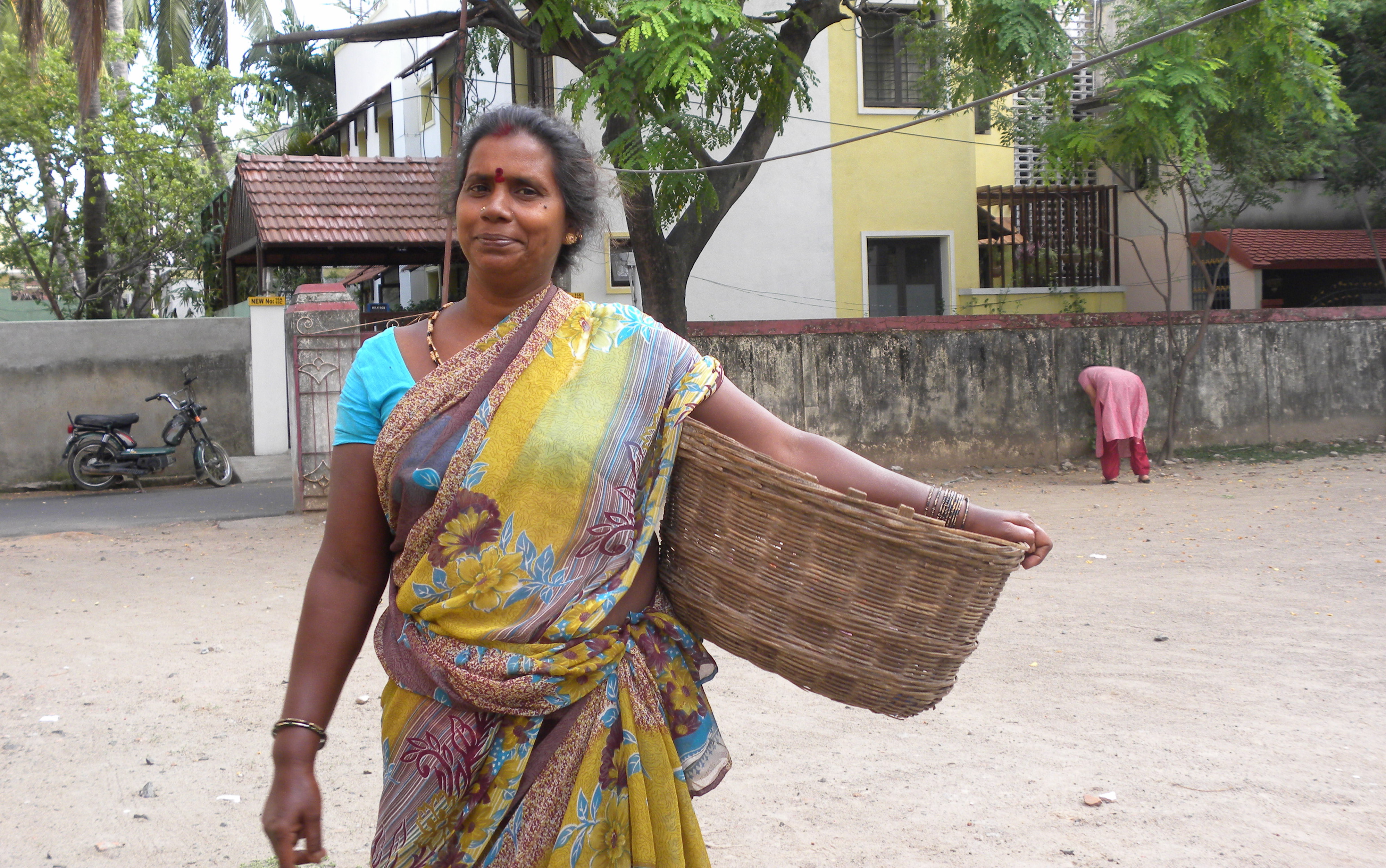
“This lockdown is indefinite,” said Ammu. “We have to manage.”
And they do. India has a Public Distribution System (PDS), where essential items are distributed every month to every family that holds a PDS ration card (which, with the exception of a few high-income families, every family is eligible). The items are charged a fraction of the market price; in April and May of this year, the government issued the regular PDS items of rice, sugar, toor dhal (red gram) and palm oil free of cost. The government also gave an additional Rs 1,000 cash as financial aid to all PDS ration card holders to help weather the lockdown. The provisions and cash will not suffice, but the women are content that they have the basic necessities to sustain themselves.
Some of their regulars customers have kept in touch and continue to support them during lockdown. Two sympathetic customers ordered provisions — such as rice, pulses, oil and masala sachets — in extra and gave the surplus to Sundari for free. One of Ammu’s customers gave her her PDS ration for the month of May. Selvi has started doing the domestic chores for two of her elderly clients.
Over two months into lockdown, the government’s assistance and customers’ benevolence could only go so far. The women have constricted their basic needs to the barest minimum. Selvi said that her family only eats vegetables once a week. Sundari also said that she eats much less now so that provisions last longer. She has had to pawn off her daughter’s silver anklets to pay rent. Still, she’s not planning to return to selling bananas for at least another month; her locality is a hotbed for COVID-19 positive cases. She is trying to take up domestic work near her home to earn some money in the meantime, but finding clients during lockdown will be a challenge.
Resolute as they are, the women see the lockdown as a temporary interruption, though there doesn’t seem to be an end in sight to the present lockdown. The main wholesale market in Chennai that supplies fruits, vegetables and flowers through smaller markets from where the women buy their wares has been shut since May 4, after it emerged as a COVID-19 positive hub. Even if the market opens in a few weeks, with the number of positive cases in Chennai on the rise, the women are in no hurry to resume their livelihoods.
“It’s better to forego our income than fall sick,” said Selvi. “We’ll weather this storm.”
More articles by Category: International
More articles by Tag: India, COVID-19


