















Dalit Women’s Movement Adapts for New Generations
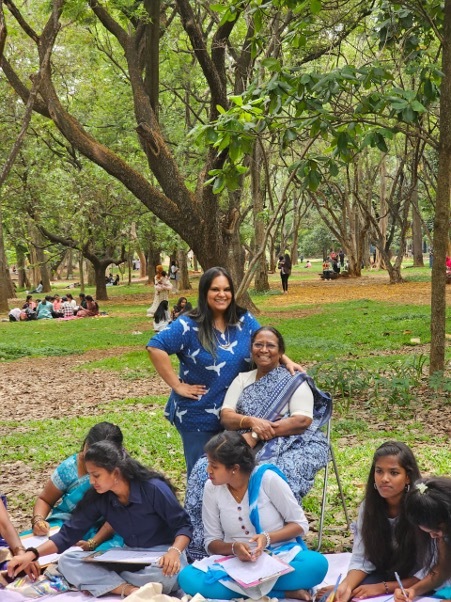
About 10 years ago, Agalya found herself sitting in a domestic workers’ meeting with her mother, listening to conversations about gender discrimination for the first time. Growing up in an informal settlement in the southern Indian city of Bangalore, she had witnessed subtle signs of bias at home, where her younger brother was often prioritized in ways she did not yet have the language to question.
She often accompanied her mother, a domestic workers’ leader in their community, to awareness meetings organized by Women’s Voice, a grassroots organization working with women from historically marginalized communities, including Dalit women.
“Initially, I went to these meetings for the free meals and to play with other children,” she says. “But slowly I started paying attention to what they were talking about — the laws meant to protect women and Dalit communities, the concept of good touch and bad touch, the realities of domestic violence, and so much else.”
Today, at 23, Agalya works as a field coordinator with Women’s Voice, the same organization that shaped her early understanding of inequality at the intersection of caste, class, and gender. Women’s Voice also serves as the secretariat of the National Federation of Dalit Women (NFDW), a nationwide network founded in 1995 to organize, support, and amplify the voices of Dalit women.
Agalya is part of a generation stepping into leadership roles within a movement built decades earlier by prominent Dalit feminist Ruth Manorama, who founded Women’s Voice in 1985 and later established NFDW.
Dalits, formerly referred to as “untouchables,” sit at the bottom of the country’s centuries-old caste hierarchy and have historically faced systemic discrimination, violence, and exclusion. Although caste-based discrimination was outlawed under India’s constitution in 1950, its effects continue to shape access to education, employment, and safety. Dalit women, in particular, face compounded marginalization due to both caste and gender.
For Manorama, now 73, building NFDW was never about just creating an organization, but ensuring its survival across generations.
“Movements have to be lit,” she says. “Maybe I will go on for another five or 10 years. After that, the second and third generations need to own it.”
The priorities of the movement have evolved alongside the women it serves.
In Manorama’s early years, access to land was among the most urgent demands. For the next generation, the focus expanded to basic services such as electricity, sanitation, and housing. Today, access to education, digital safety, mental health support, and confronting online harassment have emerged as pressing concerns for younger Dalit women.
Sexual violence and structural discrimination, however, have remained a constant across generations.
This shifting reality has required the movement to adapt and to bring younger women into leadership who understand, and often experience, these newer forms of systemic harm firsthand. That transition is already underway, and it is more complex than simply handing over leadership roles.
Priyanka Samy grew up watching the movement take shape long before she formally became part of it.
“Dinner table conversations on inequality, on justice, and on movements influenced me as a child,” says Samy, now 37. “This was not a career choice. I became part of this movement because of the passion I had for this work, and because it felt so personal and urgent.”
Samy, one of NFDW’s core members and a former youth convenor, is also Manorama’s daughter. She represents the generation now tasked with carrying forward the work her mother helped build.
“It’s where I learned my feminist politics,” she says. “For me, it’s about how we hold ourselves accountable not just to the organization, but to the larger movement, and to an ordinary Dalit woman on the ground.”
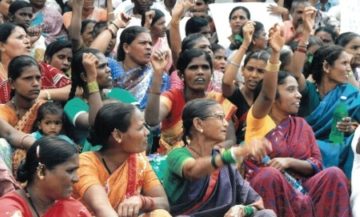
NFDW, the first national-level Dalit feminist network in India, emerged in response to the exclusion Dalit women faced within both mainstream feminist spaces and Dalit political movements, which were often led by men. Over the years, it evolved into a nationwide network focused on leadership building, community organizing, and advocacy — including pushing for caste discrimination to be recognized as a global human rights issue in international forums.
But sustaining the movement required deliberate succession.
“When I started, I realized there were many senior Dalit women leaders, but we needed to build a second line of leadership,” Samy says. “That’s how the youth convenor position was created.”
What NFDW builds, she explains, is not just an organization, but an ecosystem.
“You create an enabling environment where younger feminists take up the issue themselves,” she says. “Many Dalit women who were part of the movement decades ago have gone on to build their own organizations. That, in itself, is the impact.”
These include local and state-level Dalit women’s collectives, lawyers’ forums, and community-based organizations working on issues such as violence, labor rights, and access to justice.
But maintaining that continuity has become increasingly difficult.
“We’re in a massive funding crunch,” Samy says. When NFDW began, its work spanned much of India. Today, financial constraints have forced it to concentrate largely on four southern states and substantially reduce the number of programs it runs.
She attributes this to a combination of factors, including shrinking international funding for human rights work and the intricacies of sustaining a decentralized movement made up of smaller, community-based groups within traditional donor models.
Samy adds that donor expectations often fail to account for lived realities, prioritizing measurable outcomes over long-term structural change.
“Donors sometimes say they will fund you for three years, and expect caste-based discrimination to be eliminated,” she adds. “It’s ridiculous. We’re talking about a system that’s over 2,000 years old and is deeply entrenched in everything we do.”
In the last decade, tighter regulations on foreign funding for nonprofits have further constrained human rights organizations across India, limiting their ability to access international support.
Yet the work continues — sustained by volunteers, collaborations, individual donations, domestic philanthropies, and women who were nurtured within the movement itself.
Agalya is one of them.
As a child, she attended meetings without fully understanding their purpose. Today, she leads those same conversations, informing girls and women about their rights, consent, digital safety, and access to justice. She accompanies domestic workers to police stations when they need to file complaints, advocates for them when employers engage in discriminatory practices, and helps them access legal support when they find themselves marginalized and alone.
“I come from the same community,” she says. “For me, this is not just a job. It’s something personal.”
Recently, during a community meeting, only a handful of women had shown up. Agalya and her colleagues were about to call it off. But children who had attended previous sessions ran through the neighborhood, knocking on doors and urging their mothers to come.
“They didn’t want the meeting to stop,” she says with a smile. “They knew they would learn something important.”
Now she is thinking about how to train and involve the next generation of young Dalit women, ensuring the continuity of the movement that helped shape her own life.
“We have to use the opportunities that the previous generation created for us,” she says, “and make sure we create new opportunities for the generations that come after us.”
Reported by Nikita Mandhani in collaboration with Restless Development as part of the Walking the Talk program
More articles by Category: Feminism, International
More articles by Tag: Women's leadership, India, women's rights, International


