
















Alicia Garza, the principal and co-founder of the Black Futures Lab, is determined to flip the where candidates talk about Black communities, but don't talk to them—beginning with "the largest survey of Black people conducted in the United States since Reconstruction."

Kathryn Kolbert, co-counsel in the landmark Planned Parenthood v. Casey Supreme Court case, gives her perspective on the current push to ban abortion — and what we can do about it.

The results of South Africa’s 2019 general election on May 8 were promising for champions of gender equality in politics, but

I’m hardly the only high school student stressed about navigating what could be crippling student loan debt. This debt has already reached $1.5 trillion and women, who make up the greatest population of student-debt owers, are particularly burdened by debt harsh effects on everyday life.

In 2018, Fabiano Contarato became the first openly gay man to be elected to the Brazilian Senate. The 52-year-old senator, who represents the state of Espírito Santo, was elected in the midst of a shift in Brazil’s political climate toward extremist and fundamentalist views; the president elected in 2018, Jair Bolsonaro, has consistently made racist and homophobic remarks and has been called “Trump of the Tropics.”

After a narrow defeat in the Virginia legislature, the ERA campaign is heating up in several states.

A New York Times article examined how Democratic presidential candidate Sen. Amy Klobuchar has treated her staff members. Nichola Gutgold asks: Will other candidates be given similar scrutiny?

Even before the media gave these women’s political visions a chance, it has largely narrowed in on evaluating whether these women possess a single quality — one that they seem to care about only when it comes to female candidates: their likability.

Abrams’ reluctance to concede was not only about her determination to win, but also about preserving Georgia’s electoral integrity.

On Tuesday, in the run-up to the opening of the Indian legislature’s winter session on December 11, women’s groups came together to express frustration and outrage that the Women’s Reservation Bill, which aims to ensure Indian women’s equal representation in elected office, has not yet been passed.

In October, disabilities activist Mara Gabrilli was elected to the Brazilian Senate at the age of 51. Many saw her victory as a sign that although a lot of extremism and hatred has been expressed in Brazilian politics over the past few years, it’s possible for this nation to elect figures aligned with a progressive agenda.

While social media is helping to encourage young people to vote in record numbers, the actual process of voting is exceptionally digitally inept.

Cooper's new book, Eloquent Rage, explores how women's anger can fuel social and political change.

Like Trump, the current front-runner in the Brazilian presidential election, Jair Bolsonaro, is white, far-right wing candidate who symbolizes a great threat to women and democracy in the country.
Dr. Blasey Ford herself has largely been seen as credible, which in turn appears to be a sign of cultural progress. Yet the public narrative that has been maintained about perpetrators has not progressed in tandem with this evolved view of survivors.
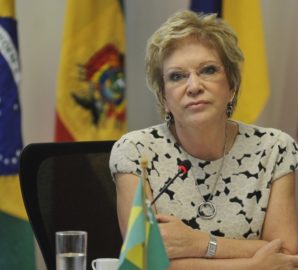
Suplicy, who is now 73, served in Brazilian politics for years. But even before her political career, Suplicy brought discussions of important issues straight to Brazilian homes through a television show called TV Mulher, during which Suplicy gave sex advice to female viewers in a political era of dictatorship.

Inspired by the late Marielle Franco, more women, especially black women, are feeling encouraged to participate in politics.

Often considered the “swing vote” on the Supreme Court, Justice Kennedy spent his 30-year career making arguably the most bipartisan decisions in the courtroom. Democrats and progressives had come to rely on him as a key figure in the fight to protect existing abortion rights at the federal level.

Lupe Valdez is a proud, lesbian Latina. Valdez’s represents other underrepresented Texan identities, too: She is the daughter of migrant workers. She is a veteran, a federal agent, and a former Dallas county sheriff. She is a gay women of color who wants to fight for LGBTQ+ rights and women’s rights.

A new study finds little diversity on political news teams, but researchers are left with more questions.

Women hold fewer than one-quarter of elected positions in the U.S. Eight top women's organizations are uniting to change this picture.

The Women's March marks its one year anniversary with huge turnouts at marches all over the U.S., and launches a campaign to mobilize candidates and voters.

While American women reach new milestones, including holding a record number of seats in the Senate, their representation in national legislative office still lags behind a hundred other countries, including falling two places below Saudi Arabia, which is notorious for its terrible treatment of women.

22-year-old Tyler Bryant, a senior at Alabama State University and president of the Alabama College Democrats, explains the efforts many students made on the ground to mobilize young voters and black voters to help Jones win.

Despite the accusations of sexual assault and molestation made against Alabama Republican candidate for U.S. Senate Roy Moore, as well as the racist and anti-semitic comments he made — like his claim that America was great during slavery — nearly two-thirds of white women voted for him.