















It's time for the rise of women in South African politics
The results of South Africa’s 2019 general election on May 8 were promising for champions of gender equality in politics: The Independent Electoral Commission (IEC) confirmed that 45 percent of the 400 seats in the National Assembly are now occupied by women, a figure that stood at 42 percent in 2018.
But even after this election, another crucial opportunity was still available for women in South African politics. Although Cyril Ramaphosa was inaugurated as South Africa’s newest president on May 25, he still hadn’t named a deputy at the time. While many speculated that Ramaphosa may call a woman to the task, he ultimately chose to appoint a man, David Mabuza, who has long been accused of corruption.
Three highly capable women were speculated to be called to the task, including former Minister for Science and Technology Dr, Naledi Pandor; former Minister in The Presidency and former African Union (AU) chairperson Dr Nkosazana Dlamini-Zuma; and former Minister for International Relations Lindiwe Sisulu. All three women are political heavyweights who participated in the country’s struggle for liberation from the apartheid that plagued the nation from the 1960s through the 1990s. They have all showcased their capacity to lead after rising through the ranks of government and political leadership and advancing progressive political agendas locally and internationally in the positions they have occupied.
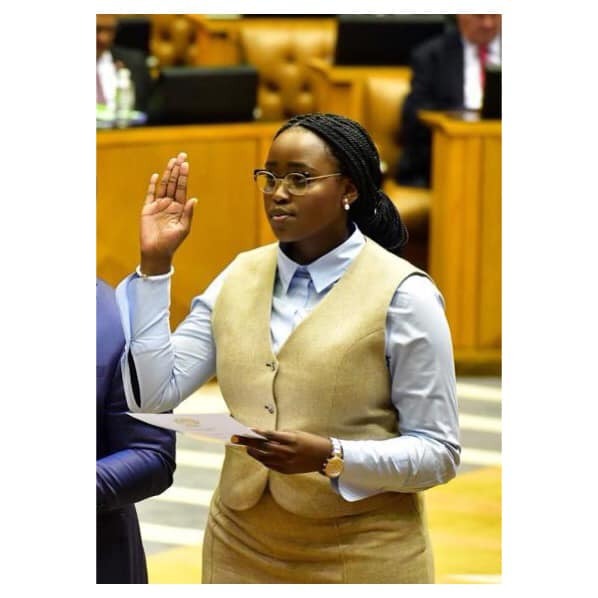
Even though none of these women were chosen for that particular position, the election demonstrated how quickly women are rising to power in South African politics. Fifty-one percent of 26 million registered voters at the recent general elections were women, and two political parties represented at the polls — National Freedom Party and GOOD — were led by women. Three young women were sworn in as members of Parliament (MPs) on May 22, including 25-year-old #FeesMustFall activist Naledi Chirwa, who ran with the militant opposition party Economic Freedom Fighters (EFF); 30-year-old Siviwe Gwarube, who had previously served as executive director for communications of the Democratic Alliance (DA); and another 25-year-old #FeesMustFall activist, Nompendulo Mkatshwa, who ran under the banner of the governing party, the African National Congress (ANC).
Their rises occur in tandem with other African countries electing more women to high levels of political power than ever before. Malawi, Central African Republic (CAR), Liberia, and Ethiopia have all had women presidents in recent years. Joyce Banda previously served as Malawi’s first female president from 2012 to 2014. Catherine Samba-Panza tried to bring stability to conflict-stricken Central African Republic (CAR) as the country’s interim president from 2014 to 2016. Nobel Peace Laureate and Africa’s first female president, Ellen Johnson Sirleaf, also previously served as Libya’s head of state from 2005 to 2017. In 2018, Sahle-Work Zewde became Ethiopia’s second female president.
It is against this backdrop that the question of how women’s political participation can affect women’s lives may finally be answered. This new South African administration faces a broad set of socioeconomic and political challenges, including the consistent negative economic growth in the nation in recent years, marked by an increasing unemployment trend, and embedded violence against women and children. Hopefully an increase of women in decision-making positions will not only lead to more solutions to the government’s past shortcomings in advancing the protection of women’s dignity, but also offer fresh perspectives that can help ensure sustainable solutions to a national crisis.
More articles by Category: Politics
More articles by Tag: Africa, Women of color, Elections, Equality, Women's leadership


