
















While the news cycle in January was dominated by reports on Japanese hostages held by the militant group Islamic State and the Paris attacks on the offices of the satirical newspaper Charlie Hebdo, some stories didn’t receive as much attention.
The author, a former sex crimes prosecutor, points out that true reports of rape are all too common, false reports of rape are rare but they exist, and good investigations can tell them apart.

The conflict in eastern Ukraine, now in its 10th month, has taken a heavy toll on the country’s population. Wide-ranging violations of international humanitarian law have been documented on both sides of the conflict, following clashes between Russian-backed rebels and the Ukrainian government forces in the eastern regions of the country.
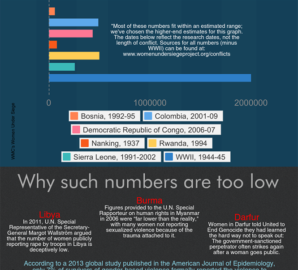
We know there’s a problem but we don’t know how big it is. That’s what governments, scholars, and others argue when trying to figure out how to allot funds toward this problem of sexualized violence in conflict. If we don’t know the numbers, they ask, how can we help properly? How can we mount prosecutions? Offer reparations? Put in place proper advocacy? So the thinking goes.
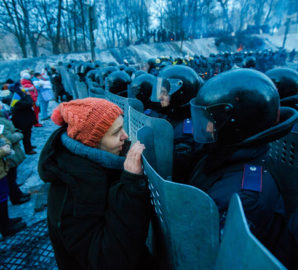
Thirty-year-old Anna Guz was held by pro-Russian rebels for six days in May. (Guz is not her real name; she asked to be identified by a pseudonym for safety reasons.) Men in military uniforms abducted the pro-Ukrainian activist, along with her boyfriend, from her Donetsk apartment in the middle of the night.
Following the end of the #16Days of Activism Against Gender-Based Violence Campaign, WMC’s Women Under Siege has gathered some of the best tweets out there in the hope that this action, this dialogue, this advocacy doesn’t stop here. We can do more. We must.

At the age of 18, Leyla’s three-year lesbian relationship was discovered. She ran away to Baghdad from her home in the conservative Iraqi city of Basra, though her girlfriend wasn’t able to escape. Staying behind turned out to be deadly.

With the 16 Days of Activism Against Gender Violence starting tomorrow, November 25, I thought I’d share some of my favorite recent reads on gender-based violence, whether close to home or far afield.
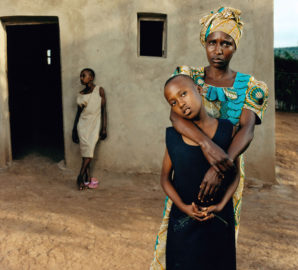
Countless women and girls have been raped to death, held as sexual slaves, gang raped, and subjected to sexual mutilation in conflicts during the last century—in the Rwandan genocide, the Nanking massacre, the war in the former Yugoslavia, Sierra Leone’s civil war, and Burma’s long-running armed conflict, to name a few.

Bimbatta Niamey, a poised and soft-spoken woman from West Africa’s Burkina Faso, was suddenly stripped of all her stability and left to rebuild her life alone in December 2012, when her husband died of liver complications. The family of her husband, who was a chauffeur, immediately withdrew her entire savings while she cared for him.

Her father helped her escape. He knew if she stayed in Ivory Coast, she’d be married against her will as a teenager, her genitals ritualistically cut, raped by her husband, and forced to bear his children. Her life as she knew it would end. She left for New York, where her father thought she would be safe. Now the U.S. immigration system wants to send her back. She is 16 years old.


On May 28, 2014, most Indian newspapers ran front-page stories about two teenage girls, cousins, who had been hanged in the Indian state of Uttar Pradesh after being allegedly gang-raped. Some papers also printed the disturbing image of the girls’ bodies hanging from a mango tree in their village. The public display of the young girls, wearing blood-stained clothes and riddled with thorns, caught India’s attention.

Just like any other population caught up in a war zone, people with disabilities suffer displacement, injury, and trauma. About 6.5 million of the 43.51 million people who have been displaced due to conflict live with a disability. Yet in conflict, when the social fabric is vulnerable and resources are limited, people with disabilities face increased violence while their protection needs often go ignored.