















Left behind: Inheritance practice in West Africa leaves women with nothing
Bimbatta Niamey, a poised and soft-spoken woman from West Africa’s Burkina Faso, was suddenly stripped of all her stability and left to rebuild her life alone in December 2012, when her husband died of liver complications. The family of her husband, who was a chauffeur, immediately withdrew her entire savings while she cared for him.
His family told her she couldn’t stay in what they called her “husband’s house.” “They said I couldn’t keep anything,” said the 35-year-old mother of three as she tearfully recounted what happened.
Just weeks later, Niamey, originally from Jula-speaking Dédougou in western Burkina Faso, received a phone call from a woman in Togo who claimed to be pregnant with Niamey’s husband’s child. She had to tell the woman he had died.
Without a home, money, or transportation, Niamey was panicked, uncertain of how to support herself and her three children. No one offered to help financially or watch her kids, preventing her from finding full-time work. “I asked myself,” she said, “‘What am I going to do?’”
Niamey’s kind of double loss—of her spouse and then her money—is one that occurs with disturbing frequency in Burkina Faso and much of West and North Africa. A 2011 study by Amber Peterman at the International Food Policy Research Institute reported that more than half of the widowed women in these parts of Africa do not receive assets when their husbands die. The report, which calls the inheritance discrimination female widows face a “clearly gendered problem,” says the deceased spouse’s assets go to his natal family in most cases.
Such entrenched discrimination is deeply rooted in both legal and cultural practices. A 2002 study on Nigeria, Ivory Coast, and Ghana by Marie-Antoinette Sossou at the University of Denver reported that women, who are often considered subordinate to men, are rarely able to control (sometimes legally) their deceased spouses’ land. This means they also can’t profit from gardening or sell the land, putting women at a severe, ongoing economic disadvantage.
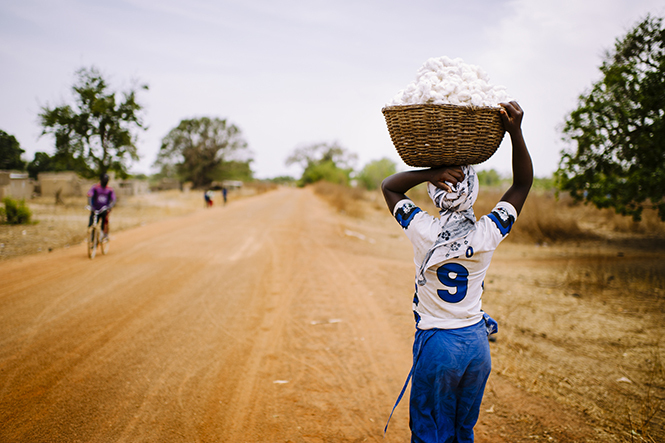
Eighty percent of formerly married Burkinabé women rely on support from relatives, primarily children, to survive. The rest struggle to find work such as making tofu, working as domestic help, or harvesting cotton, as seen here. (Ollivier Girard/Center for International Forestry Research)
Culture trumps law
Even when laws are in place, cultural gender roles and sexism frequently take precedence over legalities in most West African countries, according to Sossou.
In Burkina Faso, there actually exists a law designed to protect female divorcees and widows, said Bilampoa Gnoumou Thiombiano, a professor at Université de Ouagadougou and one of the authors of a 2012 study on “marital breakdown.” But women tend not to utilize the law because either their marriage was not a civil one (and therefore unprotected) or they don’t have the social power or enough information on how the law works, Gnoumou wrote in an e-mail.
Still, in Burkina Faso, “there is virtually no system of formal social protection,” reported Gnoumou’s 2012 study, which was published in an academic journal called Canadian Studies in Population. The study noted that the writing of wills is not common in the country. Instead, the husband’s extended family members have the cultural power to automatically claim his resources after he dies, leaving none for his still-living wife.
Eighty percent of formerly married Burkinabé women rely on support from relatives, primarily children, to survive, according to the report. However, women with young, financially dependent kids—like Niamey—are left to provide for their families alone, with little idea of how to hold on to their money when their husbands die.
“No one knows who to talk to,” Niamey said.
Women’s rights in West Africa slightly vary depending on the norms of a given ethnic group but regardless, many face severe oppression on multiple levels, said Rachel Snow, a professor at University of Michigan who works in women’s empowerment for the United Nations.
“The status of women in Burkina is just terrible,” Snow said. “Women don’t have independent means; men control the money.”
According to Snow, women face the harshest discrimination in French-speaking areas of the region, which is home to numerous tribes and ethnic groups. Although the mistreatment can be devastating for individual women and their children, Snow said specific statistics on women and families and the impact of gender disparities are sparse because not enough research has been done on the poor and socially intricate region.
Nigeria, just 75 miles east of Burkina Faso, has moved considerably further in the direction of gender equality despite the issues with land ownership, said Snow. The country has inheritance laws and a constitution that protect women, according to a 2013 story in The Africa Report, although many women are still culturally required to hand over all assets to their husbands’ families, just like Niamey.
Finding a way forward
Today, in order to make ends meet, Niamey cleans the homes of wealthy Europeans, a practice common in Burkina Faso. Childcare is covered because two of her children are enrolled in school and the youngest either joins her at work or is babysat by her aunt.
To add to the pot, Niamey took on a second job a year ago. The one-woman business is run out of her home: She sells breads, cookies, juices, and tofu, all made in the evenings.
“It’s not a lot of work,” Niamey says of her two jobs and single-parent role.
Yet Niamey, who customers describe as humble and reserved, is not one to ask for help. She has not shared the story of her difficult past—or another factor holding her back—with many.
“I used to text her and she wouldn’t respond,” said Rasheda Sawyer, a supporter and customer who learned of Niamey’s history several months after knowing her. Sawyer, who served as a girls’ empowerment Peace Corp volunteers from 2010 to 2012, created WANPOT (translated to “one pot”), a collective that funds grassroots projects to help disadvantaged Burkinabé women. “Almost one year after I met her,” she said of Niamey, “I asked why she doesn’t respond. She then told me.”
Niamey cannot read. Even so, from the start, she expressed a commitment to both pulling her family out of its desolation and helping other widowed women with similar experiences, said Sawyer. As part of her WANPOT sponsorship, Niamey donates soy and tofu to her neighbors struggling to feed their children and sometimes hires other widowed women to help her cook.
As much as struggle is a featured component of the lives of women like Niamey, there is good news for her and others in her position: Widowhood’s negative impact decreases “markedly” over the course of five years in West Africa, according to the 2012 study on marital breakdown. And education, said Snow, plays a major role in women’s empowerment and recovery. “Once they’re literate, they have confidence and can interact in a manner that’s better [for themselves and their children],” she said.
Right now, Niamey is working to expand her cooking business beyond the 10 clients she currently has. And as of this month, she will begin night classes to learn to read and finish her elementary school degree. The future, while not easy, looks promising.
More articles by Category: International, Violence against women
More articles by Tag: Law, Africa, Sexualized violence


