
















Many educational institutions in Tunisia — especially those in rural areas, where people are generally more conservative and traditional — separate girls and boys from each other within the same class so that female students won’t mix with the male students.

This is the first time a mastermind of mass rape has been held legally responsible in DRC. But the story doesn’t end here. There are still a few major issues to watch.

Today a historic conviction came down in the Democratic Republic of Congo. It was the first time an official or commander has been convicted of masterminding rape in the country.
There is disproportionate rate of HIV infection among young women in sub-Saharan Africa. Here's what you need to know ahead of World AIDS Day.

U.S. Ambassador to the UN Nikki Haley is going to Africa. South Sudan, the Democratic Republic of Congo, and Ethiopia, specifically. She says in an October 22 CNN op-ed that President Trump is sending her “to get a first-hand picture of what can be done.”

In the violence that rocked Kenya following the disputed elections of 2007, the media reported hundreds of cases of sexualized violence. Jane’s was one of them. Today, Jane grapples with HIV, trauma, and empty promises of reparation. Her husband was killed in the violence, but his body has never been found.

Grace sits staring vacantly ahead, her hands tightly clasped in her lap. She is 16 years old but has a tiny frame that makes her look no older than 13. Underneath her checkered school dress, a small bump sticks out. In four months’ time, she is due to give birth to her stepfather’s child.

After her husband died, Margaret, 55, saw no alternative but to sell her body in order to feed her four children. She would walk down to Lake Victoria every day to buy fish to sell in the market. But first she had to have sex with a fisherman. For at least the past two decades, fishermen at Lake Victoria have demanded sex before selling their catch to female fish traders.
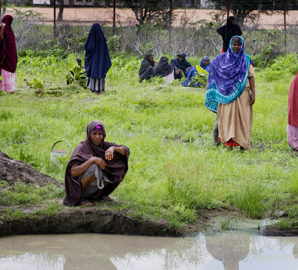
Once known as a refugee-friendly nation, Kenya is becoming more resistant to taking in people who have been forced to flee their homes. That means added challenges for the nonprofit Heshima and the refugee girls it supports, says executive director Alisa Roadcup.

Throughout the conflict in DRC, children have been abducted and made to serve as soldiers. While most are male, it is estimated over a third are female, used mainly as domestic and sexual servants, but sometimes as fighters. Now an NGO has released a report showing that many of the girls weren’t enlisted by force.

Wars fought because of ethnic hatred often seem to be more brutal than others. This is just a personal observation, having studied many. Just look at Rwanda, whose 1994 war saw between 250,000 and half a million women raped, often with objects and often publicly, in order to spread maximum humiliation and terror.

Mary Elias, of Laje village in Malawi’s southern Zomba district, speaks in metaphors. “We are carrying both water cans,” she says of the situation for single mothers in drought-ridden Malawi—meaning that women with children but without partners are solely responsible for feeding, clothing, and educating their progeny. Already a Sisyphean task in a country the United Nations Development Program regularly ranks in the top 20 poorest on earth, this has become nearly impossible in the past few years.
Yagna Ibrahim is a woman who has a presence that is difficult to ignore. She strides into the room with grace and confidence, pulls out a chair, and sits down next to her friend and fellow women’s rights activist, Rabia Musa.

Six years after one of the worst single incidents of mass rape ever recorded in the 21st century, no perpetrator of the Walikale mass rapes in the Democratic Republic of the Congo has ever been brought to trial in either a domestic or international forum. The attacks were condemned at the time by the United Nations Security Council, which urged swift prosecution. The hundreds of victims have never received any acknowledgment or reparation from the Congolese state.

When the Democratic Republic of Congo was dubbed the “rape capital of the world” in 2010 by Margot Wallström, the former UN special representative on sexual violence in conflict, understandably the government of DRC was not happy. Besides that, putting one country above all others when it comes to violence against women is a debatable move: So many places have horrifying records of rape and impunity for such cases. But Wallström had good reason for aiming her words at what is unambiguously a truly terrible place for women.


There’s a darkish room, maybe 12 feet by 13 feet, tucked into the back area of the ground floor of a school called Lycée Wima. Seated along walls of peeling paint are more than a dozen women sewing patterned bags, shoes, dresses, and dolls on elegant Singer sewing machines from the time between the last world wars. The work is exacting.

Colonel Magistrate Freddy Mukendi is an imposing man who speaks from behind darkly shaded eyeglasses. He takes up the full space of a lounge chair, giving off a breezy, if formal, comfort in his own skin. Considering his high-level position in the DRC, this may not be entirely unexpected.

Maseru, Lesotho—“That’s how African men are,” the woman said. She and two others laughed aloud at the infidelity of their husbands. Their laughter resonated in the hotel lobby, attracting disapproving stares from the men in business suits who occupied most of the other coffee tables.

In January 2008, during the violence following Kenya’s disputed elections, someone banged on my door. The man was a friend of my neighbor and, since my neighbor wasn’t home, I thought I might be able to help. But when I opened the door, he forced his way into my house and raped me.

In 2011, a Thomson Reuters poll found that Somalia was ranked among the top five most dangerous countries to be a woman. Fewer than three years later, Human Rights Watch concluded that two decades of civil conflict in the country had created a large population of civilians vulnerable to sexualized violence, in a report titled “Here, Rape is Normal.”

Twenty-five years of breathing in dust has led Mireille Mbale to drink milk when she can afford it; it is what she believes will guard her against lung disease. She makes less than $5 a day. Years of the eastern Democratic Republic of Congo’s brash sun have dried her exposed skin.

Bimbatta Niamey, a poised and soft-spoken woman from West Africa’s Burkina Faso, was suddenly stripped of all her stability and left to rebuild her life alone in December 2012, when her husband died of liver complications. The family of her husband, who was a chauffeur, immediately withdrew her entire savings while she cared for him.
