
















The portrayal of sexualized violence as an instinctive and inherent feature of masculinity leads has a potentially devastating impact on our society.

Louis CK’s self-redemption asks the public: What do we expect of the men accused of sexual misconduct after they face public condemnation? Can we, should we, forgive them?

By chronicling how these allegations against Kelly have been an open secret in the entertainment industry for years, the series' director dream hampton exposes how both Hollywood and the United States legal system have essentially enabled Kelly’s abuse by ignoring it.
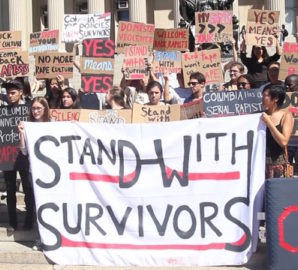
In November, Education Secretary Betsy DeVos released a proposal for new rules regulating how schools respond to issues like sexual harassment and assault. We are still in the midst of a comment period which could help stop these damaging changes.

In late November, officials from the Ministry of Social Welfare, Relief and Resettlement announced that the Law for Protection from Violence against Women, legislation women’s rights activists have advocated for since 2013, will likely be enacted in 2019.

The legislation, which would hold congresspeople personally liable for paying for settlements related to harassment rather than the taxpayer, now awaits President Trump’s signature.

Cheryl Zondi is a 22-year-old University of Johannesburg student studying social work. On October 15, Zondi began what would be a three-day-long trial at Port Elizabeth High Court based on her allegations that her church leader, Pastor Timothy Omotoso, raped her between the years 2010 and 2015.

Focusing on women solely in terms of gender-based violence reduces it to a “women’s issue,” which gives men, either consciously or unconsciously, a reason not to listen to or exempt themselves from conversations related to this issue.

In 2017, Forbes listed Morocco as the second most dangerous country in the world to which women can travel. Earlier this year, the Moroccan government, thanks in no small part to complaints made by women’s rights organizations, finally acknowledged the country’s problem with harassment by passing the Violence Against Women Act in February.

A new documentary, Stolen Daughters: Kidnapped by Boko Haram, follows the lives of the 276 Nigerian schoolgirls who had been kidnapped by Boko Haram in 2014. The film also features interviews with girls who had been previously taken from their homes by the same group.

On Friday, United States Secretary of Education Betsy DeVos released the Department of Education’s new proposed regulations for Title IX which put the burden of proof on sexual assault survivors to defend their claims of assault.

Pakistan is a country governed by moral values and strict cultural codes, and perhaps no Pakistani citizens are as strictly policed in terms of these values than woman.

It was only a matter of time before the echoes of Hollywood’s #MeToo and #TimesUp movements reached Bollywood, India’s film industry. That watershed moment finally arrived this September, when Indian actress Tanushree Dutta made accusations of harassment against industry veteran Nana Patekar

I’m still trying to work my way to a healthy appreciation and understanding of both my body and my sexuality. But my interpretation of them is warped by my experiences with sexual assault and objectification, with the need for desirability and validation that has been beaten into me as a woman.

Priscila Gama, a 34-year-old Brazilian architect and entrepreneur from wanted to do something to help women in the face of pervasive violence. In 2016, she and a team launched the Malalai app, which enables women to let pre-authorized friends follow their routes when moving around the city by any means, whether by foot, car, or public transportation.

In light of the Women's Media Center's brand new report evaluating the impact of #MeToo, Ashley Judd — Chair of the WMC Speech Project and one of the instigators of the #MeToo movement — spoke to Women Under Siege's Lauren Wolfe about her role in the movement, what #MeToo has accomplished, and what it will still accomplish in the future.
Dr. Blasey Ford herself has largely been seen as credible, which in turn appears to be a sign of cultural progress. Yet the public narrative that has been maintained about perpetrators has not progressed in tandem with this evolved view of survivors.

After almost a year of unprecedented media attention on the topic of rape culture, America’s newest college students may be better armed with a clear understanding of the once-taboo topic of sexual assault than any before them.

Psychology and medical students and social workers need to learn how to accommodate people that have been through the trauma of rape or they will continue to not only be unable to help but also worsen the experiences of one out of every eight people.

The Tale is based on the real Jennifer Fox’s life, specifically focusing on the sexual abuse she endured as a child from her riding coach (Elizabeth Debicki) and her running coach (Jason Ritter). The film is an exploration of memories, and how these memories intersect with the truth.

Our society has failed to recognize many manifestations of sexual violence as serious threats, engaging instead in a long history of blaming victims for their inability to extricate themselves from an unwanted sexual encounter.

The recent allegations against New York Attorney General Eric Schneiderman echo offenses by other law enforcement authorities.

On May 10, Spotify announced it will essentially act as an omniscient curator of the music of two problematic (if not criminal) artists: R. Kelly and XXXTentacion. Both of the artists’ music will still be available on the service, but Spotify will no longer actively promote their work.

Prout has been an activist and advocate ever since she was sexually assaulted by a student at the elite prep school St. Paul’s in 2014. She has since launched the hashtag and movement #IHaveTheRightTo. This month, Prout published a memoir: I Have The Right To: A High School Survivor’s Story of Sexual Assault, Justice, and Hope.

On April 26, 2018, the provincial court of Navarra, Spain, ruled that five men had not raped a Spanish woman, but sexually abused her. Under Spanish law, sexual abuse is a crime that does not use intimidation or violence, and therefore warrants a lesser sentence than does rape.