
















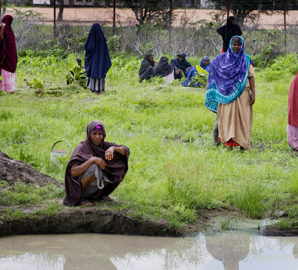
For many refugee children, especially girls, paying for and staying in school is a challenge. This program in a Ugandan refugee camp is working to change that.

When the women of Rwandit village learned how much initiation ceremonies for girls and boys were really costing them—in terms of money and lost education – they radically reformed their traditions, giving women and girls more power in the process.


While it is great that Brown’s case has been spotlighted, it is also important to realize that her story is symptomatic of a larger issue: the criminalization of child sex trafficking victims.

Niñas sin Miedo, or Girls Without Fear, works to promote human rights by educating young girls on sexualized violence and offering conferences and workshops on teen pregnancy prevention, sexual abuse, and harassment. It also empowers the girls by teaching them to ride bikes together.

This is the first time a mastermind of mass rape has been held legally responsible in DRC. But the story doesn’t end here. There are still a few major issues to watch.

A call comes in at 4:58 p.m. The night shift hasn’t yet started, so the day team that has been working since 7 in the morning goes out. We leave at 5:30. There’s no explicit rush. The 11-year-old isn’t bleeding.

It is 9 a.m. on November 9, and hundreds—maybe 1,000—people have gathered to watch something many believed would never happen: the trial of a group of men who allegedly gang-raped approximately 50 little girls, aged 18 months to 11 years, in a village called Kavumu. Justice has been four years in the making.

Over the summer, researchers published a study that offered proof of a phenomenon in American black communities that has existed since slavery: By being perceived as more mature, black girls fall victim to what researchers are calling a “perception trap,” and are treated negatively as a result.

As world leaders descend on New York City this week for the United Nations General Assembly, one group has released a report that exposes a frightening lack of government knowledge of how the rights of women are progressing in various countries.

The week after she handed in her AK47 rifle, Patricia found out she was pregnant. Patricia had been a rebel fighter in the Revolutionary Armed Forces of Colombia, or FARC, for 14 years. Last month, she was one of 7,000 rebels to hand in their weapons in a low-key ceremony that marked the end of the armed struggle.

Guatemala City—It’s not a stretch to say that the reproductive rights of women and girls are not fully recognized in Guatemala. On top of that—or perhaps because of it—Guatemala has one of the highest rates of teen pregnancy in Latin America, where one in three girls becomes a mother before reaching the age of 18, according to a 2014 UNICEF report.

With Trump dominating nearly every bit of news across the country and in many parts of the world, reports of major human rights violations against women are being overshadowed.

With this morning’s news that the Islamic State has claimed responsibility for the suicide bombing at the UK’s Manchester Arena Monday night, the obviousness of the target begins to make a sick kind of sense.

As with other sport, there are several “official” competitions sanctioned by licensed organizations for college rugby. But there are also unofficial matches—our “friendlies,” our festivals. During these events, teams gather for weekends full of rugby matches, drinking, bruises, wearing over-the-top costumes, and even more rugby. Nothing says “fun” to these people quite like slamming into each other full force while a little buzzed and wearing a tutu.

I was in seventh grade, a twelve-year-old pudgy, buck-toothed, frizzy-haired, acne-prone girl totally oblivious to my supposed physical flaws and shortcomings. I lived in my own sheltered bubble. I went to school, did homework when I got back home, and then played in the backyard with our neighbor’s kid. I went to the library with my mother a lot. Perhaps most informatively, though, I lacked exposure to most media. I watched TV only once a week and seldom watched movies (except for the occasional viewing of Dumbo). This fostered a sense of cluelessness about societal expectations of beauty.

Our society very clearly communicates that pretty is everything. Pretty is skipping breakfast. Pretty is counting calories. Pretty is losing weight (and not gaining it back). Pretty is being told by friends that “you look so skinny.”


Thirteen-year-old Jane* lived in Melito Porto Salvo, a village in Calabria, a region that is commonly referred to as Italy’s toe. She was young, confused, and lonely after her parents decided to separate. Like many children in this situation, she struggled to make sense of her new world. All of that changed when she met 19-year-old Davide Schimizzi in the summer of 2013. Their romance filled an emotional void in her life.
Once known as a refugee-friendly nation, Kenya is becoming more resistant to taking in people who have been forced to flee their homes. That means added challenges for the nonprofit Heshima and the refugee girls it supports, says executive director Alisa Roadcup.