















Of the thousands of unreported, ignored stories in India, here’s one
Despite the outrage at violence against women that spread through India this past year, thousands of women and children continue to be victims of rape, trafficking, and other forms of sexualized violence. The stories of these women and children go unreported and are largely ignored by global campaigns against violence.
But one of the worst and most brutal cases has been that of Soni Sori, a schoolteacher in the central Indian state of Chhattisgarh who has been in police custody since 2011. Sori was accused of being linked to the Naxals, an armed leftwing extremist group that has waged a war against the Indian state since the 1960s.
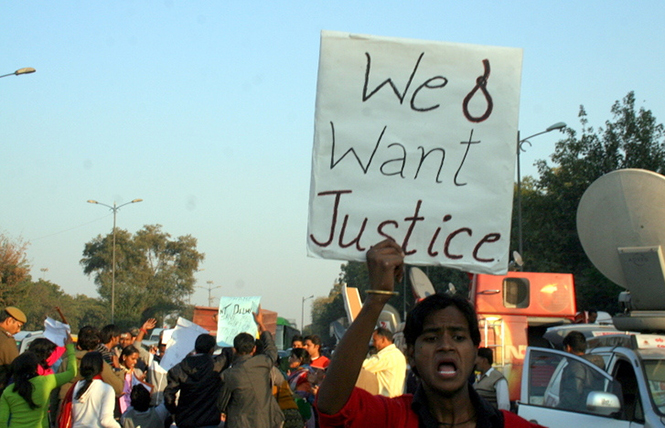
Protesters demonstrate against the December 2012 gang rape in India. (Ramesh Lalwani)
Sori has been subjected to unspeakable torture during her time in custody. She was denied basic medical examinations and treatment until the Supreme Court ordered her transfer to a Delhi hospital. There, hospital records showed, she was “brought in unconscious, the X-ray showed injuries on her head and back, and black marks were observed on her fingertips”—indicating she had received electric shocks. Stone pellets had also been inserted into her vagina and her rectum, the records showed.
Sori has written several letters from prison. Tehelka newsmagazine published one, dated March 7, 2012:
“The government is simply waiting for me to die. I am telling you all the Chhattisgarh government will kill me. I am not safe here. In future, if something happens to me, the Chhattisgarh government will be responsible for it. Please do something. My health is not good. I don’t know if it is because of the electric shocks or something else, but my body has become weak. I want to remain alive to be able to fight this battle. I pray to all of you, please help me stay alive.”
The state has repeatedly failed to establish its multiple cases against Sori. She has been charged with waging war against the state, conspiracy, sedition, and contributing to and raising funds for terrorist activity, all of which she has denied, according to news reports. She was accused of receiving money on behalf of a Naxalite unit from a local steel company called the Essar Group. But the two Essar men arrested for allegedly offering bribes were released within two months.
The National Human Rights Commission of India (NHRC) issued a report saying that Sori had been singled out for harsh and humiliating treatment. Meanwhile, Ankit Garg, the police officer in charge of Dantewada who had allegedly witnessed his subordinates torturing Sori, was awarded a presidential gallantry medal.
Civil society groups have staged several protests against Sori’s detention and treatment in custody, and there was a nationwide campaign for her release. The government has ignored all of this.
Then, on Tuesday, November 11, Soni and her nephew, Lingaram Kodopi, a journalist arrested under similar charges,were granted bail. They were released today from jail.
But will Sori ever really be free? What future awaits her in Dantewada, where the Indian government has virtually no footprint and a parallel underground administration, the Naxals, is in charge?
Chances are that the police will find other ways to re-arrest her.
But if Soni Sori’s story appears as an aberration of justice, then enter the Naxal corridor which streaks through the Indian heartland, from Bihar to Odisha, Jharkhand, Chhattisgarh, Maharashtra, and Andhra Pradesh. There is hardly any media coverage or governmental presence in the unmapped jungles of Dantewada, home to hundreds of Soni Soris.
Women here face violence at home, they are harassed by security forces when they leave the house, and some are even intimidated by local Naxals. But it doesn’t stop there.
Dantewada may be too remote to reach, but there are thousands of young girls tricked, trafficked, and sold in numerous brothels and placement agencies for domestic help in the national capital and other big cities. These girls are forgotten victims and survivors of brutal violence. India, after all, is a major source of human trafficking in South Asia, according to the U.S. State Department.
Here, in India, attacks on women using acid are also too frequent. Stop Acid Attacks, an online campaign in India that fights acid violence, lists such cases: A 21-year-old girl was attacked by a family member after she rejected his marriage proposal. She is fighting to survive and battling for justice. Another victim, a 15-year-old girl, was attacked by a classmate while going to class.
The reasons for the attacks vary. But the results are the same: death or permanent disability.
There are many other areas of violence against women that remain undocumented. In the eastern Indian state of Assam, for example, women are routinely killed in what is known as “witch hunting.” At least 12 cases of “witch hunting” were registered this year in Assam, according to the Assam State Commission for Women, a committee under the State Assembly that works to raise the status of women in the country. The main reason, in most cases, is to take the land and property of the women by accusing them of being “witches.”
Women are subjected to rape, torture, discrimination, intimidation, enslavement, victimization, and even sale. But there is no documentation nor any means to give a voice to these women and help them get justice.
But the media, the government, and the international community can make a difference. The world needs to know that these things are happening in remote places so they can begin to address these blind spots of violence against women and children.
More articles by Category: Disability, International, Violence against women, WMC Loreen Arbus Journalism Program
More articles by Tag: Sexualized violence, Rape, Law


