















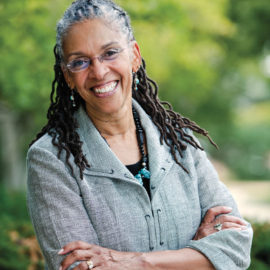
Bonnie Thornton Dill
Bio:
Bonnie Thornton Dill is dean of the College of Arts and Humanities and professor of Women’s
Studies. A pioneering scholar studying the intersections of race, class and gender in the U.S. with
an emphasis on African American women, work and families, Thornton Dill’s scholarship has
been reprinted in numerous collections and edited volumes. Her recent publications include an
edited collection of essays on intersectionality with Ruth Zambrana entitled Emerging
Intersections: Race, Class, and Gender in Theory, Policy, and Practice (Rutgers University
Press, 2009), and numerous articles.
Prior to assuming the position of dean, Thornton Dill chaired the Women’s Studies Department
for eight years. In addition, she has worked with colleagues to found two research centers that
have been national leaders in developing and disseminating the body of scholarship that has
come to be known by the term “intersectionality.” Today she holds the title of Founding
Director for both the Center for Research on Women at the University of Memphis and the
Consortium on Race, Gender and Ethnicity at the University of Maryland. She serves as chair of
the Advisory Board of Scholars for Ms. magazine, is the past president of the National Women’s
Studies Association (2010-2012) and a past vice president of the American Sociological
Association (2007).
Professor Thornton Dill has received recognition as an outstanding scholar, teacher and mentor
through the Jessie Bernard Award and the Distinguished Contributions to Teaching Award,
given by the American Sociological Association; the University System of Maryland Board of
Regents award for mentoring; and as the Stanley Kelley, Jr. Visiting Professor for Distinguished
Teaching in the Department of Sociology at Princeton University in 2009-2010.
Her most recent research drew on her knowledge and experience as a teacher, mentor and
institution builder around issues of race/ethnicity, class and gender in higher education to
examine the experiences of historically underrepresented minority faculty in research
universities.
Thornton Dill earned her doctoral and master’s degrees in sociology and human relations
respectively from New York University, and her bachelor’s degree in English from the
University of Rochester.
WMC Live
February 16, 2013 | Johnnetta Cole, Barbara Smith, Bonnie Thornton Dill, Salamishah Tillet |
Gender-based violence,
Politics,
Race/Ethnicity,
Robin Morgan
WMC Live #26: Johnnetta Cole, Barbara Smith, Bonnie Thornton Dill, Salamishah Tillet. (Original Airdate 2/16/2013)
Robin celebrates Black History Month with Bonnie Thornton Dill on race, gender, and class; Salamishah Tillet on violence against women and girls; Barbara Smith on black feminism and gun violence; and Johnnetta Cole on the glory of African-American women.
Recent Articles


