















Trans Latinas Need More than Emilia Pérez
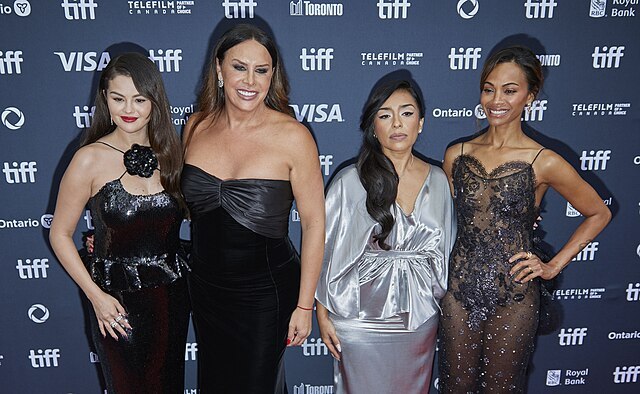
The recently-released film Emilia Pérez stirred a social media conversation and commentary about how identity and culture are policed among Latinos after actor Eugenio Derbez criticized Selena Gomez’s Spanish-language skills in the film. He apologized soon after.
While it’s a valid and needed conversation, this has also distracted from a major issue in Hollywood — the nearly zero visibility of Trans Latinas.
Having won big at the Festival de Cannes, the dark comedy musical’s titular character is a Trans Latina woman, as imagined by French, white, straight auteur Jacques Audiard and played by Spanish, Trans actress Karla Sofía Gascón, who’s beloved in Latin America for her telenovelas work.
For Mariah López, non-Trans or non-Latina actors playing Trans Latina parts isn’t a dealbreaker. López is the executive director of Strategic Trans Alliance Radical Reform (STARR), founded by Stonewall legends Marsha P. Johnson and Sylvia Rivera, who López calls her mother.
“Obviously, the preference is to have Trans people playing Trans people, Black people playing Black people,” she shares after shouting out John Leguizamo for his role in To Wong Foo, Thanks for Everything! Julie Newmar and actor Guillermo Diaz in 1995’s Stonewall. “We actually weren't offended by those presentations, and they became these favorites because there was an authenticity to the characters,” López recounts, noting how the actors showed “respect for the character [and] have been allies in real life.”
Arely Westley Kafati is a Trans activist and community organizer in New Orleans. She works on Trans Latina rights in immigrant detention centers. Westley had more concerns. “It's nice that we have trans representation in Hollywood. It's nice that we have Trans sisters coming and being on this big platform,” she shares. “But this [film] is only talking about a [single] person… We need to be more inclusionary and think about how we introduce the whole entire trans dynasty to the world.”
“That pipeline, what helped create MJ [from Pose]...and other Trans Latinas is one that's under attack right now”
For Westley, that means portraying the Trans Latina immigrant story and focusing on the majority of the community that doesn’t have anything approaching the fictional Emilia Pérez’s resources. She wants stories of resilience and joy, yes, but also the truth of the oppression Trans people face, something the film glosses over.
While Westley and López are glad Emilia Pérez exists, telling its singular story, it’s frustrating that there aren’t more opportunities, particularly for community-member filmmakers and especially considering that Trans people, like other marginalized groups, were so vilified this election cycle.
According to GLADD’s Where We Are on TV 2023-2024 report, representation of transgender people is down, with just 24 characters across broadcast and streaming channels. That’s as low as it’s been since the 2017-18 season. Moreover, just shy of a third of straight people in the U.S. personally know (or know that they know) a Trans person. So for the remaining two-thirds without personal experience, media representation can make all the difference.
If Trans filmmakers aren’t crafting those stories, someone else will. Just think of Trump’s ads, declaring that he’s for “you” while his opponent was for “they/them.” These fear-baiting spots, aired during the World Series in many markets, depicted Trans people as ugly, evil villains, as a threat.
In the International Journal of Communication, Dr. Traci Abbott of Bentley University asks “why such narrow, prejudicial stereotypes still dominate mainstream media. Fictional representations of trans people have been present in American media consistently since the early 1970s, but primarily as guest or secondary transfeminine characters constructed to uphold the hegemonic authority of cisgender masculine heterosexuality.”
Much of the media, Emilia Pérez and its predecessors included, see Trans people as a vehicle to use, rather than as actual human beings with distinct perspectives. These films and shows end up marking Trans people as “the other” by refusing to center their actual experiences, even when they’re supposedly the central characters.
If we’re ever going to get meaningful Trans Latina representation in Hollywood and hopefully the acceptance it will bring with it, the film industry and sectors beyond should nurture Trans Latina talent. López notes that Michaela Jaé (MJ) Rodríguez is one of the only Trans Latina actresses of note, having become famous in FX’s series Pose. But, as López points out, “That pipeline, what helped create MJ, or what would have fostered a further passion for the arts and career and representation in the arts for me and other Trans Latinas is one that's under attack right now.”
So this community that faces extreme rates of violence, who are dying in immigration centers, will have to wait longer and work harder to have more of their stories told. And that’s an injustice no single film, and particularly not one made by a straight white guy, can fix.
More articles by Category: Arts and culture
More articles by Tag: Transgender, Trans Latinas, Latinas, Latines, Emilia Pérez, Selena Gomez, MJ


