















Loreta Janeta Velázquez, the Veteran You Didn’t Know About

Netlix or Amazon Prime couldn’t have scripted it: A Cubana who disguised herself as a soldier, under the alias Harry T. Buford, for the South, was wounded in battle, went on to spy for the North, and then wrote about it. Believe it or not, Velázquez was one of an estimated 1,000 women who fought in the Civil War.
For Veterans Day, IDAR/E talked to writer and director María Agui Carter, a professor of visual media arts at Emerson College, who produced Rebel, a hybrid fiction/non-fiction feature on Velázquez’s fascinating yet largely unknown journey.
Q: How did you first learn about Loreta Janeta Velázquez? Why did you find her story compelling?
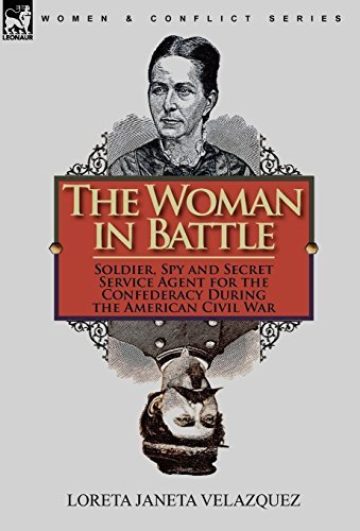
Agui Carter: I came across an original copy of Loreta Velázquez’ 1876 memoir, The Woman in Battle, in Widener library at Harvard. I was interested in Loreta’s struggle —as a teenager who dreamed of being a hero, not the girlfriend of the hero, and as a female in a world dominated by strict gender rules. She was a brilliant a trickster, a complex woman surviving in 19th century wartime America on her imagination and wit.
My film Rebel is not just a story about the veracity of what she did or did not do during the war, it explores the construction of historical narrative, and how the politics of race and gender influence our national memories.
Q: In the mid 1800's, what was happening politically between Cuba and the United States?
Agui Carter: Loreta’s family was part of the Cuban community intimately linked to the United States. Her life was deeply impacted by many of the conflicts between Anglo Americans and Latinx of the times. In the 19th century, North Americans regularly visited and owned businesses in Cuba, and the Cuban upper classes did likewise in America, preferring to send their children to study in the United States. Cuban businessmen flourished in North America, particularly in New Orleans society.
In 1845, Loreta’s family moved from Havana where she was born, to Mexico. When the U.S.-Mexico war broke out, her father fought for Mexico and then lost his estate to Texas. The family moved back to Cuba, where her father inherited a plantation. Loreta was sent to live with her aunt in New Orleans to continue her education. She gradually begins to adopt U.S. culture, and eventually meets and elopes with a Texan federal soldier, who joins the Confederacy when the Civil War breaks out. Loreta must forge an ethnic and national identity in the face of many opposing allegiances within her, from Cuba but with ties to the American South through Texas and New Orleans. She starts out fighting and aligning with the Confederacy, and ends up spying for the North.
Q: Loreta documented her own story. Why was it buried?
Agui Carter: Jubal A. Early, an influential former Confederate General and attorney, was outraged at her memoir. An unreconstructed misogynist, he refused to believe there were any women in the Civil War armies, although he himself threw out two women serving under him in the field when he found out their sex. But Early was most upset that Loreta wrote disparagingly about the Confederacy. His goal post-war was to commemorate the Lost Cause romanticized version of Confederate heroism. Loreta debunked that myth of honorable southerners fighting for states’ rights, so he cast aspersions on her. He called her a hoax and a prostitute and started a campaign against her.
Early was one of the principal architects of the Lost Cause and would shape the direction of the Southern Historical Society. But make no mistake, the Civil War was about slavery, and it was a defining moment in U.S. history where this country bent their arc toward justice. We are not finished. We are in the middle of a new Civil Rights moment with Black Lives Matter. We are continuing to fight for a nation that believes in equality for all, and that means African Americans, and all BIPOC peoples. Today, with Latinx populations in the South exploding over the past decade, the “race question” must now be framed in a context beyond Black and White.
Loreta is a window into a more complex understanding of the South during an era that ripped apart Southern institutions and social codes. Some Americans continue to imagine a Civil War history that is part nostalgia, part myth, and perhaps long for a time more reminiscent of white supremacy, as we have seen in these divided times. That history still haunts the South, with its never fully answered questions about the “race problem,” as it also haunts this nation.
Loreta’s story asks us to rethink how we define our national identity and history in a heterogenous society.
Q: What threats did Loreta and other women who disguised themselves among Civil War soldiers face then?
Agui Carter: Since they were not allowed in the armies, women soldiers like Loreta had to hide their identities and their sex. Menses often stopped because with all the marching and rations they lost a lot of body fat. Like male soldiers, the women faced duress, hunger, difficult material conditions, even death. But the fact they were hiding their gender also meant they had additional tribulations, loneliness, secrecy, and if wounded or injured, many even refused medical treatment out of fear of a doctors discovering their sex.
Q: What are the take-aways from Loreta's life for women, especially Latinas, who are currently in the Armed Forces?
Agui Carter: Loreta was an officer and an intelligence agent a century and a half before women were even allowed in battle. Like Latinx women in today’s army, Loreta was a patriot and a soldier. She was an immigrant who risked everything for a country she grew to love, the United States. It wasn’t until 2013 that the Pentagon removed the ban on women in combat. She was fighting in the 1860's. Today 18 percent of women are officers, and 16 percent of the military is Latinx. Latinx are the fastest growing minority population in the military. But Latinx are not getting promoted at the same rate as others – of the 37 highest ranking officers in the military, none are Latinx.
“At the end of her life, we find her supporting another cause, Cuban independence from Spain, and records of her publicly speaking out against slavery to Congress.”
Q: Today’s uprisings against systemic racism and violence include a reckoning with tributes to the Confederacy and its life or death defense of slavery. How do we reflect on Loreta in that framework?
Agui Carter: Loreta is a Cuban daughter of a plantation family who comes of age in New Orleans and follows her Texan Confederate husband to the front just after losing her babies. She begins with the Confederacy and ends up spying for the Union. In fact, the only official records found about her in the National Archive show she was spying for the Union. What most excited me is her maturation as someone who turns against war as a solution and finds that war is about profit, not ideals, and that the South and Confederacy she grew up in was a mirage. At the end of her life, we find her supporting another cause, Cuban independence from Spain, and records of her publicly speaking out against slavery to Congress.
To be Latinx in 19th century North America meant to wrestle with divided loyalties, for these were often citizens or sons and daughters of countries that were on the brink of, or had just experienced, their own revolutions. Further, Latinx immigrants wrestled with the displacement or destabilized racial/ethnic identities as they made their homes in the United States, wanting at once to assimilate and share in the power structure, and at once to affirm their own cultural genesis. To accomplish her disguises, Loreta often passed as a European white American. Loreta’s ethnic masking and unmasking illuminates the cultural dilemmas Latinx often faced, and the multiple ways in which minorities negotiated racial politics of the time.
Q: How challenging was it to produce Rebel? Is there another phase of this project?
Agui Carter: Rebel took me over a decade to make because I had to cobble together financing over time to shoot it in between other films. It was my first major fiction directing, and it was a period film. The entire material world had to be recreated for this film. There were big war scenes with lots of extras and explosions to direct. I had to prove to funders that I was up to the task, and so it took me a while to film samples that showed I had the directing chops to handle very ambitious material.
I’ve written a treatment for a fiction series inspired by her life. It’s a story full of drama and intrigue and high stakes set in the 19th century as revolutions rock the Americas and as the United States fights internally about what kind of nation it will become. It’s about a complex and fascinating woman who refused to be bound by the expectations of her time, who refused to conform to gender binaries in her identity and relationships and was feminist before the word existed. Loreta used both her wits and great beauty to survive in a world full of challenges for women and Latinas of the time.
Q: Which actress would make a great Loreta in a feature film or series?
Agui Carter: Ana De Armas would be really interesting. She’s a talented actor and can bring the pathos, the joy, and the rebellious spirit, and she’s a Cuban from Havana, like Loreta.
More articles by Category: Race/Ethnicity
More articles by Tag: Veteran, Veterans, Veterans Day, Military, Civil War, Confederate, Union, Cuba, Ana De Armas, Rebel, Maria Agui Carter


