
















Radhia Jerbi is a prominent Tunisian feminist and lawyer who has served as the president of the National Union of the Tunisian Woman (NUTW) since 2013. Jerbi is also a member of the Human Rights League, the Maghrebian Women’s Union for Peace and Development, and the women’s section of the Lawyers’ General Council. Jerbi recently talked to the FBomb about everything the NUTW has been doing to guarantee gender equality and a secure future for Tunisian girls and women.

The most critical voices among those pushing back against this recent onslaught of anti-choice legislation and rhetoric are those of people who have been pregnant or had abortions themselves.

As I watched the mainstream media cover this day this year, I noticed that hardly any mentioned the female leaders of a famous 1990 protest.

The results of South Africa’s 2019 general election on May 8 were promising for champions of gender equality in politics, but

On June 4, the House Committee on the Judiciary held a hearing on “Threats to Reproductive Rights in America.” 18-year-old Youth Testify leader HK Gray testified at the hearing about the barriers she faced when seeking an abortion in Texas as a minor, including needing a judicial bypass to obtain an abortion.

I’m hardly the only high school student stressed about navigating what could be crippling student loan debt. This debt has already reached $1.5 trillion and women, who make up the greatest population of student-debt owers, are particularly burdened by debt harsh effects on everyday life.

If women are going to seek abortion no matter the legal status of abortion in the country they live in, who will illegal abortion hurt the most? The answer can be found in examining how significant a role class plays in a woman’s decision to have an abortion.

In 2018, Fabiano Contarato became the first openly gay man to be elected to the Brazilian Senate. The 52-year-old senator, who represents the state of Espírito Santo, was elected in the midst of a shift in Brazil’s political climate toward extremist and fundamentalist views; the president elected in 2018, Jair Bolsonaro, has consistently made racist and homophobic remarks and has been called “Trump of the Tropics.”

In 2019, Uruguay will have presidential elections, and it’s more important than ever that organizations advocating for reproductive rights stick together and continue to keep fighting to educate their society and advocate for a continued cultural shift toward acceptance of women’s reproductive rights.

Even before the media gave these women’s political visions a chance, it has largely narrowed in on evaluating whether these women possess a single quality — one that they seem to care about only when it comes to female candidates: their likability.

Abrams’ reluctance to concede was not only about her determination to win, but also about preserving Georgia’s electoral integrity.

In October, disabilities activist Mara Gabrilli was elected to the Brazilian Senate at the age of 51. Many saw her victory as a sign that although a lot of extremism and hatred has been expressed in Brazilian politics over the past few years, it’s possible for this nation to elect figures aligned with a progressive agenda.

At the end of September, the nation’s attention turned to Supreme Court nominee Brett Kavanaugh and the now-infamous hearing regarding Dr. Christine Blasey Ford’s allegations of sexual assault against him. While that Supreme Court-related news was obviously worthy of attention, it caused many to overlook the fact that just days later, the Supreme Court began its October sitting on the first Monday of the month.

While social media is helping to encourage young people to vote in record numbers, the actual process of voting is exceptionally digitally inept.

The stories of the silenced matter, even when the outcome of sharing them are not necessarily concrete.

Like Trump, the current front-runner in the Brazilian presidential election, Jair Bolsonaro, is white, far-right wing candidate who symbolizes a great threat to women and democracy in the country.
Dr. Blasey Ford herself has largely been seen as credible, which in turn appears to be a sign of cultural progress. Yet the public narrative that has been maintained about perpetrators has not progressed in tandem with this evolved view of survivors.
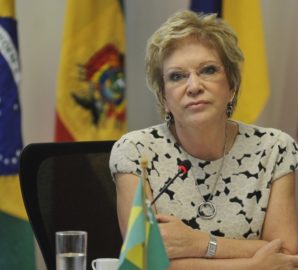
Suplicy, who is now 73, served in Brazilian politics for years. But even before her political career, Suplicy brought discussions of important issues straight to Brazilian homes through a television show called TV Mulher, during which Suplicy gave sex advice to female viewers in a political era of dictatorship.

Inspired by the late Marielle Franco, more women, especially black women, are feeling encouraged to participate in politics.

Marielle Franco’s murder was not an ordinary crime but one with a triple meaning: It was an act of femicide, black genocide, and an act of silencing the downtrodden.

Often considered the “swing vote” on the Supreme Court, Justice Kennedy spent his 30-year career making arguably the most bipartisan decisions in the courtroom. Democrats and progressives had come to rely on him as a key figure in the fight to protect existing abortion rights at the federal level.

Lupe Valdez is a proud, lesbian Latina. Valdez’s represents other underrepresented Texan identities, too: She is the daughter of migrant workers. She is a veteran, a federal agent, and a former Dallas county sheriff. She is a gay women of color who wants to fight for LGBTQ+ rights and women’s rights.

Minors should have the right to have an abortion without parental consent or notification because teens who choose not notify their parents before having an abortion likely do so for very good reasons other than privacy or shame.

In early May, Kim Kardashian West made headlines for her attempts to ask White House officials to advocate for a presidential pardon for 62-year-old Alice Marie Johnson. While this case is certainly worthy of attention, her advocacy generally overlooks the fundamental problems of racism and prosecutorial discretion within the criminal justice system.

Removing the barriers to accessing safe and timely abortion is an economic justice issue.