















What do we mean by rape in war?
For many of us, the phrase “wartime rape” evokes blurry, broad ideas of military assault, battles, and weapons. Just like the common misconceptions that surround rape in places like the U.S. or the UK (such as the idea that rape is a crime committed by a shadowy stranger in a dark alley, when, according to UK charity Rape Crisis, “only 9 percent of rapes are committed by ‘strangers’”) it is easy to make incorrect assumptions about the causes and manifestations of wartime rape.
Not understanding what we’re up against will only slow us down from stopping it.
The UN Security Council Resolution 1820 of 2008 made the crucial step of identifying rape as a specific tactic of war. It was vital to officially acknowledge that the use of sexualized violence by armed forces and military groups may be strategically adopted as a means of infiltrating populations, destroying communities, demoralizing civilians and leaving a devastating lasting legacy. But it is also extremely important to avoid the mistake of assuming that all rape in war is necessarily a strategic decision made by military commanders and carried out systematically, or indeed that rape must play a role in all conflict. This would be to oversimplify the enormous complexity of the problem, which takes many forms and has many different causes, and to jeopardize the process of searching for effective solutions and countermeasures.
There are some situations, for example, where rape is not a strategic choice decided on by military commanders, but a consequence of poorly trained, undisciplined, or underpaid troops who engage in sexualized violence of their own volition. In a recent interview with the New York-based think-tank the Council on Foreign Relations, Professor Elisabeth Jean Wood of Yale University and Assistant Professor Dara Kay Cohen of Harvard University’s Kennedy School of Government explained that rape “often emerges from troops on the ground and is then tolerated by the chain of command—not because commanders have recognized strategic benefits but because the costs of effectively suppressing it appears too high.”
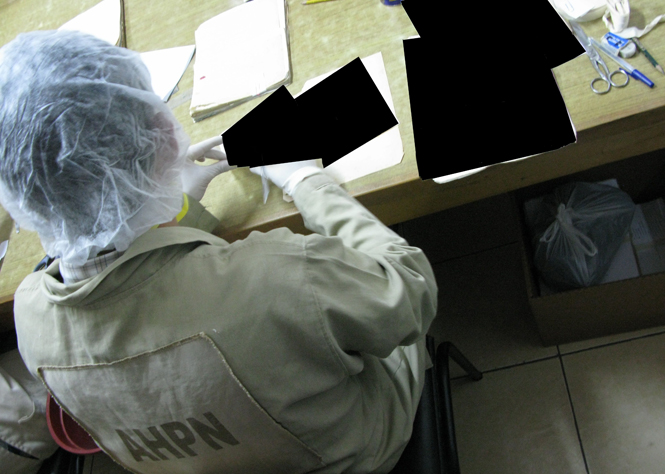
A researcher in the archives of the Guatemalan National Police sorts through (blacked out) documents to determine who was responsible for different aspects of the country’s brutal civil war—including mass rape. (Lauren Wolfe)
In addition, the motivation behind sexualized violence during conflicts ranges enormously, from “bonding” exercises between soldiers to the desire to break down communities to forms of ethnic cleansing. Women Under Siege has identified 10 separate reasons why rape is used as a tool of the Democratic Republic of Congo’s war alone.
(See Women Under Siege’s detailed analyses of how and why rape has been used from the Holocaust to Libya here.)
Another common misconception is that wartime rape involves a single sexual assault by one male soldier against a female victim. Sadly, the situation is far more complex, with conflict-related sexualized violence encompassing crimes such as gang rape, sexual slavery, rape in front of family members, repeated assaults, and forced sexual activity between victims—all of which are documented in Women Under Siege’s “patterns of violence” sections of its conflict profiles. In addition, wartime rape may involve variations ranging from the use of inanimate objects to the loss of a fetus when a pregnant woman is deliberately raped.
Yet another easy mistake to make is to assume that wartime sexualized violence always ends with the conclusion of the war. The psychological and physical impact of rape on both survivors and communities and the forced pregnancy of women allow the horrors of sexual assault to live on. Medical complications arising from rape may affect survivors for years after the conflict, with a 2009 Harvard Humanitarian Institute report on sexualized violence in DRC revealing that many rape survivors suffered fistulas, HIV, and sexually transmitted infections as a result of their assaults. (Right now, Women Under Siege is tracking all of these consequences of sexualized violence in Syria on its live map.)
In many if not most societies, social stigma against rape survivors is such that the lives and social structures of rape survivors and their communities are irrevocably altered after conflict has ended. Women from Guatemala to Kenya have chosen a debilitating silence over unburdening in order to keep their families and reputations intact.
It has even been recorded that local rates of civilian rape can increase enormously in the aftermath of conflict-related sexualized violence. According to a 2010 Oxfam report on eastern DRC, “from 2004 to 2008, the number of civilian rapes increased by an astounding 1733 percent or 17-fold, while the number of rapes by armed combatants decreased by 77 percent.” As the report points out, these findings seem to demonstrate the risk that conflict-related rape can lead to “a normalization of rape among the civilian population,” and perhaps even to “the erosion of all constructive social mechanisms that ought to protect civilians from sexual violence.”
The dangers of misconception and mistaken assumptions are broad. To assume that rape is inevitable in any war, as Wood’s research refutes, is to risk alleviating guilt and blame from perpetrators and to jeopardize prosecution. To assume that rape is always committed by soldiers rather than civilians, or always by men against women, is to ignore a large group of victims who desperately need aid and support.
Luckily, ideas and attitudes are evolving. Awareness not only of the existence of wartime rape but also of its complex nature is becoming more widespread on the international stage. The Nobel Women’s Initiative’s new International Campaign to stop Rape and Gender Violence in Conflict—for which Women Under Siege serves on the advisory committee—recognizes the need for targeted action in its three-pronged approach, which aims to prevent rape in conflict from arising in the first place, to protect victims, and to prosecute perpetrators.
In order to achieve this successfully, it will be vital to continue to analyze and raise awareness of the varied and specific manifestations of wartime rape and to devise specific solutions accordingly. In that recent interview for the Council on Foreign Relations, Maria Eriksson Baaz, associate professor at the School of Global Studies at the University of Gothenburg, and the Nordic Africa Institute, and Maria Stern, professor at the School of Global Studies, University of Gothenburg, warned against “generalized remedies” and advocated “better listening to the stories of those affected by war,” in order to devise relevant, targeted solutions best designed to make real difference to those on the ground.
It’s not the time to shy away from complexity—not when every hour we spend looking away, unsure, overwhelmed, more lives are being ruined by sexualized violence in conflict.
For more on the solutions to wartime rape, click here.
More articles by Category: International, Violence against women
More articles by Tag: Rape, War, Sexualized violence, Activism and advocacy


