















Uber, buses, and streets: How safe are women in public spaces?
In a visit to India in January, U.S. President Barack Obama said women everywhere should be able to “walk the street or ride the bus and be safe.” They should be “treated with respect,” he said.
Yet less than two months before President Obama visited the country, a 26-year-old woman from Delhi said she was raped by a taxi driver for Uber, a Web-based taxi firm that allows passengers to book rides using a phone app.
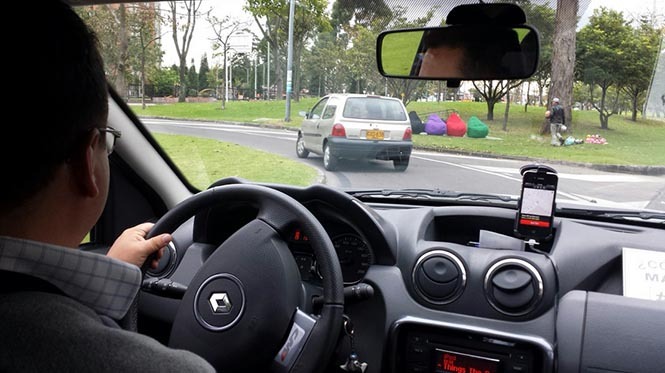
A passenger rides in an Uber taxi in Bogota. (Wikimedia)
On the night of December 5, 2014, the woman, who has not been identified in legal documents or press reports, used the Uber app to book a taxi to take her home after she had dinner with her friends, she said in a complaint filed against Uber in the U.S. District Court in California. The driver, Shiv Kumar Yadav, picked her up at 11 p.m. During the 45-minute drive to her home, the woman fell asleep. She said she awoke to find herself being assaulted by the driver.
The woman has accused Uber, which is based in California, of failing to ensure passenger safety. The complaint says:
“She [the plaintiff] is violently and viciously sexually assaulted by Yadav [the accused] in the back of his Uber taxi. She could tell that the car was parked in a remote, secluded area, but could not see or identify anything outside of the windows. She desperately tried to open the doors to escape, but they were locked. To stop her from moving, Yadav slapped her on the face several times, and banged his head against hers. He also warned her that if she yelled or tried to escape, he would insert a metal rod inside her. She finally relented, begging Yadav not to kill her. The assault lasted 30-45 minutes.”
She said that as Yadav raped her, he threatened her with violence similar to what happened in the fatal 2012 Delhi gang rape, in which the victim was brutalized with an iron rod. That attack sparked widespread protests across India that called for stringent laws on crimes against women. A three-member committee was set up and, within three months, authorities amended the country’s criminal law on sexualized violence.
Still, more than two years later, the safety of girls and women in Uber cars—and in public spaces overall—remains a serious concern, and not just in Delhi or India as a whole. Since 2012, there have been at least eight cases in the U.S.—in major cities including Washington, D.C., Chicago, Boston, and Los Angeles—in which drivers of Uber taxis have been accused of sexually assaulting passengers. Twenty percent of women surveyed by the U.S.-based nonprofit organization Stop Street Harassment have reported being sexually assaulted in public spaces, according to a 2014 survey. And when you start looking at sexual harassment, the numbers are staggering: In London, 43 percent of young women in a 2012 survey said they had experienced it during the past year alone.
These incidences of even minor violence have profound consequences for women. For instance, in Kigali, Rwanda, women’s fear of sexual harassment and other forms of sexualized violence have “limited their participation in activities outside the home during the day and at night,” UN Women says, stopping them from going to school among other things.
So what’s it going to take to stop all this violence in public? Can a truly gender-safe public arena even exist?
Holding the company responsible, not just the attacker
The survivor of the Uber rape case told WMC’s Women Under Siege that she could not comment because of the ongoing lawsuit. She is fighting two court cases simultaneously—one, the lawsuit against Uber filed in California; the other, a complaint filed against Yadav. He has been charged with “committing rape causing grievous bodily harm,” “abducting a woman,” “criminal intimidation,” and “voluntarily causing hurt” under sections of the Indian penal code. Yadav has denied all of the allegations. His trial is ongoing.
In a public statement to the press in late January, Douglas H. Wigdor, the lawyer for the 26-year-old rape survivor, said: “We intend to hold Uber responsible for the significant physical and emotional harm it has caused to our client, while simultaneously seeking a court order mandating that Uber initiate certain safety precautions that they appear unwilling to do voluntarily.”
According to the lawsuit, Uber had overlooked several safety standards when hiring Shiv Kumar Yadav, the driver accused in the attack. Yadav was hired while being out on bail after being arrested for a separate case of rape. He also didn’t have a commercial badge, a mandatory requirement for all commercial drivers.
A complaint against him had also been made to Uber by another woman, Nidhi Shah, just 10 days before the attack on the 26-year-old woman. Shah wrote to Uber, saying Yadav had stared at her inappropriately. After the December 5 rape, she wrote on Twitter: “I had reported Shiv Kumar Yadav to @Uber on Nov 26th. They said via email they would check on him. Not soon enough. #DelhiShamedAgain.”
Uber did not immediately respond to requests for comment.
Soon after the December attack, the Delhi government banned all Web-based cab services and imposed strict regulations on requirements for a radio-taxi license, according to reports. Under the new regulations, all Web-based taxi drivers must install GPS-based tracking devices, acquire transport department badges, and have panic alarm buttons in the cars.
But will this be enough?
In an interview with the local English-language daily The Indian Express, which was conducted before the lawsuit was filed, the survivor of the Uber rape case told the reporter, “The incident has left a deep impact on my psyche. I feel scared to go out alone.”
For many women, the fear or trauma of violence makes them fearful of traveling to work or being outdoors alone, as was found in that survey in Kigali. In Delhi in 2010, another woman was dragged into a pick-up truck and gang raped by five men. The woman, who has not been identified because Indian law forbids naming a victim of rape, told me she was scared to go out after the attack.
“I didn’t even go to work for a while, and the company that I worked for informed me that they found it difficult to continue paying me,” she said. “So I left Delhi and came back to my hometown.”
She fled Delhi, her job, and her career. The court case dragged on for almost five years. Only four months ago, the five men were convicted and sentenced to life in prison, according to news reports.
Applying a gender lens to urban planning
In India’s public spaces, according to a 2011 report by the National Crime Records Bureau, a state-run body that publishes data on crime, a woman is harassed or assaulted every 51 minutes. Last year, Delhi recorded a 30 percent increase in sexual assaults, news reports said citing police.
The city’s police chief, BS Bassi, attributed the rise to an increase in people reporting the attacks—as opposed to an increase in the crime. But, while this may be true, it still means that gender-based crime is extremely high in the city.
Recognizing public anger over women’s safety—and following another heated debate triggered by the Uber case—political parties such as the anti-corruption Aam Aadmi Party and the national ruling Bhartiya Janata Party made the issue a key focus during their recent state assembly election campaigns. Promises of adequate street lighting, more closed-circuit televisions, and security forces made up of women became the rhetoric, news reports said.
“We began talking about the issues of gender in urban planning in 2005 and today, 10 years later, the government is accepting its importance,” Kalpana Vishwanath, an activist with Jagori, an Indian nonprofit that works on women’s safety issues, said. “In the early days, it was an uphill task to even convince the government that there was any gender dimension to urban planning, design, and governance.”
But India isn’t the only country that has historically overlooked the critical need of mainstreaming gender in public transport and public spaces. According to a 2010 UN global initiative, “Safe Cities,” numerous developing countries had a high prevalence of sexualized violence—it cited a 2011 study that found that 68 percent of women had undergone sexualized violence in the Ecuadoran capital of Quito. The initiative also cited another 2011 study that found that 55 percent of women in Port Moresby, capital city of Papua New Guinea, had been sexually assaulted in market spaces.
So, where are we headed? What can make our cities safer for women? Will the promises and laws proffered by various political parties and politicians amount to anything?
The key may lie in using participatory approaches like focus groups of women to consult on urban planning and involving women in key urban designs and transport planning decisions. Women may place emphasis on issues men might miss, like the problems surrounding gender-blind transport that “assumes male labor patterns,” such as during peak formal office hours, vs. the different hours women may keep in domestic or informal-economy work. Then there are the physical safety issues of actually traveling on public transportation like overcrowding on buses and trains, which can lead to sexual harassment or assault, and badly lit stations. New laws and protection strategies, such as gender-segregated travel or more CCTVs, could be short-term answers, but the real solution may exist in viewing the city and its spaces through a gender lens, through which women’s realities can be seen more clearly. Women better understand the problems that women face, and they may be able to come up with better, safer, and more liberating solutions.
After all, the city belongs to women as much as it belongs to men.
More articles by Category: International, Violence against women
More articles by Tag: Rape, Sexualized violence, Asia, Activism and advocacy


