















The smartest way to end rape in war
As a human rights lawyer for more than 40 years, pushing every avenue to advance women’s rights, this month’s Global Summit to End Sexual Violence in Conflict hosted by UK Foreign Minister William Hague and Angelina Jolie was a confirming moment of hope. I never thought that I would see, in my lifetime, more than 70 foreign ministers and more than 120 countries attend a summit and commit to action on sexualized violence and, as an important corollary, women’s equality.
I read with great interest Amelia Hoover Green’s recent blog post critiquing the summit’s focus on the use of sexualized violence as a “tactic” of war. She makes the legitimate point that sexualized violence in armed conflict is not a simple issue—that it is not always a tactic of war and that solutions must be informed by social science research.
I want to respond to Green by offering another perspective: viewing the summit’s focus on rape used as a tactic of war and the opportunities it created as a springboard, both for ending sexualized violence in conflict and furthering women’s equality in times of war and peace.
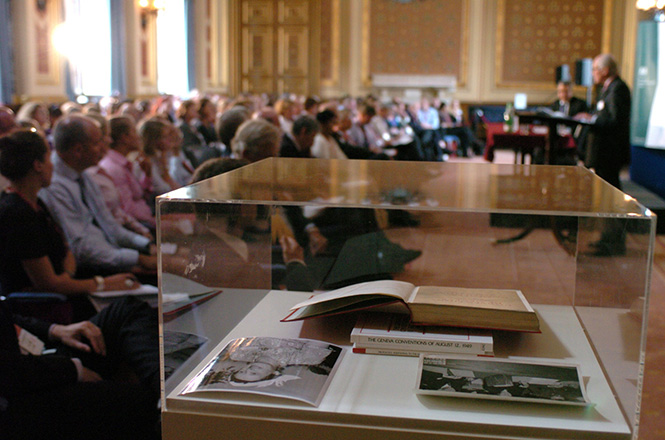
The UK summit presented the opportunity to leverage a new framework, including the recognition that rape "is a grave breach of the Geneva Conventions (seen here) and, when used as a method of warfare, it will always be unlawful." (UK Foreign and Commonwealth Office)
The intransigent use of rape in war reflects the embedded inequality of women around the world and the very “ordinariness” of sexualized violence against women. However, studies of power imbalances, military structures, and the perpetrators of war rape and their motives, while valuable in understanding the problem, do not in and of themselves provide evidence of what works to end such crimes.
So why the focus on sexualized violence in armed conflict when it constitutes only a small portion of sexualized violence around the world? Because it works.
The term “regime theory” is given to the study of what has worked to bring about historic global changes, such as ending slavery or the use of chemical weapons. Political scientists have found that campaigns grounded in existing consensus, such as those that have utilized international humanitarian law (IHL), are particularly effective. In this context, the summit’s emphasis on the use of rape as a tactic of war makes perfect sense.
Let me explain.
Under international humanitarian law, sexualized violence is a grave breach and where it is used to achieve military objectives, it is a prohibited tactic or method of warfare. And where it’s used in this way, it needs to be treated as such.
The idea is that sexualized violence in war must be stigmatized at the highest levels in order to successfully deter its use. A focus on use of unlawful weapons or tactics puts the onus on states in ways that are not accomplished by prosecuting more soldiers or “errant” commanders for the use of rape in war. For example, no one is calling for the prosecution of whoever launched the chemical weapons in Syria, nor was the use of mustard gas ended after World War I by prosecuting the soldiers who used it. They instead have gone and go after those higher up.
However, what has shown to be effective in stopping such heinous practices, such as the use of rape as a method of warfare, is putting the focus on states and stigmatizing their actions or inactions before other states. Stigmatization has been shown, time and again, to deter the use of the targeted weapon or tactic.
This is because states seek legitimacy and do not want to be singled out and ostracized, much less sanctioned. Linking ending sexualized violence in war to states’ adherence to the Geneva Conventions and other international mandates on weapons and tactics leverages the strength of this international legal framework, which states are invested in. This can be seen, for example, in the quick and effective response to the use of chemical weapons in Syria.
There are additional reasons for rape and sexualized violence, when used as a tactic of warfare, to be treated under the framework of IHL that regulates means and methods of warfare. For one, ensuring that strategic rape is governed by the IHL weapons framework will buttress existing efforts to stop its use and open up new avenues for justice, accountability, and redress for victims of war rape. Additionally, crucial to saving the lives of war victims is the fact that weapons and tactics being used in armed conflict are constantly assessed for the lethality and severity of the injuries they cause, both for determining whether their legality should be reviewed and for updating and improving relevant medical protocols.
Examining the injuries of strategic rape and including them in the medical protocols for war zones, as is done with other weapons, would lead to enhanced knowledge and preparation among medical providers in military and other field hospitals to treat the complex injuries of female survivors of strategic rape.
Furthermore, a focus on sexualized violence in war, which galvanizes existing political actors to act on this issue, however limited, and using the absolute non-discrimination principles of international humanitarian law, has great potential for radically advancing women’s rights to equality of treatment in war and peace. For example, the impacts of the war crimes prosecutions for rape and sexual violence in war at the International Criminal Tribunals on Rwanda and Yugoslavia have not only progressed women’s rights in the arena of war. These trials have resulted in new, broader definitions of rape and sexualized violence (which were subsequently the basis for the definitions adopted by the International Criminal Court) and have set precedents for the use of protective measures for rape victims testifying in court. These new definitions and protections for victim witnesses are now being used in domestic courts and proceedings. For example, the United States (which isn’t even a party to the ICC) in 2012 updated its outdated definition of rape to language that closely tracks the definition used by the ICC for federal domestic rape cases. Or, for another example, protective measures modeled on those used at the international tribunals were used in a rape prosecution in domestic courts in the Democratic Republic of Congo just earlier this year.
However, despite the rhetoric employed by states calling rape and other forms of sexualized violence a “weapon of war” and the Security Council’s recognition that rape is used as a “tactic of war to humiliate, instill fear in, disperse and/or forcibly relocate civilian members of an ethnic group,” to date, no states have taken steps to treat its use like they treat the use of other unlawful weapons or tactics of war. This is not surprising considering the patriarchal roots of the laws of war and given that rape and sexualized violence are primarily utilized against girls and women. Add to this the fact that historically rape and sexualized violence have been marginalized and, until recently, have not been recognized or treated with the same gravity as other war crimes.
However, the summit did result in progress on this issue. One positive step forward on this front was the recognition in the summit’s “Chair’s Summary” that rape “is a grave breach of the Geneva Conventions and, when used as a method of warfare, it will always be unlawful.” The summary went on to note that “ministers agreed that sexual violence in conflict, when used as a method of war, or as a form of terror or intimidation, is a security issue that demands a security response.”
This is why the summit and its focus on rape used as a tactic of war were so important; it presented the opportunity to leverage a new framework, one that hasn’t been tried before, to deter and, hopefully, end, the use of rape in war. And making progress toward its eradication in one area will only help strengthen and buttress its eradication in all wakes of life. This is why Foreign Secretary Hague’s historic efforts to end the endemic use of sexualized violence against women in armed conflict has my vote.
We can—and must—use and leverage the opportunities offered by this initiative to push for historic advances for women’s rights to equal protections of law in war and peace.
More articles by Category: International, Violence against women
More articles by Tag: Rape, War, Sexualized violence


