















The Only Meaningful Resolution to the Rohingya Crisis Is One That Centers Rohingya Women
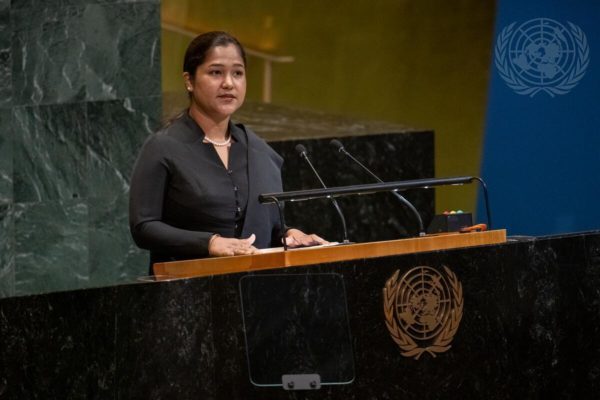
In September, a high-level UN conference on the status of Rohingya and other minorities in Myanmar shined a welcome spotlight on a deepening humanitarian and political crisis. Nearly five years after the Myanmar military’s coup, more than a million Rohingya — an ethnic minority group in Myanmar (the majority of whom are Muslim), which is among the most persecuted in the world — are refugees in neighboring Bangladesh. A severe shortage of humanitarian aid is unable to meet their ever-growing needs, nor those of the 3.6 million internally displaced persons of all ethnicities within Myanmar since the coup.
The Rohingya have fled violence in Rakhine State, largely following the military’s “clearance operations” there in 2017, and continued conflict following the latest coup has since pushed more across the border into Cox’s Bazar in Bangladesh.
While the conference was short on concrete commitments regarding actions to resolve the crisis, civil society representatives and member states generally agreed on the need for concrete steps and that conditions were not yet conducive for a voluntary, safe, and dignified return of refugees to Myanmar.
So, how can the international community actually devise a “comprehensive, innovative, concrete and time-bound plan for a sustainable resolution of the crisis” as envisioned when the United Nations resolved to hold the conference?
As a start, it should take direction from the Rohingya women who spoke at the conference, and ensure that women, and the gendered impacts of conflict, are at the center of any decision-making about the Rohingya’s future and accountability efforts.
Women and girls make up almost 75 percent of the 1.1 million Rohingya refugees in Cox’s Bazar. Conditions in the camps are dire, with overcrowding, a lack of livelihood opportunities, entrenched patriarchal social structures, limited educational resources, and insufficient services — including for sexual and reproductive healthcare.
And, thanks to reduced funding from the United States — which has drastically cut its humanitarian aid since the Trump administration took power in January — as well as reductions from other funders, the situation is deteriorating rapidly, with the Joint Response Plan launched by the UN and Bangladesh only 37-percent funded for 2025.
Gendered violence and insecurity, including abductions, extortion, and killings, are rising in Myanmar due to the continuing conflict and a post-coup economic crisis (caused by the junta’s economic mismanagement, reduced investment, and international sanctions). In Myanmar’s northern Rakhine State where the Rohingya are located, as well as in other ethnic areas, continued conflict and humanitarian aid blockages have left women and girls facing insecurity, starvation, and a lack of essential services, particularly maternal healthcare. Hundreds of thousands in internally displaced person camps, the majority of whom are women, suffer from overcrowding and a lack of basic food and services.
Forced recruitment by the Myanmar military and armed groups also poses constant dangers, with women resorting to early marriage to avoid having to serve in a military that has a long history of committing sexual violence against ethnic women. Women also face increased economic hardship as men are called to serve. Due to desperation, women, both in Myanmar and in refugee camps, are deceived by traffickers into treacherous journeys and dangerous occupations, including forced labor and the sex trade.
Despite these dire conditions, the crisis response has been characterized by inertia within the UN Security Council, which has not passed a resolution on Myanmar since December 2022. There is also the failure by the junta to implement ASEAN’s April 2021 Five Point Consensus to resolve the crisis, as well as the general marginalization of women in conflict resolution efforts.
As Rohingya women’s rights activist and former political prisoner Wai Wai Nu told the conference, “You already have the evidence. You already have the power. What is missing is the political will.”
An immediate step for the international community is to improve the harrowing living conditions in the camps in a manner that takes account of the unique challenges facing Rohingya women. Livelihood opportunities for women, educational opportunities for girls, and safe and accessible sexual, reproductive, and maternal healthcare should be priorities.
The United States pledged $60 million in aid at the conference, tying the aid to “meaningful policy changes by Bangladesh to allow livelihood opportunities.” It’s critical that these opportunities are gender-equal so that women can develop skills and economic independence to prepare for repatriation. Thailand provides a model with its recent announcement that Myanmar refugees will be allowed to work, but as the details of the plan are developed, it must ensure that women benefit equally from these employment and skill-building opportunities.
Increased security infrastructure for women and girls within the camps must also be part of any action plan in order to address gender-based violence. Greater security on the ground — such as better lighting, posted security personnel, and safe access to sanitation facilities — along with livelihood, vocational, and educational opportunities, will help prevent women and girls from turning to harmful coping mechanisms, including trafficking and child marriage.
It is also crucial to diversify male-dominated leadership within the camps. Women were largely absent from camp elections held this past summer, and gender norms tend to circumscribe women’s roles in the public sphere. Rohingya women, as proven by conference speakers Lucky Karim and Wai Wai Nu, can be powerful voices for their community. Women have also proven skillful at conflict resolution and peacebuilding, which will be crucial to foster greater inter-ethnic understanding to neutralize deep-seated prejudice and ethnic tensions within Myanmar, thereby creating safe repatriation conditions for Rohingya.
Increased security would also mean improving access to gender-sensitive justice in the camps, as male-dominated justice systems often fail to address women’s needs and perpetuate unequal social structures. Justice systems could be made more gender-sensitive by incorporating women-led justice initiatives, which put women in leadership roles to advocate for legal and social change, inform women of their rights, and seek to overcome stigma. It is also critical to build gender sensitivity among community representatives, faith leaders, and security actors.
Gender-sensitive accountability for past human rights abuses is also essential as persistent impunity for those violations created the conditions for the current crisis. Cases and investigations at the International Court of Justice, the International Criminal Court, and the Federal Court in Argentina must adequately account for sexual and gender-based violence and provide redress for survivors, as domestic avenues for justice are unavailable.
The Independent Investigative Mechanism for Myanmar (IIMM) has provided crucial documentation and research supporting these efforts, including reporting on sexual and gender-based violence. Yet it is facing a funding crisis due to the liquidity crunch facing the United Nations and a reduction in voluntary contributions from member states. The IIMM needs resources to continue its essential work.
At the conference, member states identified the central role of ASEAN, but its Five-Point Consensus has thus far failed to provide results, and women have been excluded from dialogues, despite promises in ASEAN’s Regional Plan of Action on Women, Peace, and Security. ASEAN will not send observers to what is expected to be a sham election in December due to concerns that a severely circumscribed slate of candidates, limited geographic scope resulting from continued conflict, and lack of electoral safeguards will ensure an undemocratic and gender-unequal result. Yet, ASEAN members are free to send observers on a bilateral basis, which would provide legitimacy to the junta.
ASEAN members and other countries should reject any attempts to whitewash the crimes of the misogynistic military junta via a spurious election, institute policies to ensure inclusion of Rohingya and other ethnic women, and prioritize the concerns of gender-diverse populations in any engagement on Myanmar.
As others have noted, the conference was long on promises but lacked time-bound, concrete actions, making continued focus on the crisis vital if progress is to be made. But no solutions are valid or viable without due consideration of the gendered impacts of next steps — which can only be guaranteed by the meaningful, safe, and inclusive participation of Rohingya women.
Michelle Onello is an international human rights lawyer and senior legal advisor at the Global Justice Center, an international human rights organization that promotes gender equality through the rule of law.
A version of this opinion was published in Mizzima, a Myanmar news source in exile.
More articles by Category: Gender-based violence, International, Race/Ethnicity, Violence against women
More articles by Tag: Asia, Rohingya, United Nations


