















The Harassment and Abuse Women Face in India’s Legal System Is Turning Fatal
NEW DELHI — Last December, a judge in the northern Indian state of Uttar Pradesh, who had allegedly suffered sustained sexual harassment by her senior, wrote an open letter to Chief Justice of India (CJI) DY Chandrachud seeking permission to end her life.
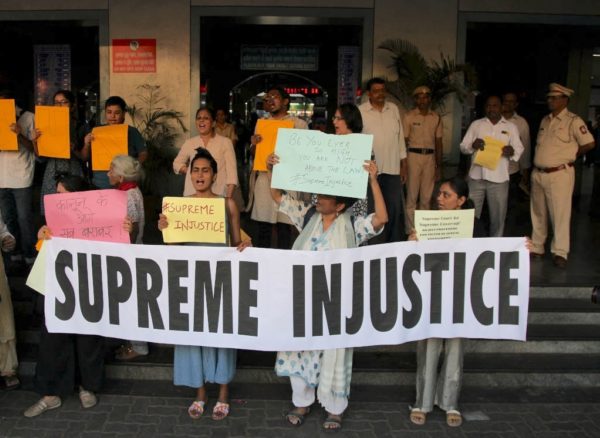
“I have been sexually harassed to the very limit,” the letter read. “Kindly permit me to end my life in a dignified way. Let my life be: DISMISSED.”
The letter quickly went viral. In response, Chandrachud requested a report on the case from the Allahabad High Court, where the judge first had registered a complaint in the court’s internal committee, but the inquiry remains ongoing.
A month later, an assistant public prosecutor in the southern state of Kerala died by suicide citing similar workplace abuse.
S Aneeshya had allegedly suffered relentless harassment and “mental torture” from her colleagues, as well as reprisal for speaking out against their unethical conduct.
“I haven't done anything wrong,” she said in audio recordings sent to her close friends. “I am on the verge of committing suicide.”
The two cases have provoked a long-overdue reckoning on the hostile environment for women working in the Indian judiciary, one marked by systemic harassment, intimidation, institutional abandonment, and arbitrary dismissal. And despite efforts to seek justice and accountability, women face formidable barriers, with complaints often ignored or dismissed. The blanket impunity is now pushing some of them to the extreme.
These cases by no means reflect a recent phenomenon.
In 2019, a former junior court assistant of the country’s Supreme Court accused former CJI Ranjan Gogoi of sexual harassment. In an October 2018 affidavit sent to every judge in the apex court, the woman detailed how she faced extreme victimization even after she was terminated, facing a criminal complaint of cheating and forcibly having to beg Gogoi’s wife for forgiveness. A relative, who worked as an attendant in the Supreme Court, was also terminated.
After the media widely reported the letter, the top court called for a special hearing with a two-member bench — which included Gogoi. Only when the Women in Criminal Law Association called out foul play did a new bench form that excluded him. Still, the case was ultimately thrown out due to a lack of electronic evidence against Gogoi.
And before that, in 2014, a judge in the central state of Madhya Pradesh resigned due to repeated sexual harassment by a colleague in the state’s high court, who then had her transferred after she refused his advances. The judge claims she was unable to file a complaint due to a lack of reporting committee. After also writing to then-CJI H L Dattu, a petition for her colleague’s impeachment was submitted in 2015. While the committee found her transfer unlawful, it purportedly found no evidence to support her claim of sexual harassment. Her colleague, therefore, continued his service until his retirement in 2018, while the judge was not reinstated to her post for another eight years.
In the majority of such cases, the accused often face minimal consequences and continue their careers uninterrupted, while women not only endure severe mental and emotional distress but also sacrifice valuable years of service.
The inhospitable environment for women in judicial services likely contributes to their abysmal representation: While women join judicial services enthusiastically at the subordinate court level (at about 35 percent, per the India Justice Report 2022), women’s representation in the high courts dwindles to about 13 percent. Of the sanctioned 34 judges in the apex court, only three were women as of June 2023.
In 2013, India passed a robust law to safeguard women from sexual harassment at the workplace —the Prevention of Sexual Harassment (PoSH) Act — which mandates every organization, public or private, to have more than 10 employees for an internal committee to regulate and administer complaints of sexual harassment. But in practice, the internal committee (IC) is only as effective as it wants to be.
“Sexual harassment at the workplace is a matter of great concern as it continues to be taboo in our society,” said advocate Gauri Kumari, an IC member of a district court in the eastern state of Bihar and the first Dalit woman to become the vice president of the Munger Bar Association.
Her IC was only instituted in 2022, but so far, only three meetings have been organized. “When we organize meetings, male members tell us to do it among ourselves because these are ‘women’s issues,’” she said. “Men in this profession don’t treat women with dignity and respect.”
Supreme Court lawyer Shobha Gupta said that the moment women raise their voices against harassment and abuse, they face immediate and severe consequences. “Once the proceedings begin, the survivors are attacked by damaging their professional record and assassinating their characters,” she said. “Speaking up against sexual harassment is making women lose their jobs.”
Inspired by the open letter from the judge in Uttar Pradesh, Eliza Gupta, another former civil judge and judicial magistrate in the northwestern state of Rajasthan, wrote an open letter to Indian President Droupadi Murmu, Prime Minister Narendra Modi, and the country’s top court alleging mental torture, verbal assault, and arbitrary dismissal from service for opposing senior advocates’ overreach into her work.
“Being a judge, I was harassed,” she wrote. “I was removed from service with stigmatic remarks, which will not allow me to live peacefully with dignity in any part of the world."
Gupta told WMC Women Under Siege that she had faced harassment and abuse since the beginning of her career as a judge and hasn’t see “such a coercive work environment anywhere.”
She said that senior advocates have constantly harassed her, impeded her work, and verbally abused her on the dais, including a particular incident last September when she said she was verbally assaulted on duty.
Gupta reported the incident in several complaints seen by WMC Women Under Siege. Shortly after, Gupta’s senior transferred her to another court. As soon as Gupta arrived, she said, she was handed an order of discharge. The complaints Gupta had filed were also dismissed.
As for her letter, Gupta has yet to receive a response from any of the addressees.
“I have lost my job, been harassed for two years, and I can’t even find another job,” she said. “My studies and years of experience are a complete waste.”
Gupta also filed a case against her termination order, which is pending at the High Court of Rajasthan. If she doesn’t get justice, she said, she intends to move her case to the Supreme Court.
“The structure of patriarchy is so strong that it shows no matter the position you work in—which caste, religion or ethnicity you belong to,” said Shabina, a caseworker at the women’s rights organization Vanangana, located in the same region in Uttar Pradesh as where the judge resided. “It’s also a question of lack of representation of women in different forms of the profession, so when a woman takes charge in an office full of men, she feels alone and unsafe.”
Women have reported many instances of harassment and abuse as civil servants in the Indian judiciary, at the risk of their careers, as well as their mental, physical, and emotional well-being. But, with cruel irony, justice for them has remained elusive.
Aneeshya’s abusers were suspended from their positions, but no police complaint was filed despite Aneeshya’s voice notes and journals documenting their harassment. Only after the family appealed did the probe begin. The accused were arrested and promptly released on bail as the investigation continues.
Said Aneeshya’s brother Anoop, “We just want justice so no other woman has to meet [her] fate.”
More articles by Category: Gender-based violence, International, Misogyny, Politics, Violence against women
More articles by Tag: India, Law


