















Surge in Femicides Under Lockdown Renews Calls for Colombia's Reckoning with Gendered Violence

BOGOTÁ —On the night of June 14, police reported that 30-year-old Heidy Soriano and her four-year-old daughter had been killed by her partner in the home they shared in the capital city of Bogotá. The double homicide made headlines across Colombia after weeks of mounting violence against women during a nationwide lockdown. Just that morning, 23-year-old university student Daniela Quiñones had disappeared returning home from a party. Police, who later found her body dumped in the Cauca River, said another partygoer had killed her when she refused his sexual advances.
The back-to-back killings— two out of a total five violent deaths in less than 48 hours — were enough to set off national indignation.
Experts have attributed the spike in violent crimes against women to the state-mandated quarantine, which was in place from March 25 to September 1. The country has since begun to gradually reopen and moved on to a “selective quarantine” for people confirmed or suspected of having the coronavirus. While the quarantine has helped curb the contagion, official reports suggest that women are suffering from violence at alarming rates.
The weekend after the murders, demonstrators marched in various Colombian cities, blocking important thoroughfares and singing feminist chants, to protest what they perceived as the government’s failure to protect women as reports of gender-based crimes were skyrocketing. In the first 11 days of the quarantine, calls to a national hotline for violence against women jumped 103 percent compared to the same period last year.
“Violence against women is not a priority for the government,” said Laura Daniela, a 21-year-old sociology student at a march in Bogotá. “It’s only when we come out to the streets that the government recognizes the problem.”
From March 25 to July 2, the national hotline for violence against women received an average of 119 calls daily — a 130-percent increase from last year, according to government figures. Surprisingly, the government also reported a dip in legal medical evaluations (which are usually conducted after a police report) for all forms of gender-based violence, including domestic violence, sexual abuse, and homicides. Experts, however, have stated that victims may have been more inclined to seek support from a hotline than report their abusers to the police.
“To live with your aggressor and to report him could increase the violence,” said Estefanía Rivera Guzmán, coordinator of the Antimilitaristic Feminist Network’s Femicide Observatory.
Although women’s rights organizations like the Antimilitaristic Feminist Network have kept an eye on official figures, they have also tracked deadly crimes against women on their own. From March 16 to August 23, the Femicide Observatory counted 222 femicides — murders committed due to a woman’s gender. Meanwhile, Femicides Foundation Colombia, another women’s rights group, reported 112 femicides from March to July, which represented a 34-percent decrease from the same months last year.
Still, Rivera described the femicide figures as “scandalous.” For Rivera, the data collected by the Observatory reflects what advocacy groups had warned all along: that gender-based violence would rise as lockdowns forced women to stay home with their abusers. Their database shows that, in most cases, the suspected murderer was a man close to the victim.
“This is a historic and structural violence that precedes the pandemic,” said Rivera. “But what seems to cause an increase now is being in close contact with the aggressor.”
While the lockdown may seem to create the ideal conditions for intimate partner violence to increase, Rivera emphasized that all other femicides committed by men who are not the victim’s partner, such as that of Quiñones, have also continued unabated during the pandemic.
Around the world, governments have reported similar increases in gender-based violence as countries fight the coronavirus crisis with lockdowns and stay-at-home orders. The United Nations has called this phenomenon a “shadow pandemic,” urging authorities to boost hotlines and shelters and support women’s organizations on the frontlines.
Before the pandemic, an increase in legal protections for women in Colombia still failed to diminish the prevalence of violence against them. In 2015, Congress approved legislation that recognized femicide as a crime and toughened sanctions for these murders. And last year, Congress reformed the domestic violence law, widening the legal definition of a domestic violence victim to be more inclusive. Yet most of these crimes go unpunished while state institutions have struggled to attend to high numbers of domestic violence cases — at least 67,600 were recorded in 2019 alone.
Gender-based crimes have increased in recent years, with figures making alarming headlines last year. The NGO Sisma Mujer reported that in 2019, a woman was killed every three days, sexually assaulted every 24 minutes, and assaulted by another method of violence every 13 minutes. In all these cases, the perpetrator was the victims’ current or former partner. A 2019 government study that analyzed gender-based crimes from 2014 to 2017 indicated that a total of 23,189 women in the country were at extreme risk of dying of femicide.
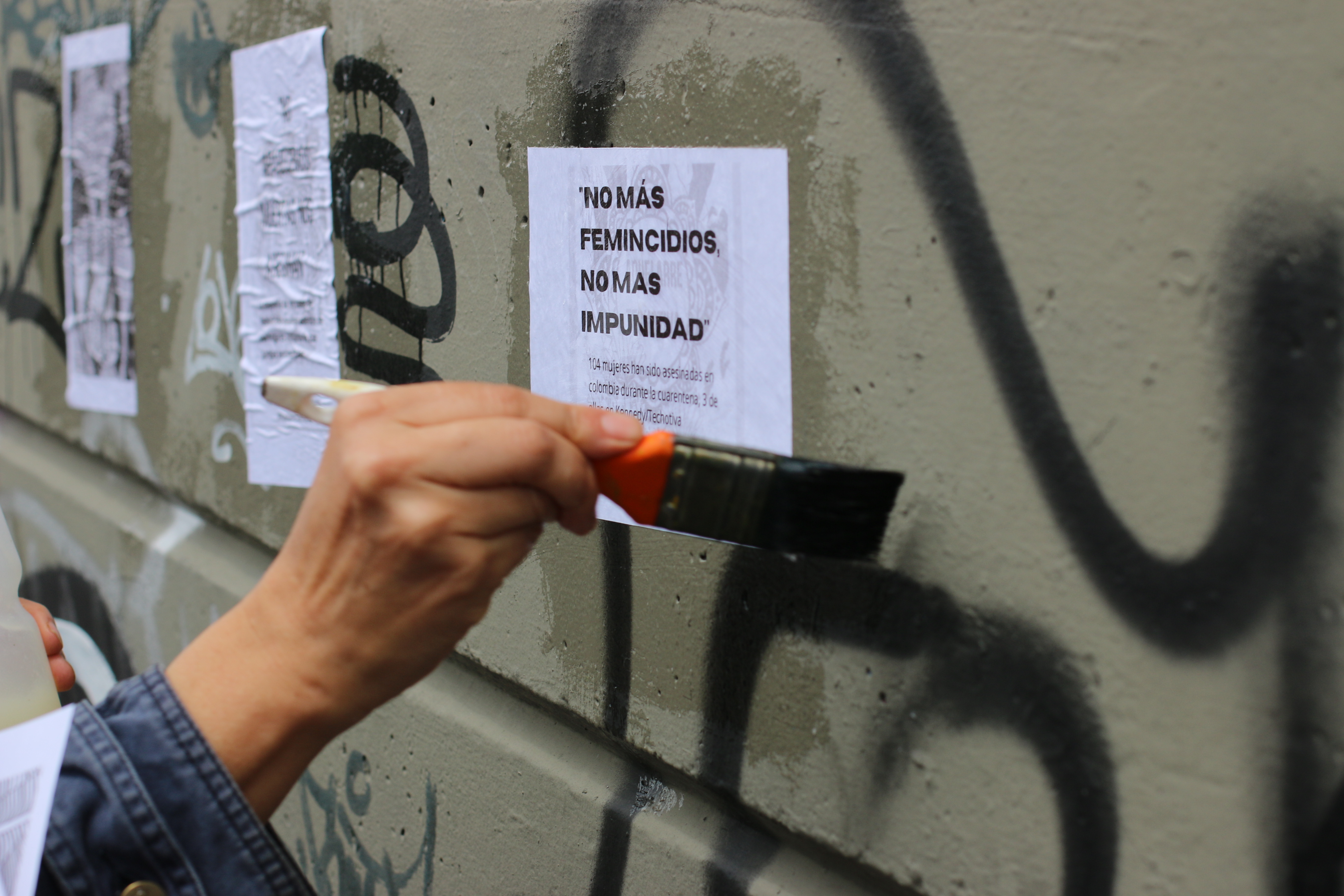
Experts say that stay-at-home orders have exacerbated the ongoing crisis, but crushing unemployment figures could also have a hand. According to the National Administrative Department of Statistics, an additional 2 million women lost their jobs from March to May.
Paola Soriano, a social worker at the nonprofit Women’s Advisory Board in the rural town of Duitama in central Colombia — and the cousin of femicide victim Heidy Soriano — said unemployment may limit women’s ability to leave unsafe homes.
“The majority of independent women relied on informal jobs, like street vending or recycling,” said Soriano. “With everything that has happened, they’ve lost their jobs and have had to depend economically on a man for rent, utilities, and food for their children. This creates conflict in the home, but also forces women to accept their situation.”
At the outset of the lockdown, the government implemented new measures to prevent an expected increase in violence against women. Officials designated $3.7 million into bolstering national hotlines and opened up 65 additional shelters across the country. In Bogotá, employees from more than 600 supermarkets and drugstores were trained to assist victims of gender-based violence as the quarantine made it harder for women to report their abusers from home.
Still, advocacy groups have said these measures fail to address the scope of the problem.
“Because of the historical debt the government has with these issues, these measures are important, but aren’t enough,” said Dora Saldarriaga, a lawyer and councilwoman representing the Estamos Listas political movement in the city of Medellín. Women in rural areas with little state presence have long been denied access to life-saving services like access to women’s shelters, said Saldarriaga. The new measures do little to correct these historical injustices, she added.
Meanwhile, municipal family welfare agencies, which handle domestic violence cases, have remained open during the quarantine as mandated by President Iván Duque Márquez. Still, these facilities are largely underfunded. A recent report from the Inspector General’s Office revealed that only 0.8 percent of these offices are fully staffed — most are operating without the necessary legal and medical experts to guarantee victims’ rights.
In response, the Estamos Listas movement has sent the national and local government a petition with 15,000 signatures demanding stronger action from the state. The petition asks authorities to declare a humanitarian crisis, which is usually called when a group of people is under threat due to emergency circumstances. Saldarriaga argued that the alarming number of gender-based violence cases substantiated the need for this extreme measure.
The petition also calls on the government to incorporate a gender perspective in the creation of security and crime policies; assign more resources to prevent and attend to these cases; create specialized groups to investigate gender-based crimes; and adopt a public database system that keeps up-to-date figures on protective orders.
President Duque has yet to publicly respond to the petition, which was formally submitted on August 20. But in June, his administration announced eight new measures intended to address the increase in femicides. These include a new control room administered by the National Police to monitor these crimes, a bill to reform family welfare agencies, and a social program that seeks to improve the economic conditions of victims.
“We have to condemn all femicides because they are one of the worst expressions of violence in society,” said Vice President Marta Lucía Ramírez in a press release.
The High Presidential Council for the Equality of Women did not respond to a request for comment about the list of demands of the Estamos Listas movement.
“The state may be effective for some women, but until the state takes seriously the redistribution of resources so that women have economic stability and safe places for them, it’s difficult for the effect of these measures to be real and to truly protect the lives of women,” said Rivera of the government’s response.
In 2018, the Duque administration designated $1.4 million to address gender equality in its four-year National Development Plan. But experts say more resources are needed to guarantee women’s safety. Saldarriaga said a large percentage of femicides could be prevented if the government spent more on enforcing protective orders. Colombia’s legal medicine and forensics agency reported that 35 percent of femicide victims who died in the years 2014 to 2017 had previously denounced their abuser.
Rivera of the Femicide Observatory agreed. Rivera claimed that the government is inefficient in preventing repeat offenses. She noted that the suspect in Soriano and her daughter’s femicides had previously been charged with abuse. “How is it that no one is following up on this man? There are men who have three, four, up to seven charges of domestic violence, and the state doesn’t have a strategy for following up on these men. This is impunity.”
In a separate campaign, the Femicide Observatory has also petitioned the government to declare a state of emergency in response to the growing violence. President Duque instated a state of emergency to attend to the pandemic, an emergency order that allows the government to issue regulations via presidential decrees without the approval of Congress. The advocacy group contends that the president should take a similar approach to the gender-based violence crisis. More than 7,800 people have signed onto the online petition that was submitted to the government on August 20.
“The state of emergency for women has been constant, but so has been the absence of resources to eradicate this violence,” said Rivera. “We need the government to recognize the state of emergency, but also to invest resources and real actions.”
More articles by Category: Gender-based violence, International, Violence against women
More articles by Tag: COVID-19, Colombia, Femicide


