















Researchers Lean on Coffee Customs to Curb Intimate Partner Violence in Rural Ethiopia
A group of researchers based at Harvard T.H. Chan School of Public Health, the International Food and Policy Research Institute, Addis Ababa University and the Ethiopian Public Health Association together with the Abdul Latif Jameel Poverty Action Lab (J-PAL) have turned to traditional coffee ceremonies to help stem intimate partner violence (IPV) in Ethiopia and educate about HIV in the country’s more rural areas.
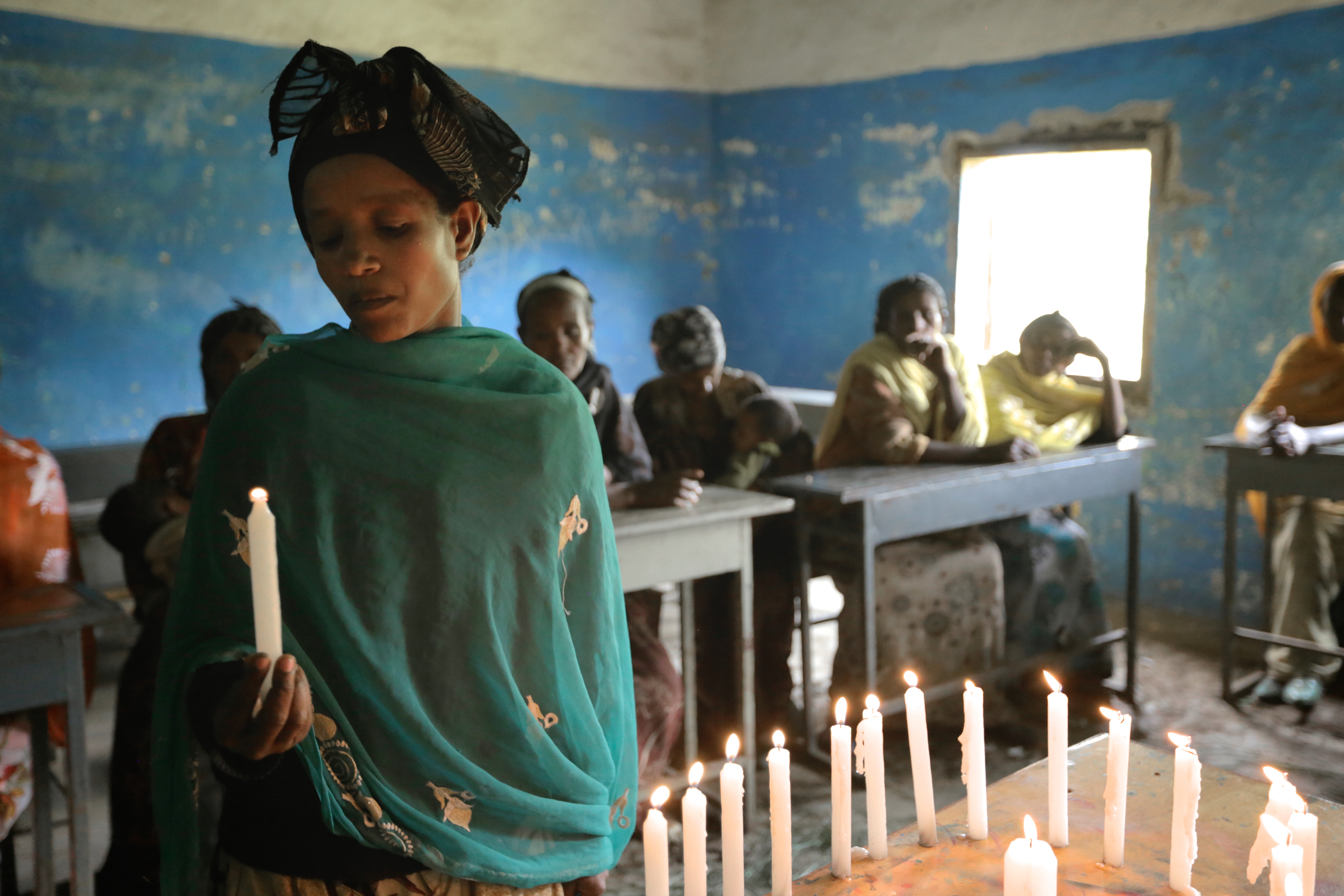
Called Unite for a Better Life (UBL), the program launched in 2015 uses a gender-transformative, participatory approach and is delivered to groups of men, women, and couples. UBL is designed to engage the participants in discussions and critical reflection around gender norms, power and violence in relationships, and sexual relationships and HIV while also building important skills in conflict resolution, communication, and listening — all over a cup of coffee.
According to a 2016 Ethiopian Demographic and Health Survey (DHS), published by the government the following year, IPV rates hover around 30 percent for women in the country, but Samuel Tewolde Gebretsadik, one of the designers of the UBL program, believes the rates to be higher. “I am local and know the number to be significantly higher than reported in research studies,” he told Women Under Siege in an email interview.
In Ethiopia, coffee ceremonies are an integral way of life. “Ethiopians use their coffee ceremony not only to consume the drink but also to discuss issues or concerns, ranging from home to country or global matters,” said Gebretsadik.
“Our colleagues had the idea to embed an IPV prevention program in the coffee ceremonies since these are the natural way people get together and discuss issues,” said Dr. Vandana Sharma, the lead researcher.
The program also provides an opportunity to challenge some gender norms, Sharma said, including women’s traditional role preparing the coffee and serving it. During the program sessions — which are designed to address the root causes of gender-based inequalities and promote gender-equitable attitudes and behaviors by challenging gender stereotypes and unequal roles in the home — the men helped by preparing the coffee.
“They had to take on roles not traditionally thought of as roles for men,” Sharma added.
The program was comprised of 14 total sessions, each about two hours long and held during the traditional Ethiopian coffee ceremony, and was delivered twice a week over seven weeks. Each session was led by trained facilitators from the area, who engaged participants in interactive discussions, exercises, and role-playing activities that reflected on gender norms and power in relationships — particularly, in domestic settings.
For example, during the session on men’s and women’s roles in and out of the home, participants created a 24-hour schedule of what a typical man and woman in their community would usually do at each hour of the day. When they added up the hours, both men and women were surprised to find that women spent more hours than men working for the family. The revelation opened up dialogue on how men and women can better support each other.
“It’s an intensive intervention,” Sharma said.
UBL was evaluated with a large cluster-randomized controlled trial in which 64 rural villages in southwestern Ethiopia were randomly assigned to either receive the intervention — in men’s groups, women’s groups, or couples’ groups — or not to receive the intervention. Within the communities, almost 7,000 households participated in the trial. The villages comprised both Christian and Muslim households and were characterized by both low socioeconomic status and limited access to education — especially for women. For example, 75 percent of the women in the intervention had completed no formal schooling.
A 2006 World Health Organization (WHO) ten-country study on violence against women reported very high levels of IPV across those countries, including in southwestern Ethiopia, and was the impetus for the UBL program and the evaluation. It found that nearly half (49 percent) of ever-partnered women in Ethiopia experienced physical violence by a partner at some point in their lives, and 29 percent had experienced it over the past year from when the study was conducted. Additionally, 59 percent of ever-partnered women experienced sexual violence during their lifetimes.
“Ever-partnered” was defined in Ethiopia as “ever married, ever lived with a man or currently with a regular sexual partner.” IPV refers to any behavior within an intimate relationship that causes physical, psychological or sexual harm to those in the relationship.
Dr. Negussie Deyessa, who led the Ethiopia component of the WHO study, became one of the UBL team members.
To evaluate the UBL program, data on different forms of IPV — consistent with the WHO’s standard definitions — and other key indicators were collected at baseline and again two years after participation in the program.
“The way the trial was designed allowed us to understand whether there are different impacts based on who the program was delivered to,” Sharma said. “In terms of the violence outcomes — sexual IPV and physical IPV — we found that there were reductions in past-year sexual IPV, specifically, in the arm in which men participated in the program together.”
There were no reductions in IPV in the women’s intervention arm of the trial or the couple’s arm, they found, but there was evidence of increased support for gender-equitable norms, such as for more equitable decision making, male involvement in domestic tasks; and intolerance of violence in the home. There was also some evidence of decreased perpetration of physical IPV among participants who completed 12 or more of the sessions in the men’s-only groups.
“The big changes were in sexual IPV within the men’s arm,” said Sharma. “The results are really fascinating and tell us that group composition does matter when it comes to intimate partner violence prevention in this context.”
Sharma added that further research is needed to understand why couples’ and women’s interventions were not effective in reducing IPV in this setting, as well as the potential mechanisms through which the men’s intervention led to change. Gebretsadik explained, “Men changed for good because through UBL, they confronted, challenged, and questioned the truth about inequalities at home and beyond.”
The trial also found that UBL significantly improved HIV-related outcomes, such as increased condom use, HIV testing, and discussing sex among spouses. Increased joint household decision making and men’s involvement in domestic chores and childcare were observed among all three groups.
One woman who participated in the couples’ intervention reported that she and her husband were now better able to share ideas and jointly make decisions through healthy conversations, emphasizing how critically important it was to engage the husbands in the program. “Most of the women from this area agree that the men have changed,” she said.
Results from the program were recently published in the peer-reviewed medical journal PLoS Medicine.
“From a policy standpoint, decisions should be based on evidence, especially when it comes to interventions addressing violence, as there’s potential for harm,” Sharma said. “It’s really important that we rigorously test programs so that we can determine whether they are having the intended effect.”
UBL has been adapted to humanitarian settings, specifically, for Somali refugee populations in Ethiopia, who experience even higher risks of IPV. In this refugee setting, the program sessions are delivered in Somali tea talks.
The team also developed a podcast-based version of the program, which can be delivered via mobile phones, an approach that is particularly useful during COVID-19 restrictions on in-person gatherings. Coffee or tea — depending on the context — remain an important component of the podcast series as well. Several-minute-long coffee or tea breaks, complete with the sounds of pouring liquid and clinking cups, are interspersed within each episode and signal to listeners to consume their beverage while reflecting on the concepts and issues that were discussed.
There are no group sessions currently being implemented, but the UBL program is still active in other ways. Funds permitting, Sharma said they are considering how to scale up the program across Ethiopia and, potentially, in other contexts.
Harnessing culturally-informed strategies to prevent intimate partner violence, as UBL does, can offer a path toward gender equity. Given the lessons and evidence from Ethiopia, there is plenty reason to believe that tailored programming, designed and delivered by and for target communities, can ultimately improve the lives of countless women and their families. They just need the investment.
More articles by Category: Gender-based violence, International, Violence against women
More articles by Tag: Domestic violence, Intimate Partner Violence, Ethio, Africa


