















Photos: Everyday life in Juárez, one of the most violent cities on earth
The year photographer Itzel Aguilera moved to the Mexican border city of Ciudad Juárez in 2008, it achieved notoriety as the most violent city in the world. Living there with her husband and daughters Valeria, 6, and Dalia, 7 months old, Aguilera, who is 42, was starting to feel unsafe.
“We were going through a very difficult time, a period of true violence,” she said. “I began to realize that I didn’t have very many options to go out.” When she’d lived previously among the 22 million souls in Mexico City, she had created a haunting series of black-and-white portraits of the Mennonite community in northern Mexico that capture the joy of a life lived closely in connection with the earth. However, in Juárez, her work turned inward by necessity to represent the intimate details of daily life—to capture lives in a place of violence but to show that they didn’t consist of only violent acts.
“My idea was to begin to embrace the city,” she said. In all my trips to Juárez, I had never heard anyone say those exact words. I went to the city for the first time in 2010 to conduct interviews with writers and photographers for a book project, More or Less Dead, about cultural representations of feminicide and violence against women in Juárez. When I moved to Mexico City in 2012, I traveled to the border in February and in May to work on a short film, If Images Could Fill Our Empty Spaces, about photographers representing violence, which is how I met Aguilera. She was the only female photographer of the four that appeared in the film, and her story of how violence impacted her photography reminded me of the truly gendered nature of conflict, the way that women and children experience the threat of violence differently than men.
When discussing how her work changed due to violence, Aguilera explained: “I began to take photographs of our daily scenes. I considered it a special situation in that, at that time, my daughters and I had to be protected in the house. We went out to the porch and to the patio.”
But news of the outside world filtered into the warm cocoon of home. When the media represented Juárez, it vacillated between the distant language of numbers and the sensationalist language of dead bodies. From 2008-2010, the city was ranked the most violent city in the world. According to Molly Molloy, a New Mexico librarian who is one of the few researchers keeping track of Juárez homicide statistics, says that at the height of violence in 2010, there were an average of 9.9 murders a day. Between 2007 and 2013, there were 11,699 murders. And while in 2013, the city dropped to number 37 on the list of the world’s most violent cities, the killing continues.
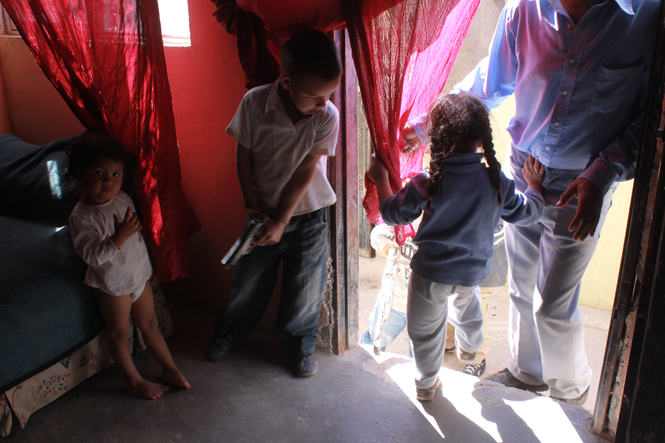
Children play “outlaw” because, as the photographer says, “they see so many stories of violence and they live it every day.” (Itzel Aguilera/CEDIMAC)
The elevated numbers of extreme violence against women in the first decade of the 2000s brought many researchers like myself to the city. Although the murders of women made up only 6-18 percent of homicides in any given year, they often involved sexualized violence and/or women’s bodies being dumped in public spaces. In one famous case, the bodies of eight women were discovered in a cotton field in 2001. According to Molloy, in 2008, the year that Aguilera arrived in the city, there were 1,623 homicides in total, and, of those, 98 involved women.
The PM, a popular daily Juárez newspaper, often features headlines like “They Were Left in Pieces” alongside a photo of arms and legs strewn across a highway. When I interviewed PM crime scene photographer Lucio Soria in May 2013, he showed me photos of more than 3,000 dead bodies he’d photographed. I looked at a photo of a bloody young man riddled with bullet holes lying on the pavement next to a car. Above the body, on a small hill, a group of people looked down on the scene. “I arrived before the police, when he was still alive,” Soria said. “Lots of people in the neighborhood gathered around to see what had happened. I looked at the people in the photo, tried to analyze their faces to see what it meant to watch death, to look down from above and observe. Hundreds of photos. A head placed next to an armless torso. Bodies on exhibit, arranged just so. Naked women lying in the street with messages written on their flesh, men thrown into the dunes along the Camino Real.
“Are you going to throw up?” Soria asked me.
As Aguilera watched how the city was represented in the national and international media, she asked herself whether there a way to show the city as damaged as it was but still capture its humanity. Her visits to people’s homes took on an elegiac quality, with families constantly mourning the death of loved ones. One man she met was drowning himself in alcohol. “You see their loss, the fatality, the disgrace,” she said.
Aguilera’s photos capture the particular experience of women, as in this photo from the June 10, 2011, march of Javier Sicilia’s Movement for Peace with Justice and Dignity. Citizens marched in defense of human rights holding signs that said “No More Blood” and banners with images of murdered human rights activists Susana Chavez, Josefina Reyes, Marisela Escobedo, and Ernesto Rabago. In Aguilera’s photo, women peer out of barred windows, their eyes following the march. The image speaks of confinement, of the spaces women inhabit in the city.
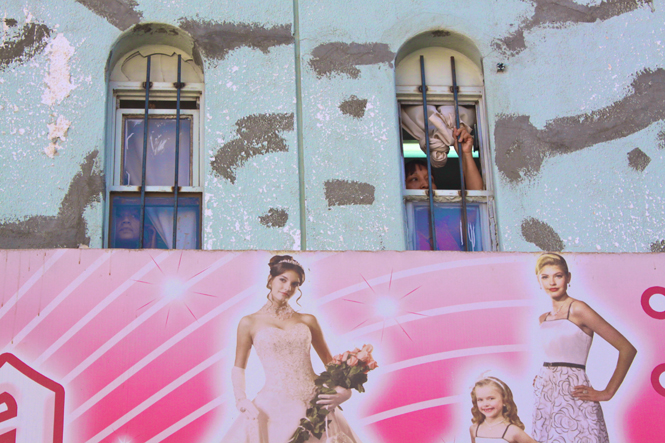
From behind bars, women watch a protest march against violence in the streets of Juárez. (Itzel Aguilera)
In another picture (at top), Aguilera catches children playing “outlaw.” A young boy with a toy gun stands in a darkened doorway, watching his little sister walk outside into the sunlight. There is something about the moment captured, the balance of dark and light, the posture of the boy, that makes the threat of violence seem real and pervasive—even reaching children. When I was in Juárez working on my film, Juan Delgado, who sells copies of PM and lives with his three grandchildren told me, “They used to play cops and robbers.” Now, said Delgado, “they pretend to behead each other. They shout, ‘I’ll kill you. I’ll cut you up.’”
In one photo of Aguilera’s series on mothers of feminicide victims taken for the Center for the Integral Development of Women (CEDIMAC), Doña Julia Caldera, mother of a young woman named María Elena, stands next to a portrait of her daughter. María Elena left for work on June 19, 2000, and never returned. She was 15 years old. In October of the same year, her body was found on a property in Juárez.
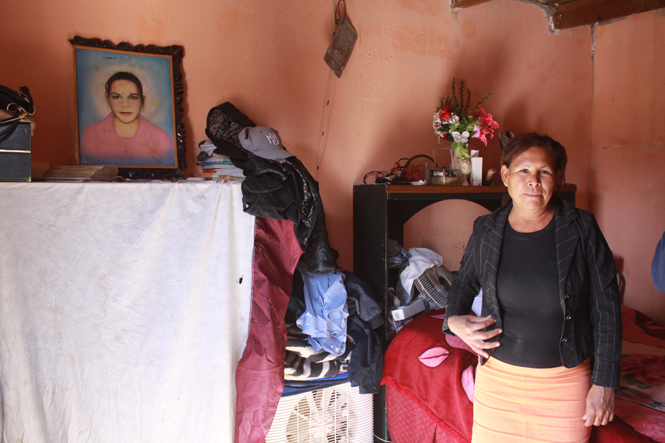
Dona Doña Caldera poses with a photo of her daughter María Elena, 15, who left for work on June 19, 2000, and never returned. (Itzel Aguilera/CEDIMAC)
On my last night in the city in May 2013, I sat in an ice cream parlor with Aguilera and her daughters. Valeria and I ate cookies and cream ice cream while little Dalia attempted to eat a giant cone of lime ice cream that mostly ran down her face and onto her shirt. Valeria proclaimed her love of ice cream and said, “Things I wish would never end: ice cream, fruit, my age.” Then, sitting up straight in her chair, legs swinging beneath the table, she said, “But pollution and violence—I wish they would end.”
More articles by Category: International, Violence against women
More articles by Tag: Rape, Americas, Sexualized violence


