















'Fragility' of India's Laws Fails Victims of Sexualized Violence
NEW DELHI — “They just attempted, right? They didn’t actually rape?” Kritika* recalled the officer on duty saying when she and her parents went to the police station to report her assault.
Four years ago, when she was a final-year college student at Techno India University in Kolkata, Kritika was sexually assaulted by four men, all of whom were recent graduates of the university. She was at her friend’s apartment waiting out a downpour, where she met them.
“They would have raped me had I not been on my period,” she told Women Under Siege.
Accompanied by her parents, she had gone to the police station to file a First Information Report (FIR). “It’s better if you don’t file a complaint,” the officer replied, much to their shock.
The exchange, she told Women Under Siege, made her feel like she needed to prove that she took active steps to communicate her lack of consent — as if, she said, she was assaulted because she failed to take responsibility for her own safety.
The officer told them that Kritika’s case fell under another police department’s jurisdiction and that his department “can send a warning, at best.”
“He even asked us to ‘settle’ and ‘compromise’ because one of the perpetrators had an influential background,” Kritika said.
Under Indian law, police are duty-bound to file a FIR and provide adequate protection to the victim even in instances of rape threats. Any failure by law enforcement to register a rape complaint is a criminal offense punishable by imprisonment of no less than a six-month term, in addition to a potential fine. But just because the law exists, it is in no way a guarantee that it will be enforced, not least of all by an undermanned, under-trained justice system.
In Kritika’s case, no disciplinary action was taken against the investigating officer for refusing to file the case and conduct an investigation.
Lacunae in the Indian justice delivery system
In India, a rape is reported on average every 15 minutes, according to 2018 crime data from the National Crime Records Bureau (NCRB), while the conviction rate stands at just 27.2 percent.
While rape is a non-bailable offense under the Indian Penal Code, a lack of evidence in most cases affords a loophole. “Rape cases in India have an astonishingly low conviction rate because law enforcement officials are not well trained,” said Samidh Choudhury, an advocate at Kolkata High Court. “This leads to inadvertent destruction of evidence, delay, and the like. The police are also not sensitized enough to speak reasonably to a rape victim, which often makes the victim feel like she is the accused due to hours of unscientific, traumatizing investigation.”
“There are no personality-profiling assessments for police officers, prosecution officers or judges,” said Brinda Adiga, a renowned social activist. “Transparency and accountability of all the departments is low, so there is no information related to how or why cases are disposed of or acquitted in the public domain.”
As far as legislative recommendations are concerned, the most important would be better guidelines for the conduct of investigations and trials in sexual assault offenses. “Conduct of trials should be streamlined through official guidelines so that the cases don’t drag on for years,” said Choudhury.
While there are Fast Track Special Courts (FTSCs) set up precisely to expedite trials for “offenses of rape and gangrape of women and children,” their presence — as well as funding — varies state by state.
“[Until] last year, there was no information available regarding the actual establishment of such courts in various states and its implementation,” said Choudhury.
And just setting up FTSCs is not enough, she said. Proper legal assistance is very much needed for speedy trials, as is specialized training for investigative officers for gender-based crimes.
Meanwhile, the lack of witness protection law in India makes rape survivors and witnesses vulnerable to pressure that ultimately undermines prosecutions. For instance, Dalits, or the so-called “lower-caste” families, are often pressured not to pursue a criminal case if the accused is from the dominant caste.
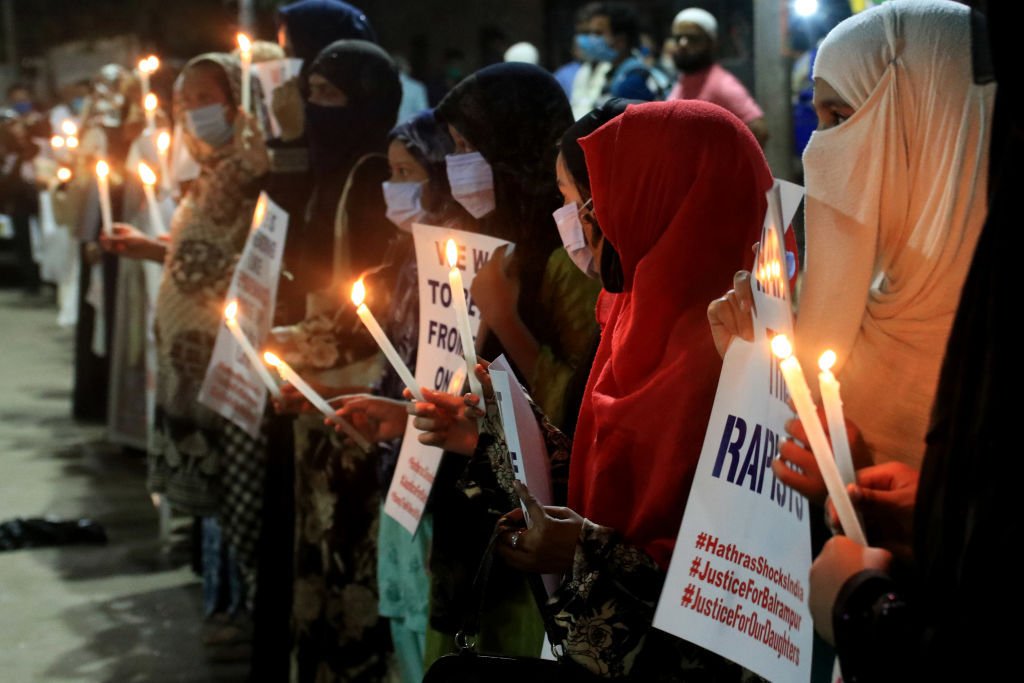
On September 14, a 19-year-old Dalit woman in Hathras, Uttar Pradesh (UP), was brutally gang raped by four dominant-caste men.At first, UP police did not register a FIR against the men. Following her death on September 29, officers burned her body without familial consent before the trial. According to the victim’s mother, the family was not even allowed to perform last rites.
About a week later, a video emerged of a Hathras district magistrate threatening the victim’s family to change their statements, implying that the media wouldn’t always be there to stand with them. “Don’t lose your credibility,” he said. “It is up to you whether you want to change your statement or not.”
Rape myths and normalization of predatory behavior
In India, predatory behavior has become uncomfortably normalized. It is a society in which violence is considered routine, sexuality is made violent, and women’s prior sexual experiences are often considered to invite their abuse, with social systems, institutions, and attitudes invariably protecting the accused.
Priya Varadarajan, founder of DURGA, an advocacy organization for the protection of women in public spaces, told Women Under Siege that she once accompanied a woman to a police station to file a FIR against her boyfriend who sexually assaulted her. The police officer summoned the boyfriend and “just made them resolve their issues, shake hands and move out,” Varadarajan said.
“He said if a girl has a boyfriend, obviously people will sexually abuse her,” Varadarajan said. “There has to be sensitivity, and police stations need to be women-friendly.”
Varadarajan believes that sexual assault is the only crime in India in which the victim has to prove that the crime occurred, claiming that the existing process for investigations is entirely fraught with medieval biases against women.
What’s more, current NCRB data indicates that 94 percent of rape cases are committed by persons known to the victims, making it all the more difficult to report their abusers. The alternative, both culturally and circumstantially, is to remain silent.
A cog in the human rights wheel
There is also a lack of awareness that crimes against women are actually punishable offenses.
“For me to report a crime, I’d need to know that it is a crime,” said Varadarajan. “I’d need people around me to support me; I’d need the police to be receptive; and I’d need to be confident that the judicial system would take its course.”
It is imperative to first understand and study the models of patriarchy that allow the justice system to be manipulated by social stigma and cultural, societal, and familial pressures.
“[The] fragility of laws has made justice a blunt tool handy to the influential, further favoring the power structure,” said Choudhury.
A cocktail of structural barriers with law enforcement and throughout the judicial process — such as drawn-out, humiliating investigations and trials — ensures that justice for victims remains evasive. And while civil society and activists work overtime to keep the pressure on the government to register and investigate cases of gender-based crimes, they’re under-resourced to pursue these cases on their own.
There is hope as long as there is conviction to use the law as an instrument of change. Constitutional values can and must be radically interpreted to properly address the realities of violence against women, but that won’t happen until violence against women is considered a major cog in the human rights wheel and not merely a national issue or a problem of moral responsibility.
Until then, we can expect much of the same as these crimes continue unabated.
*Kritika's name was changed for her protection.
More articles by Category: Gender-based violence, International, Violence against women
More articles by Tag: India, Sexualized violence, Sexual assault, Sexual harassment


