















For Kashmiri Women Students, Iran Offered a Rare Education. Then War Came.
On the morning of February 28, as Tehran felt the first tremors of the joint U.S.-Israeli strikes, Sobia*, 20, pressed herself into the corner of her apartment in the central-western part of the city. The night before, the mood in the city had shifted. Sobia barely slept. The air carried a kind of warning. Lying awake in the dark, she made up her mind: If the worst came, she would make arrangements to return to Kashmir.
Sobia is a Kashmiri first-year medical student at Iran University of Medical Sciences. She was meant to start her second semester of classes that morning.
It would take her days to reach the Jolfa land crossing in Iran’s East Azerbaijan Province, and a few more to reach Kashmir, without any means of telling her parents in that time that she was still alive.
Sobia is one of many Kashmiri students who study abroad in Iran — including women. She’s a part of a current cohort of nearly 2,000 Kashmiri students — part of a larger group of 3,000 Indians — studying medicine there, said Nasir Khuehami, national convener of the Jammu and Kashmir Students’ Association. “They are enrolled in some of Iran’s most established medical universities,” he told WMC Women Under Siege. Including those targeted in strikes.
Two weeks into the war, in the northeastern province of Golestan, Reeba* is waiting in her hostel. She is still alive, but the internet clampdowns across Iran have made even that much feel uncertain — at least, to Reeba’s mother.
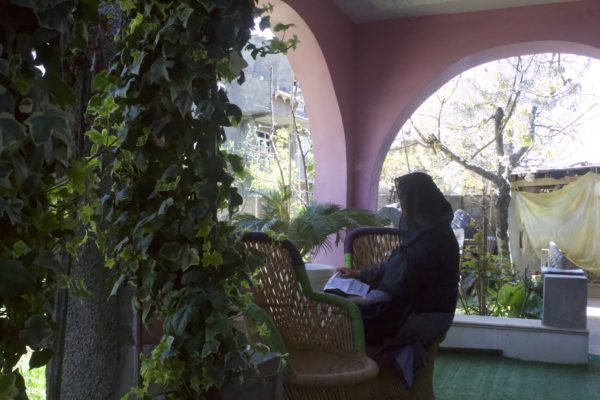
When I meet Reeba’s mother in her home in Srinagar, she is waiting by the window, where she has not strayed since the war began. Hanging from the window’s handle is a small, laminated card — an old school identity card, with Reeba’s younger, rounder face smiling back, memorializing a time before entrance exams and borders and a war that was never supposed to reach her. Her mother picks it up and sets it down, only to pick it back up again.
She is waiting for the three dots on her phone screen that indicate that her daughter is texting. When messages do come in, Reeba is assuring her mother that everything is fine and that she needn’t worry. But some days, they never come.
For Reeba also, Iran was the only viable path to realizing her dream of becoming a doctor.
In Kashmir, Reeba would rarely venture outside on her own, especially in the late evening. In their community, Reeba’s mother explains, there are unspoken rules about where a woman can walk, when, and with whom. The watchful eyes of neighbors would look upon a young woman alone on the street with suspicion — a cultural consequence, she says, of a region under decades of military presence. Both societies observe a kinship in religious conservativism, but Iran was a place that Reeba’s mother saw as more advanced, with a broader outlook, where women could move through the world more easily and live their lives with a sense of independence.
It’s not exactly the picture of Iran that is popularly held in the West, which fixates on the gender apartheid under the Islamic regime as a metric of civilizational difference. That is not to discount the severe discrimination against women under the current regime, but a wider lens shows that women in Iran are far from passive subjects of subjugation. To the contrary, over the past few years, they have been steadily seizing freedoms — on campuses, in cities, in daily life — in ways that have surprised even returning Iranians.
For Kashmiri women students, the freedom that mattered most was the freedom of education, of studying medicine without fear of identity-based violence. That specific freedom, on Iranian campuses, was real.
Iran has never felt entirely foreign to Kashmir. Kashmiris have called their valley Iran-e-Sagheer (“Little Iran) for centuries. In the 14th century, Mir Sayyid Ali Hamadani, an Islamic scholar from Hamadan, Persia (in present-day Iran), arrived in Kashmir with 700 disciples and transformed the valley. He brought with him not only religion but also the Persian language, medicine, poetry, craftsmanship, and philosophy that shaped Kashmiri identity at its core.
Kashmir became part of a wider Persianate cultural world from that century onward, where influences from Iran and Central Asian cities like Bukhara and Samarkand blended with indigenous traditions, not to replace them but to create something entirely its own, which explains the many cultural, artistic, and architectural similarities seen between Kashmir and Iran today. The imprint is still visible in the wooden Persian-style mosques and Sufi shrines of Srinagar, in the pashmina and papier mâché crafts brought by Hamadani’s artisans, and in the Persian vocabulary woven through Kashmiri language and poetry.
When both mothers imagined their daughters in Iran, they were not envisioning a foreign place but, rather, one that Kashmir had always carried inside itself. The architecture would feel familiar, and the rhythms of a Muslim academic life would not require translation.
Kashmir is India’s only Muslim-majority region, a Himalayan territory administered by New Delhi and contested by Pakistan since the two countries were partitioned in 1947. Three wars, a decades-long armed insurgency, and one of the most densely militarized civilian populations in the world have shaped daily life here.
In 2019, the Indian government revoked the special constitutional status of Jammu and Kashmir, thereby stripping the region of its semi-autonomous status after seven decades and bringing it under direct central control. For some Kashmiri Muslims, the years since have been marked by a deepening sense that they would always be subjects of suspicion in their own country.
Sending a daughter to study elsewhere in India — where Muslim women in hijab have been turned away from college classrooms, harassed by security forces (or worse), and targeted in online auction-style apps — is not a first choice for many families.
Pakistan, the country with which Kashmir shares both a border and a religion, was never a real option, either. India and Pakistan do not have functioning diplomatic ties for ordinary travel, and a Kashmiri family sending a daughter to study there would face suspicion from authorities on both sides.
For many Kashmiri families, sending a daughter away is never only about education. In my conversations with families of returned students across Kashmir, a common thread emerges: a desire for safety and dignity — especially for their daughters — alongside the quiet hope that she would not have to shrink herself to belong anywhere.
Sobia and Reeba are now both home in Kashmir, among the nearly 1,000 Kashmir students evacuated since March, most of whom travelled overland into Armenia or Azerbaijan before flying back to their homes.
A 14-point deal between the United States and Iran struck on June 17 has brought a halt to nearly four months of devastation, but its integrity remains extremely fragile. For now, there’s no telling when or if these women will be able to return to their universities to finish their studies — or whether their universities will still be there. They’re safe now, but their dreams will have to wait.
*The women are identified by only their first names for their security.
More articles by Category: Education, International, Politics
More articles by Tag: Iran, Kashmir, Education


