















Denying basic human rights, Italy to deport dozens of Nigerian women tortured and trafficked
I’d been working on a short radio story for the July 30 UN World Day Against Trafficking in Persons when I realized that the fight against human trafficking in my country, Italy, has become a disaster. Vincenzo Castelli, one of the founders of an Italian nonprofit called On the Road, which works with victims of trafficking, had given me some incontrovertible data showing that there is a tremendous lack of resources for police investigations as well as for the protection and reintegration of victims. He said a national plan to change all this has been continuously delayed, apparently because of government disinterest. It only took a few hours from that point for this discovery to become hardened, like a sickly flow of lava turning to stone over a dying city.
I received a call from Francesca De Masi, who works at an organization called Be Free, a nonprofit with a strong feminist background that operates mainly around Rome providing legal and social aid to victims of violence and women forced into prostitution. We spoke for a while about her recent work in an immigrant detention center on the outskirts of Rome called Ponte Galeria, the biggest of six Italian centers for identification and expulsion (CIE). That’s how I discovered a human rights crisis hidden in plain sight—one that is actually being reinforced by the government.
There are 65 women from Nigeria who have fled Boko Haram’s violence—and who may have been trafficked—locked up right now in the Ponte Galeria, she said, having been brought there after being rescued in the Mediterranean. And, unlike other refugees fleeing violence in their home countries, as of September 2, 40 of them are going to be deported. “They are completely desperate,” De Masi said.
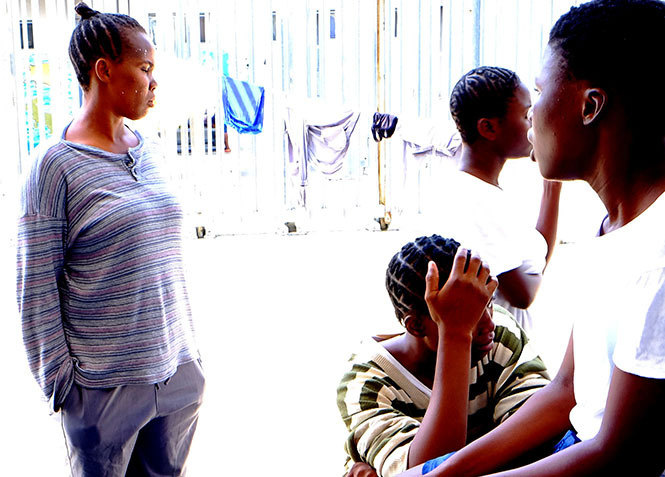
Some of the 65 Nigerian women locked inside Rome’s Ponte Galeria detention center. (Giacomo Zandonini)
Applications for asylum usually take from eight months to a year and a half to process, according to Italian immigration lawyers. Yet in the case of these Nigerian women, the Italian government has proven incredibly efficient. Twelve just received permits to stay, forcing civil society organizations to struggle to find a place for them to live after they’re finally released. But for the other 40, the situation is dire. Even so, with all of this sudden displacement, what is so strange in this case is not only the speed with which these decisions have been made by the state, but also the series of harsh decisions and general sense of disregard for the women’s lives that have led to this point.
A flouting of EU law and standard operating procedure has led to these women losing any chance they had of escaping violence and war. When I met them, I learned how truly shocking their situation has become.
A never-before-seen situation
“We are dealing with a never-seen-before situation,” De Masi told me, exhausted after a day of working in the detention center.
In her 10 years of aid she has dealt with many dramatic situations, but this time, she said, she was more than surprised at what was going on inside the Ponte Galeria.
“We are quite used to Nigerian women being brought to the center and then deported to Lagos, in Nigeria,” she said, “but usually it involves only small numbers of undocumented women who have been in Italy for years—in some cases with a failed asylum application behind them.” It’s been years, De Masi said, since she’d seen people who had been brought to the Rome detention center just after making the arduous journey by boat to Sicily, or the nearby island of Lampedusa. Even in the “dark days of Italian push-back policies” in 2009-2010 that resulted in a condemnation from the European Court of Human Rights in 2012, “we had a maximum of 20 women [at Ponte Galeria] each time,” she said.
But what De Masi found even more exceptional than the sheer number of women at the detention center at once was the fact that those women “were there to be deported, without anyone even having told them they could apply for asylum while, clearly, at least for a great number of them, they are victims of trafficking and violence.” And, she added, if deported, “they risk falling back in the hands of criminals in Nigeria.”
Staffers from Be Free visited the Ponte Galeria the morning after the arrival of the group of women, on July 23. They soon found out that the first people the women had encountered when they arrived at the center in the middle of the night were two functionaries from the Nigerian consulate—who immediately wrote up a kind of order saying, “Yes, these women are Nigerians. And yes, you can deport them.” After this kind of paper has been issued, it is then up to the Italian government, with European Union border agency Frontex, to repatriate the group. That they were never told they could apply for asylum (aka they weren’t made aware of their basic right to apply even if they entered the country illegally) indicates that Italy has had every intention of deporting them from the moment of their arrival—something confirmed to me by an international organization monitoring the cases.
‘They didn’t even know the meaning of the word “asylum”’
The majority of the women had been rescued after six days at sea before they arrived in Rome. They’d been brought first to a center of first reception on Lampedusa, between Tunisia and Sicily, where they stayed for five days while a smaller group had been landed in Pozzallo, on the southern shores of Sicily, the day before they were brought to the Ponte Galeria. The women had departed from Libya on different boats and met on a plane to Rome. None of them had known their fate at that point.
“Those who were in Lampedusa didn’t receive any information in their five days there,” said De Masi. “They didn’t even know the meaning of the word ‘asylum’ and some of them had health problems—connected to the harshness of the trip or to past violence—that were untreated.”
De Masi and her colleagues spoke immediately with the women, explaining that they had the possibility of applying for refugee status and what that meant. They all decided to apply for asylum in order to avoid immediate deportation, while at the same time they had to make appeals against orders of expulsion already issued by Sicilian police officers. But still they were being held at the Ponte Galeria, which, according to the Italian NGO Doctors for Human Rights, is “completely inadequate to guarantee the humane treatment of detainees.”
On the eve of Ferragosto, the mid-August holiday that Italians usually spend at the seaside, I was at the entrance of the Ponte Galeria. A group called LasciateCIEntrare—which can be translated as “Let us enter the CIE”—is heading up a national campaign that aims to open detention centers to media and civil society. That day, they had organized a group visit. Besides me and two campaign members, there was also a crew from RAI, the national television network, and a former deputy and representative to the UN for the Italian Radical Party.
It wasn’t my first visit to the Ponte Galeria, but it was definitely the hardest one.
Like a Libyan prison
To get into the CIE, one needs to pass through five gates. Former detainees I spoke with call it “the cage,” and once you get inside you understand why. Bars are everywhere, dividing a big courtyard into smaller open air spaces. We entered the women’s section, which now has a record number of detainees—130—and went looking for the group of Nigerians.
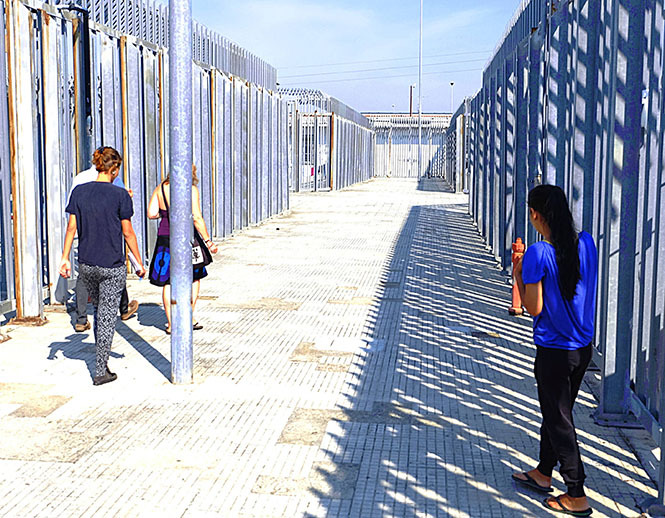
Former detainees call the Rome center “the cage” because bars are everywhere. (Giacomo Zandonini)
The women were hiding in the dorm, casting fearful glances at us. Little by little, I was able to reach out to some of them, and after some time I was sitting at a table surrounded by 10 young women. As soon as they understood they could speak freely, they didn’t stop.
Progress, as one of the Nigerian women was named, was the first to take the floor, acting as the spokeswoman for the whole group. She looked barely 18, but said she was 22. “We’re not prostitutes,” she said. “We’re here to work. Just give us something to do and we can prove it.” The others agreed loudly. “We’re not here for prostitution,” another said. “We don’t want to bring corruption to your country, but to find peace.”
I tried to explain to them that Italy must provide protection to victims of traffickers. They listened carefully when I told them that if they hadn’t paid anything to get to Libya—the typical departure point for migration to Europe—and then to Italy, thanks to some supposed “good Samaritan,” this is a sign that a criminal organization is behind their journey and might ask them to pay back a huge debt (anywhere from $60,000 to $100,000). They would be forced into prostitution in Italy or in other European countries until they did so. They nodded their heads and suddenly turned silent. It seemed that most of them didn’t even know they’d been trafficked.
After a while, Progress asked how long they were supposed to stay in the center. “You know,” she said, “We have been through so much desperation and here we feel so bad—we don’t have assistance, the place and the food are so terrible—it’s like the prison I was held in inside Libya.” (It is common for refugees and migrants to be detained during their journeys though Libya, rights groups say.)
Many of the women reported having nightmares and suffering from skin problems, intestinal disorders, and a general state of anxiety and depression. In their living areas, you could see the empty plastic glasses in which they’d been given drops of sedatives with water—sedatives are given to almost every person in the CIE for sleep, I was told. But beyond this medication, they aren’t receiving any psychological help or any kind of specialized medical assistance.
Since entering the CIE, they have not been able to make even one phone call to relatives or friends or to speak with the lawyers assigned to their case. The management did, in fact, provide them with phones, but not the SIM cards necessary to operate them.
Out of hell
When I asked if they wanted to tell me something more about their personal stories, the women formed a small queue. Ini, 25, was at the front. She spoke with a plain voice, barely looking at me, and clenching her fists. She’s from the oil-rich, southern Delta State of Nigeria. She talked about having fled Nigeria with her husband and brother five months previously. Everything went relatively well until they reached Libya. There, in the suburbs of Tripoli, she kept house in a one-room apartment they rented while the two men went out looking for small jobs. During one of these walks in the city, her brother was shot with a Kalashnikov and died a few hours later in the kind of random violence infecting Libya. Less than one month later, her husband was kidnapped by a criminal group. Ini had nowhere to go—that is, until one “gentle man,” as she put it, offered to pay for her trip to Italy.
“For two months now, I haven’t had any news from my husband,” she cried, “and I was so stressed that when I arrived here I lost the only thing that still connected me with him.” Ini showed me her belly. She was one of four women who were pregnant upon arrival. The other three were sent to a reception center run by a nonprofit after a few days, while she had a spontaneous abortion. After being hospitalized, she was taken` back to the CIE.
“It was 20 days ago, and I still lose blood every day,” she said. “But the doctor gives me only a syrup that doesn’t help.”
Progress spoke right after Ini. Her story seemed quite similar to others. It’s the typical story of an isolated and illiterate girl who falls prey to traffickers, sometimes without even knowing it, since friends, alleged fiancés, church members, or tribal leaders are the first to “sell” girls to criminals. Progress lost her parents when she was 11, and lived some time with a distant uncle who mistreated her. She eventually left and joined a community of homeless people, sleeping in barracks under a highway intersection. It was a violent environment where she was forced to commit petty crimes to survive.
“Living like that was like dying every day. That’s why I escaped,” she said. Patience, a small 19-year-old woman, echoes Progress’ words while barely holding back her tears. “I also left to find a good place to live, because I don’t have a family, but Libya is like hell,” she said of her time in Tripoli. “I’ve been raped by different men, one of them pointing a gun at my head. I had to stay in his house for weeks, treated like a slave.”
Mercy stands apart and calls me with a low voice. She’s older than the other women, in her 40s. “Look here,” she says as she opens her mouth and removes with her tongue a sort of homemade denture, revealing just a few natural teeth. “This is my story, the story of a fighter.”
She tells me about being a teacher in her home village in Nigeria. In 2002, she said, she married a prominent man from a different tribe and had a child. But after that she was unable to get pregnant again. Her husband started beating her heavily and, one day, decided to marry another woman. This resulted in a war between her tribe and that of the husband, which left both her parents dead. She continued to work as a teacher in order to support herself. But staying was too dangerous and she took the road to Niger, bringing all her savings with her. Libya came after that, but Mercy doesn’t want to talk about what happened there. “Just do something to take us out of here,” she implored in a broken voice. “We’re getting crazy.”
Mercy’s story seems convincing, but I can’t help but think that she could also be what trafficked Nigerians call a maman, a sort of “liaison officer” who accompanies and controls women in some phases of their trip and once they arrive in Europe—a motherly figure with a tyrannical power over the lives of her subordinates.
Trafficking in persons is intentionally bewildering, and its most preserved treasure is truth: Everything is done in order to conceal real names, real identities, roles, and aims of criminals and victims. That’s why the only way to fight it is to win the trust of victims.
Tortured and traumatized, yet still locked away
Two hours had already passed when the director of the center, Enzo Lattuca, finally came to find us.
As he walked us out of the center’s gates, he stressed that the case of the Nigerians is anomalous. “I’ve never seen such a large number of women brought here right after landing,” he said.
Gabriella Guido, the coordinator for LasciateCIEntrare, seemed exhausted. Since the creation of the campaign, in 2011, she has visited detention centers hundreds of times. “Trust me,” she said, “I’ve never seen something like this. These women are in a terrible psychological and physical condition and still they’re being held in the CIE.”
Like others, she stressed that they should have been released right after they landed, that they should have been brought to a reception center for refugees or victims of trafficking, where they could be helped with their trauma.
Guido said that two of the young women had called her inside their dorm and got almost naked, showing her signs of torture, burns, and scars around their genitals and on their bellies and arms. The journalist from RAI television interviewed another woman, who said she was 19. This woman, Prudence, talked about escaping Nigeria after the terrorist group Boko Haram attacked her village with a car bomb, killing her parents and 80 other people, and leaving hundreds injured. She still has signs of burns all over her body and she’s not able to sleep at night.
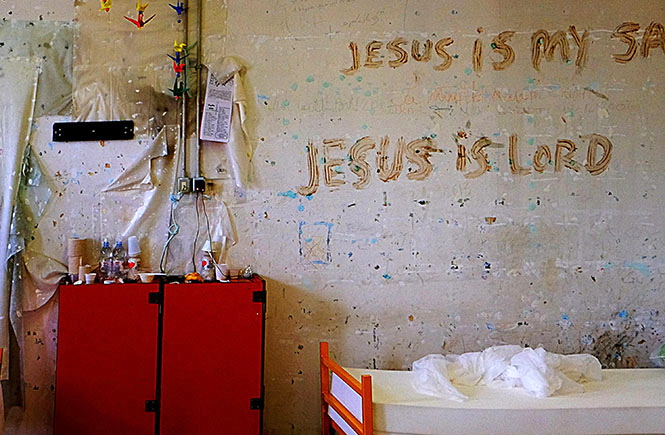
A dorm within the CIE, where the Nigerian women are waiting to hear their fates. (Giacomo Zandonini)
A few days after my visit, lawyers Enrica Rigo and Jacopo di Giovanni entered the CIE to assist the women for their second court hearing.
The issue was whether the women were to be kept in the center for a second month or not. The court decided that they should stay at least until the middle of September. The reason given was that they had to undergo personal interviews with the Asylum Commission, a governmental office that includes a representative from the United Nations High Commissioner for Refugees, inside the center. This led to the September 2 decision to deport 40 of them. The commission decided that the women were not in any danger upon returning home and hence had no reason to stay in Italy.
But the question remains: Why are any women who are clearly suffering signs of abuse and trauma being sent home? And before that, even, “Why are they here and not in an open reception center for asylum seekers?” Di Giovanni asked. (Those locked within a CIE can be held for a maximum of 90 days.)
Unfortunately, Nigerian women who are victims of traffickers often have their asylum applications rejected because they have a sort of obligation of secrecy, derived from pacts with traffickers that are often sealed with blood during violent voodoo rituals. Thus, they may find it extremely difficult to describe what they went through in detail and usually adopt vague stories about “family problems” instead of revealing their trafficking or that they’ve already been sexually exploited in their journeys through Niger and Libya. It’s probably what the traffickers themselves suggested they do.
Forever in the hands of traffickers?
While trying to put together different pieces of the puzzle of these Nigerian women, I called a nun named Sister Eugenia Bonetti. The nun, now in her late 70s, has received many prizes for her activity in support of trafficked Nigerian girls, including the “European citizen of the year” in 2013. Still, she visits the CIE in Rome whenever she can, and she runs a nonprofit called Slaves No More that offers hospitality to women victims of trafficking in central Italy.
“I am worried,” she told me. “I don’t think that applying for asylum is the best solution for [the Nigerian women] … If they receive protection, they will be released immediately [within Italy] and what will happen then?” This was exactly the opposite of what I, and others, were worried about. Without being given any social support by the state, she said, they will be in danger of being picked up yet again by human traffickers.
Sister Bonetti knows that most of the Nigerian women have been brought to Europe for sexual exploitation and that “criminal networks are so strong, that for sure they know exactly where these girls are. If they leave [the CIE] without any support, the next day you’ll find them on the streets.” And she also knows that a fast repatriation back to Nigeria would expose them to what experts call “re-trafficking”—they would again fall into the hands of traffickers, with the risk of suffering for a second time what they already went through: voodoo rituals, rape, beatings, kidnapping, hunger, and an infernal trip across the Sahara and the sea. This is where Italy appears to be in the corner of the traffickers rather than the victims. There is just no focus on protecting these women.
“We met most of the girls personally,” Bonetti told me, “and many signs confirm they’ve been trafficked, such as the fact that they didn’t pay for the trip.” Still, she concluded with sadness, “I don’t know what the right solution is.”
I then got back to Vincenzo Castelli. As soon as I told him what I had seen in Ponte Galeria, he said bluntly, “You see, this is a sign that we miss the main thing: the identification of trafficking victims.” He wondered how these women could end up in a center that would expel them back to Nigeria without being screened for having been tortured or forced into sex work.
For him, like for Sister Bonetti, the fact that a majority of them didn’t pay anything for the trip was an evident sign they’d been trafficked and needed special support.
But exactly what kind of support? According to Italian law, if somebody declares that they’ve been a victim of trafficking and provides substantial information to prove it, even without denouncing the traffickers, she or he should receive a permit to stay in Italy on humanitarian grounds and accommodation in a protected structure for up to 18 months.
Yet, Castelli said, there are just no resources anymore. “Public funds are ridiculous,” he said, lamenting the closure of long-term facilities for asylum-seekers. That, along with a reduction of funds for police investigations—confirmed by various lawyers and social workers—is the reason why, in the last five years, you can count legal proceedings against traffickers on the fingers of your hand.
Between the women’s obfuscation of their own stories and the mess that is the political situation for refugees in the EU, let alone Italy, there may now be little chance for them to find a peaceful home in Europe. As De Masi put it, “the norms against human trafficking in Italy are like an oasis in a desert: They are good, but the political and cultural contexts don’t allow them to work.”
Even more cynically, as one lawyer told me, the Italian government “seems to be supporting the traffickers more than the victims.”
Numbers of a tragedy
Statistics show that the problem of Nigerian women trafficked to Italy is exploding. According to a recent article from weekly magazine L’Espresso, in the first five months of 2015 the shores of Italy have been reached by 700 Nigerian women—nearly three times more than in the same period of 2014.
On August 21, Save the Children released a report in Italian called “Piccoli Schiavi Invisibili” (Small Invisible Slaves), revealing that hundreds of Nigerian girls who declare they are older than 18 are probably minors. Last spring, the NGO said, policemen stopped one of these girls in the streets of Apulia, in southeastern Italy. She told them she was 18, but it turned out she was 12. Save the Children explained that the girls are brainwashed by traffickers during the trip so they will know exactly what to say to Italian authorities. And there is likely a similar confusion of ages inside the Ponte Galeria, and with many of the 40 Nigerian women about to be deported.
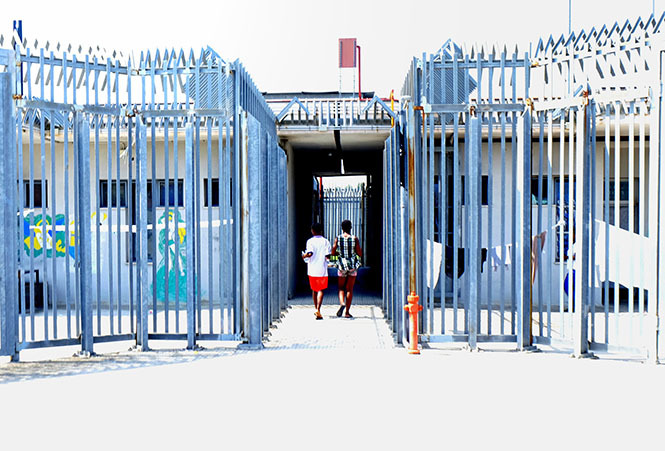
When the 40 women will be returned to Nigeria is unknown. And so is the fate of the 25 others still inside the center. (Giacomo Zandonini)
As of the end of August, Francesca De Masi and her colleagues had been working day and night to prepare individual reports for the Asylum Commission. They were working against a clock that had begun ticking frantically upon the arrival of the women on Italian shores.
The commission had for some reason asked for reports on only 12 of the women, De Masi said. In her mind, it “means that they recognize the problem of trafficking but that for sure the number is absolutely underestimated.” De Masi and her team tried to do in-depth interviews with all the women regardless in order to support their cases.
This seems to be a precise portrait of the fight for the lives of women who’ve been trafficked to Italy: a small group of willing people engaged in a race against time and against a system that barely recognizes the presence of victims. It is a system that sees them as part of the problem rather than as human beings who have been exploited. It is a system that—on top of every other indignity it inflicts—condemns them, most of the time, to remain trade commodities for ruthless criminal organizations.
For more about what women are enduring in the Mediterranean refugee crisis, click here.
More articles by Category: International, Violence against women
More articles by Tag: Trafficking, Sexualized violence, Rape


