















Carry that weight: A student protest highlights countrywide campus failure to find justice for rape
Emma Sulkowicz, a senior visual arts major at Columbia University, has been the frontwoman for the school’s mishandling of sexual assault on campus ever since she released her name to the press last spring. First in an anonymous interview in Columbia’s student-run magazine, The Blue and White, Sulkowicz revealed the intimate details of her case. But coming out to the press—specifically, The New York Times—meant not only revealing her identity but also speaking about the very intimate and graphic details of her case, those that keep most survivors of rape or sexual assault silent. Soon after, her alleged rapist’s name was released as well.
Now, after having her face publicized next to these details in some of the most read news sources in the United States, Sulkowicz is taking the publicity of what happened to another level. For her senior thesis, Sulkowicz, who says she was raped in her own dorm bed, is carrying a similar, standard-issue mattress around until her alleged rapist is expelled. She has titled the piece “Mattress Performance” or “Carry That Weight.” Since the start of her project on September 2, the second day of classes at Columbia, almost every major news source in the English-speaking world (New York Magazine, The Guardian, and Al-Jazeera, to name a few) has written about her.
“I’m not as nervous about carrying a mattress around as I am with the attention that it’s gotten,” Sulkowicz said in an interview posted on YouTube and Columbia’s online magazine The Spectator. “Last night, when I was shaking in bed and just thinking about how scary today was going to be, I was mostly thinking about how I’m not going to have anonymity anymore.”

Emma Sulkowicz is carrying around the bed she says she was raped on at Columbia University. She’s set the rule for herself that she’s not allowed to ask for help with carrying it but can take help if offered. (Andrew Burton/Getty Images)
And while wide press coverage has been instrumental in advertising her piece and its message internationally, a recent interaction with an overzealous reporter who tried to stuff his ID into her backpack left her triggered by memories of being raped.
With every article and every laden step she takes with that mattress, Sulkowicz makes one more move toward becoming the face and name behind a developing fight for justice for women on college campuses across the United States. It is a fight that is uncomfortable for many, and one that is just beginning—with all its complexity—for Sulkowicz.
The personal becomes political, and national
Sexual assault on campus has long created a lonely kind of anguish. Students face recovery and the potential for justice on their own or with a select group of friends. With her project, however, Sulkowicz is turning passive or skeptical observers into active participants—they are faced with the choice of whether or not to become part of the piece, and the dialogue on campus rape and how it is frequently mishandled.
“One of the rules of the piece is that I’m not allowed to ask for help when carrying the mattress, but others are allowed to give me help if they come up and offer it,” Sulkowicz said.
And it seems that many have been more than willing to get involved. A website has been set up by students organizing a schedule to ensure that Sulkowicz will rarely have to carry the mattress alone, and will often have an entire group carrying it for her. According to the site, the group’s goal is “to give… survivors of sexual assault in our community a powerful symbol of our support and solidarity, and to show the administration that we stand united in demanding better policies designed to end sexual violence and rape culture on campus.” The first “group carry” took place successfully on Wednesday, and a larger-scale protest will take place on the main campus plaza today. Attendees are encouraged to bring their own mattresses.
Sulkowicz’s performance piece is primarily an artistic and physical expression of the emotional burden caused by the assault, but it is also a public protest of Columbia’s mishandling of her particular case and the university’s refusal to expel her accused assailant—who has also been accused by two other women. She has joined 22 other Columbia students in filing a complaint with the federal government accusing the administration of being in violation of Title IX (a law requiring educational institutions to not discriminate on the basis of gender) by repeatedly failing to process sexual assault cases properly.
Sulkowicz told Bwog, Columbia’s student-run blog, under a pseudonym in January (she has since said that she was “Sara”) that the inadequacy with which Columbia handled her case was apparent in every step: Her alleged assailant was allowed to write his own legally advised statement, while Sulkowicz’s was jotted down by hand by an appointed Title IX investigator, who abbreviated or just didn’t make note of key facts. The “specially trained hearing panelists” appointed to Sulkowicz’s case were apparently uneducated about the basics of sexual assault, which in her case included anal rape. One repeatedly asked her how anal rape was physically possible without lubrication.
“Rape is the use of force,” Sulkowicz said. “You just shove it in and it hurts like hell and that’s why I was screaming. … I couldn’t believe it was my responsibility to educate them about that.”
After seven months and continued postponement of the case due to her accused assailant’s “academic conflicts,” he was found not guilty.
That the case went to campus trial at all is relatively unusual. According to numerous studies nationwide, one in four college women report surviving rape or attempted rape at some point in their lifetime, yet cases of sexual assault on campus go largely unreported and unprosecuted. In July, Sen. Claire McCaskill of Missouri released a survey of the sexual assault policies and procedures of 236 colleges across the nation; 41 percent hadn’t conducted any sexual assault investigations in the past five years, often boasting about the “safety” of their campus due to their record of zero sexual assaults. In addition to utter negligence, the survey exposed the incompetence of what resources did exist on college campuses. According to Time Magazine, “21% of the schools provided no training on sexual-assault response for members of faculty and staff, and 31% provided no training to students. ... 22% of institutions gave athletic departments oversight of cases involving athletes.” Sixty-four educational institutions are currently under investigation by the U.S. Department of Education for violations of Title IX.
There are examples of incompetence on the part of campus administrations in regard to sexual assault throughout the country. There was a much-reported case of a young woman named Anna who was gang-raped on two occasions by three football players in her first week at Hobart William Smith College in upstate New York in the fall of 2013. Upon filing a complaint, the college publicly released her name, causing threats and harassment from the student body. During the hearing, which took place before the trauma-indicating results of her rape kit were known, more “specially trained panelists” questioned her accusingly about her consumption of alcohol and “suggestive dancing” the night of her assault, interrupting her repeatedly and misrepresenting witness statements.
“I felt like I was talking to someone who knew nothing of any sort of social interaction; what happens at parties; what happens in sex,” Anna told The New York Times. Although the U.S. Department of Education says that sexual assault investigations should take around 60 days, the panelists cleared the three football players in under a week.
Massachusetts’ Amherst College is another school at which administrators have notably mishandled sexual assault cases. The school is currently under federal investigation due to repeated firsthand accounts of victims being dissuaded from reporting the rape by the administration and then when reported, not filing the report, not concluding the hearing process, and even admitting a survivor of assault to a psychiatric ward against her will instead of investigating the perpetrator.
Choosing to deal with crime in-house
So why report sexual assault to a college campus instead of the police, as so many students choose to do? A common answer is a hope for privacy and protection. As Sulkowicz said in the first article about her case: “I heard so many horrible stories about how the police handle cases like these. Columbia also advertises its resources so much that I thought they would really listen to me. I thought I would be taken care of.”
Another common reason is the hope of expulsion of the accused, rather than arrest. According to the U.S. Department of Justice, the vast majority of sexual assaults on college campuses (and in general) are committed by an acquaintance of the survivor, with many women not wanting to “ruin the lives” of someone they used to consider a friend. For many, this is reason enough not to report it at all.
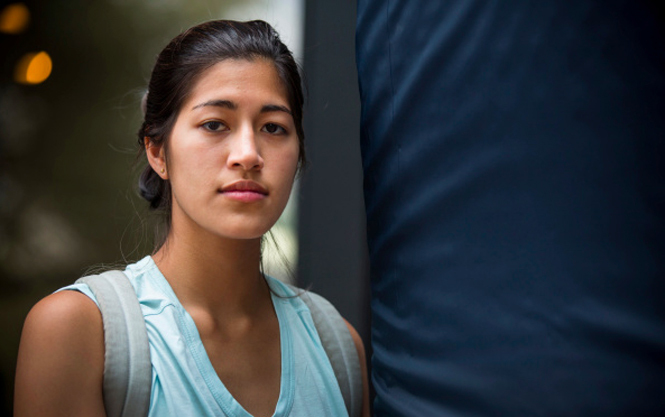
With every step she takes with the mattress, Sulkowicz makes one more move toward becoming the face and name behind a developing fight for justice for women on college campuses across the United States. (Andrew Burton/Getty Images)
Frances*, who graduated from Skidmore College in May, chose not to report her assault at the time, but later wrote an open letter to the school about the sexual assault she had experienced her freshman year, writing that she did this because “having to relive the experience by recounting it to a bunch of college employees just seemed like it would exacerbate the trauma and privacy-breaching nature of the original assault—a huge price to pay for the mere possibility of justice.” In her letter, Frances writes about the gross mishandling of sexual assault cases at many college campuses including Skidmore, yet in the aftermath of her unreported case she suffered most in the social isolation caused by her peers.
“You’re suffering a lot but it’s invisible, so your friends tend to downplay your suffering or flat out not believe it,” Frances said. “Especially if they themselves were friends with the assailant.”
Marley Smit, who graduated from Hampshire College in May, remained silent for similar reasons. “I didn’t say anything for fear of backlash from my friends who liked the person who had assaulted me and would no doubt come to his defense,” she told me in a recent interview. Smit also said she felt her attack was perhaps less serious than what happens to other women. What happened to her wasn’t the violent, anonymous crime commonly associated with the term rape, but coercion by someone she knew intimately.
“For a long time, I didn’t want to say that what happened to me was sexual assault because I didn’t want to minimize the impact of ‘real’ assault and rape victims,” Smit said. “I now realize [campus communities] should be broadening the definition of rape and assault—not minimizing it to only the most extreme cases.”
Mandatory reporting infuriates faculty
In May, I graduated from Columbia. On September 6, as an alumna, I received a personally addressed email from James J. Valentini, dean of Columbia College and vice-president for undergraduate education, regarding the recent media attention to “gender-based misconduct at colleges and universities … some of which has been focused on Columbia.”
The purpose of the email was to ensure that alumni and prospective donors would be “able to place this news in the greater context of our efforts on campus in recent months to improve our students’ experience and ensure their safety and well-being.” Valentini listed the changes being made in the methods with which Columbia deals with and prevents sexual assault and gender-based misconduct, including a new Gender-Based Misconduct Policy for Students, the opening of a second “more accessible” Sexual Violence Response Support Center, and changes in the orientation program to educate first-year students about sexual assault and consent.
These changes were the result of the international media attention drawn to Sulkowicz’s case, as well as the Obama administration’s 2011 letter to college campuses outlining the necessary ways they should be “cracking down” on sexual assault. But even before this became a larger national issue, there had been on-campus controversy about the sexual assault policy. In 2012, Columbia made it mandatory for faculty to report cases of sexual assault to the administration once confided in by a student. There was an uproar of disapproval from students and faculty alike. The central argument was that instead of increasing safety on campus, this policy dissuaded students from taking any action at all. Faculty committees were formed to discuss this policy and others. These committees took on a larger and more urgent form after the media outcry in the spring of 2014, resulting this summer in the new misconduct policy. Regardless, the mandatory reporting requirement for faculty remains in place.
Columbia’s shift in how it deals with sexual assault cases continues to meet friction from students and faculty. Most of the changes in policy were created without any involvement from the student body. Most notably, the appeal process remains under the purview of the dean of the accused’s school, “despite concerns from students about the deans’ training and the potential for conflicts of interest.” In a statement released by a coalition of student activist groups soon after the emergence of the new policy, the students expressed the feeling that they have been “stonewalled, misled, and deliberately excluded from the revision process.”
In addition to ongoing discord on the policy front, all is not well for the women who are fighting back against the system. Despite massive media attention, multiple protests, numerous Town Hall meetings since January, and three separate sexual-assault hearings and appeals on Sulkowicz’s case, her accused assailant, who after three charges of assault qualifies as a possible serial offender, remains on campus.
EDITOR'S NOTE: The story originally said that Sulkowicz was carrying her own mattress. It is actually a similar mattress provided by Columbia, not the one on which she says she was raped.
EDITOR'S NOTE: In paragraph 19, the last name of the student who graduated from Skidmore College has been redacted at her request.
More articles by Category: Education, Violence against women
More articles by Tag: Campus rape, College, Sexualized violence, Americas


