
















WMC Women Under Siege
Beneath the law: When the system inherently favors the rapist
Back in April, I wrote for WMC’s Women Under Siege about the legal gender imbalance female victims of sexualized violence face around the world. But a disturbing recent investigation by the independent Indian weekly newsmagazine Tehelka suggests that the miscarriage of justice in some cases of rape and sexual assault might be linked to prejudice on the part of those delivering justice, rather than bias within the law itself.

WMC Women Under Siege
It’s not what women wear, it’s how we treat them: Revisiting the hijab
In September, I wrote a piece for WMC’s Women Under Siege about the hijab, or headscarf, and sexual assault against women in conservative Muslim societies. I chronicled the experiences of my sister Neelo, who experienced sharp harassment as a young girl while wearing a hijab in Pakistan. The premise of the piece was simple enough.
WMC Women Under Siege
Rape in war: Are we getting it wrong?
Good news! We were wrong! Women are not being raped in terrible numbers around the world in conflict! I wish I could really say that. All day I’ve been hearing how a new report out today “upends” conventional wisdom on sexualized violence in war—that we’ve all got it wrong, that the media is misleading the world into thinking all conflicts are laden with rape, that statistics have been badly skewed in ways that make the problem seem worse than it is.

WMC Women Under Siege
No more moments of silence: How do we get from 'Take Back the Night' to 'Taking Down Rape Culture'?
On October 4, I gave the keynote address at St. John’s University in Queens, New York, for “Take Back the Night,” an international yearly march that began in the 1970s to protest violence against women. This is a version of that address.
WMC Women Under Siege
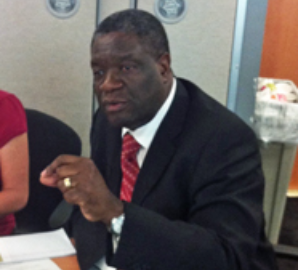
From the ground zero of rape in conflict: An interview with Dr. Denis Mukwege
I’ve found that there are few men who want to sit in a room and talk about how to stop rape. Few show up at panel discussions, few show up in virtual social media spaces to reflect or express outrage. Rape is a woman’s problem, they tell us implicitly.
WMC Women Under Siege
'We do not need any more proof': Leaders tell UN it's time to act on rape in war
In a fluorescent-lit United Nations room full of suited bureaucrats, Nobel Prize Laureate Leymah Gbowee raised a startling point. It had been a morning of declarations condemning sexualized violence in conflict and considerations of how we can better proceed to stop it when Gbowee said: “If I asked everyone in this room to explain to us about their last sexual encounter, they would be turning pink.”
WMC Women Under Siege
‘Too late for me’: Women flee Colombia to escape sexualized violence
A young woman about my age sits across from me at a table in a large house converted into an Ecuadoran church. With tears pouring down her cheeks, she chokes out the words of her story, wiping drops away with the back of her hand. I say I’m sorry for bringing up her pain.
WMC Women Under Siege
Will NATO leave Afghan women at risk?
After a decade in Afghanistan, NATO member states are preparing to remove their troops. The organization and the International Security Assistance Forces (ISAF) it leads have shifted from combat to preparing local forces for transition. Yet for the country to thrive post-war, ISAF will have to place special emphasis on gender issues.
WMC Women Under Siege
Why everyday gender inequality could lead to our next war
What if I suggested that reducing the rates of rape and sexism in the U.S. would reduce our risk of international conflict? You might think that American girls and women who regularly adapt their lives to deal with “harmless” street harassment, or who are assaulted by American men, have little to do with, say, the Iraq War. Yet research shows an undeniable relationship between the treatment of women in everyday life and a nation’s propensity for engaging in war.

WMC Women Under Siege
A forgotten battleground: Women’s bodies and the civil rights movement
Every few years, my consistently intrepid mother would experience terrifying nightmares. When I was 7, I asked her to tell me what monster was frightening her so much that she stirred and let out petrifying screams in her sleep.
WMC Women Under Siege
What’s in a name? The rhetoric of rape
Campaigners in Egypt have recently drawn attention to the increasingly widespread sexual harassment, assault, and rape suffered by women in public spaces. The severity of the situation there well documented and longstanding, with women suffering “violations of their human rights” in the form of intrusive virginity tests, “assault and torture,” and even “being dragged naked on the ground,” according to a 2011 press release from the Egyptian Center for Women's Rights.
WMC Women Under Siege
The myth of how the hijab protects women against sexual assault
I was only 6 years old when my family was forced to flee the civil war in Afghanistan for Pakistan in the late 1980s. My sister, Neelo, who is five years older than me, was enrolled in a Saudi-funded Muslim Brotherhood-inspired public school for Afghan refugees. She, like many Muslim women, wore a simple headscarf.

WMC Women Under Siege
Forced sterilization: Big media stories versus the big picture
Sweden. California. Peru. All three make lovely vacation spots, sure, but they share something more sinister, too: a state-sponsored violence so furtive, even victims don’t always know it’s taking place. Add to that list Norway, Finland, Kenya, Venezuela, and 31 more U.S. states, and you begin to see the scope of forced sterilization.
WMC Women Under Siege
A crime upon a crime: Rape, victim-blaming, and stigma
In Sudan, where tens of thousands of people have been displaced from their homes by fighting and destruction, where the lives of refugees have already been devastated by the loss of their homes and families, women bear a second, enduring pain. Because for many Darfuri women, the “crime” of falling victim to rapists and sexual attackers renders them valueless, “dishonored,” and rejected.

WMC Women Under Siege
Video: WMC's Women Under Siege director tells CNN of the horrors we've documented in Syria
As the media continues to learn about reports of sexualized violence in Syria, CNN's Brooke Baldwin talks to WMC's Women Under Siege Director Lauren Wolfe about what we've documented so far.
More In WMC Women Under Siege
Archive
- 2026
- 2025
- 2024
- 2023
- 2022
- 2021
- 2020
- 2019
- 2018
- 2017
- 2016
- 2015
- 2014
- 2013
- 2012