















A Network of Midwives Are Helping Pregnant Migrants across Mexico
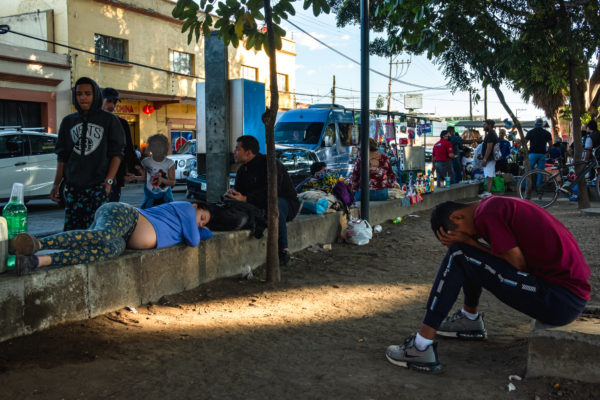
Oaxaca, Mexico – On a basketball court along the Atoyac River in Oaxaca City, several tents are erected as makeshift shelter for migrants passing through Mexico on their way to the US border. Most hail from Venezuela, Honduras, Haiti, and Cuba, according to data from the UN Refugee Agency. All are escaping harsh economic conditions and insecurity in their home countries.
Latisha Serrano, a Texan midwife who lives in the city, approaches a young woman in a pink t-shirt and beige sweater and asks her how she feels. The woman, Angelica (whose surname is withheld for privacy concerns), is pregnant.
Angelica, who said she is 18, left Venezuela six years ago with her mother and two brothers, fleeing dual economic and humanitarian crises that have left roughly 19 million people lacking access to basic services, health care, and proper nutrition. Her family is among the more than 7.7 million people who have left the country since its economic collapse in 2014.
They first crossed into neighboring Colombia, where they spent several years before Angelica’s mother continued onward to the US, crossing the US-Mexico border in March of this year. Angelica and her boyfriend Maicol, who is Colombian, followed suit shortly thereafter.
“We wanted a better life,” Angelica said. “I felt good in Colombia, but it was not enough.” Together, the young couple crossed the Darién Gap, a roadless crossing that connects Panama and Colombia, Central and South America, and one of the most dangerous migration routes in the world. From Panama, they continued through Costa Rica, Honduras, Guatemala, and Mexico, but once they reached the border, they were turned back.
Then, Angelica became pregnant.
Serrano has been volunteering as a midwife for pregnant migrants like Angelica since 2023, attending to the places where they gather–like the encampment–twice a week. When she sees a pregnant woman among them, she approaches and introduces herself. The tag hanging around her neck reads, “Parteras apoyando migrantes” (“Midwives helping migrants”).
Pregnant migrants lack prenatal care and attend appointments later in their pregnancies than women who are not on the move, according to a case study by Espacio Migrante, an organization based in Tijuana that helps migrants access their human rights, education, health care.
Serrano performs a vital service by offering prenatal check-ups, either right in the park or in her car, jotting down her evaluation notes on the backside of a printed map with the contacts of other midwives and doctors across Mexico—a network of 47 professionals whom the women can contact along their journey north. “The last thing these people want as they walk is to carry more stuff,” she said.
Midwives in the network will also accompany women to a doctor’s office if they show any alarming symptoms, such as bleeding or high blood pressure. “In such cases, we pay for the appointments,” Serrano said.
The midwives network plays an important intermediary role between these women and the health care system as well, as they often experience discrimination. “They face several difficulties due to their nationality, immigration status, language and skin color,” said the Espacio Migrante study.
“We had an experience in a laboratory,” said Mirel Yolotzin, a midwife who recently joined the network in Mexico City. “They did not want to attend the woman we [had] accompanied there, without giving a reason.” Denial of medical care was cited in the study as one of the many challenges pregnant migrants faced when encountering Mexico’s health care system, making their journeys all the more precarious.
For Angelica, her budding family also struggles to access clean drinking water and food most of the time.
“We buy drinking water when we have money,” she said. Otherwise, they take it from a nearby well. “[And] we eat when we have money.”
Angelica, Maicol, and their unborn child are subsisting on the money that Angelica’s mother sends them from the US. Maicol picks up odd jobs when he can, but as a migrant, even temporary work is hard to come by. After all, they’re not here to stay.
The women Serrano sees often arrive malnourished. Many have anemia, and some suffer from infections. “We give them vitamins and a water filter,” she said. “They cannot take vitamins if they do not have access to water.”
These new mothers’ health is endangered in other ways along the migration route.
According to the Population Council, an international nonprofit research organization, between 60 to 70 percent of all female migrants crossing Mexico experience violence or sexual abuse along the way. Consequently, unwanted pregnancies are very common.
“Many of the pregnant migrants have experienced sexual violence,” Yolotzin corroborated, adding that threats of abuse come from many sources: their partners or accompanying men, neighbors, and even the police. Some women are forced into sex in exchange for passage along their journey—including by their companions, who use them as “currency” at crossings, Yolotzin said.
“At night, they cannot protect their spaces, and whoever wants to get close, gets close.”
Soon, the network will begin offering injectable contraception, which Serrano said protects the women for three months.
The network is also trying to address the emotional toll of the migration experience for these women—as much as they can within their capacity. “When we ask them how are you feeling, they cry. We had women say no one has hugged me since I started this journey,” said Serrano. “We wanted to create a safe space, and sometimes, a person is the safe space.”
The network is still growing, but its members hope to formalize their work and, perhaps someday soon, open a physical clinic in Oaxaca to serve more women like Angelica.
Still, she said, “I constantly feel we can do more.”
One week after attending to Angelica, Serrano said that local police and immigration authorities forced the encampment to close. As often happens with those she’s served, Serrano said she has not heard from Angelica since.
More articles by Category: Gender-based violence, Health, Immigration, International, Violence against women
More articles by Tag: Mexico, Migration, Reproductive health, Reproductive rights, Latin America


