















The Powerful Impact of Sinéad O’Connor
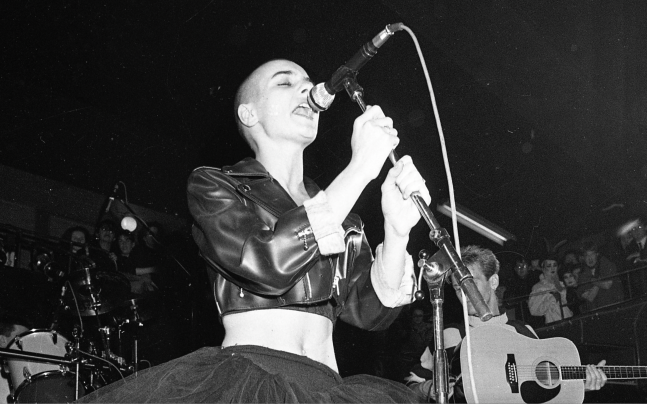
Director Kathryn Ferguson’s father became a huge fan of singer Sinéad O’Connor with her first album, 1987’s The Lion and the Cobra. He played it pretty much on repeat, she says, making it a visceral soundtrack to her growing up in Belfast in the late ’80s and ’90s.
When O’Connor’s second album, I Do Not Want What I Haven’t Got, came out three years later, Ferguson says she and her friends became devotees of the singer as well, admiring O’Connor’s music as well as how she spoke out about abortion rights, women’s equality, racism, and child abuse. But soon after they became fans, a fierce backlash arose against O’Connor.
“It was very demoralizing to see this icon of ours from our own island and this woman being treated the way she was,” Ferguson said. “And I think the seeds of the film were sown then because it made such a dent on me.”
Ferguson is referring to what happened after O’Connor’s notorious appearance on Saturday Night Live in 1992. She sang Bob Marley’s “War” a cappella, ripped up a photo of Pope John Paul II, blew out candles next to her on stage, and said, “Fight the real enemy.” The extent of the Catholic church’s role in child sexual abuse was just coming to light globally, and the backlash to O’Connor was severe: She was attacked in the media and by other celebrities, including Joe Pesci and Frank Sinatra, banned from venues, and subjected to boycotts.
Ferguson ‘s documentary Nothing Compares tells the story of what led O’Connor to this point and the aftermath. It premiered at Sundance in January, and is now in theaters in Ireland and on Showtime in the U.S. The film is a powerful reassessment of O’Connor’s experiences during this period, the courage it took for to speak out, and the impact of the attacks on her.
The movie starts with O’Connor about to perform at a concert for Bob Dylan at Madison Square Garden just a couple weeks after her appearance on SNL. Kris Kristofferson introduces her, saying her name is “synonymous with courage and integrity,” and she walks on stage. The crowd responds with an odd sound — a mix of boos and scattered applause.
The director says she finds the YouTube footage potent even after watching it many times over the years.
“She walks out smiling and she’s delighted with herself to be at her musical god’s party, but she was faced with this terrifically hostile crowd,” Ferguson said. “I just think you can just see so much cross her face, and what she's going through in that moment just felt so key . . . because you just see how everything coalesces in that moment.” O’Connor scrapped the song she was planning to sing and again sang “War.”
Ferguson didn’t want to make a regular biopic. Her film focuses on the period of 1987 to 1993, following O’Connor’s rise with her first two hit albums and then the crushing backlash. One way the movie differs from conventional documentaries is that rather than seeing people talking about O’Connor, we hear them.
She’s never cared for talking heads, Ferguson says, and the interview she and her team did with O’Connor in 2019 reinforced the decision to use audio.
“For a woman who has had her voice so reduced and diminished for 30 years, if the one thing people can take away from our film is what she has to say, that is surely exactly what we should be aiming for,” Ferguson said. “Also what we really didn't want to do was create contemporary footage that will be dragging you in and out of the era.”
In 2011, Ferguson’s made an experimental short film, “Mathair,” (Irish for “Mother”), about women’s experiences in Ireland and Catholicism and asked the singer if she would do the soundtrack. A couple years later, O’Connor’s team asked Ferguson to direct the singer’s first video in more than 10 years, “4th and Vine,” leading to Ferguson meeting her idol.
People interviewed in the documentary include O’Connor’s first husband, drummer John Reynolds, and O’Connor’s agent, manager, and friends as well as musical luminaries like Kathleen Hanna of Bikini Kill, who says that when O’Connor ripped up the photo of the pope, she and her friends thought it was “feminist performance art.” Chuck D of Public Enemy talks about O’Connor’s appearance at the 1989 Grammys, when she wore her son’s onesie tucked into her belt and had the Public Enemy logo on her head (the group boycotted the Grammys because the awards didn’t recognize hip hop).
“I love how she's using her body in this way to speak out about the things she cares about,” Ferguson said. “The fact that she chose to wear both those things in that performance I think is very powerful.”
The film uses snippets from interviews from the time, showing the questioners often condescended to O’Connor, repeatedly asking her about her shaved head. One interviewer asks about a movie O’Connor appeared in, 1990’s Hush-A-Bye Baby, about a 15-year-old high school girl who gets pregnant, saying it was like O’Connor’s situation, having had a baby young. O’Connor coolly responds that it’s not similar at all — she was 20, not 15, and she was living with her boyfriend, wanted the baby, and had money to pay a nanny.
The director of that movie, Margo Harkin, told Women’s Media Center she made it in response to several things going on in Ireland in the time that highlighted the desperation felt by women facing unwanted pregnancies — a referendum outlawing abortion which passed in 1983, the “Kerry Babies” scandal, in which a 25-year old woman was falsely accused of murder after a baby was found on the beach having been stabbed more than 20 times, and a 15-year-old who gave birth outside in the winter and died along with her baby.
Harkin asked O’Connor to do the music for the movie, and the singer requested a role in it. Harkin didn’t think there was one for her, but when an actor dropped out right before shooting due to her school exams, O’Connor joined the cast.
Harkin said she liked the way the director told the story of that time in O’Connor’s life in Nothing Compares and the decision not to use talking heads. Harkin thinks many people who were shocked by O’Connor at the time have changed their minds.
“She was right about the church. And she's just very bloody brave,” Harkin said. “She has these core beliefs because of her own experiences, and she definitely was ahead of her time and is ahead of her time. It's just such a pity she suffered so much in that process.”
When the documentary opened in Ireland at the Galway Film Fleadh, to a packed house of people of all ages, Ferguson says her heart was in her throat.
“It was quite tense, up until the moment where Sinéad rips up the picture of the Pope on Saturday Night Live. When that happened, the entire theater stood up and started cheering, and it was extremely powerful, and very, very moving,” Ferguson said. “Just to see that this is the Ireland that we're now in, where we've come after there's so much transgenerational trauma and so much that people are having to contend with in the aftermath of what's happened in this country. And I think it was hugely cathartic, that screening.”
More articles by Category: Arts and culture, Media
More articles by Tag: Music, Women's history


