















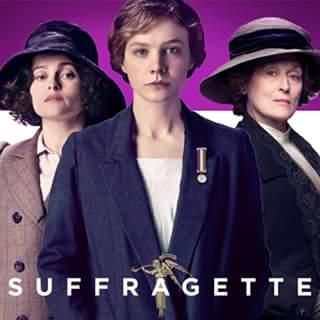
"Suffragette," with Carey Mulligan and Meryl Streep: A band of sisters coming to a theater near you
Frances Perkins emphasized in her oral history the importance of “something that probably is not written in the books.” Perkins, who went from marching for woman suffrage and advocating for safer working conditions after the Triangle Shirtwaist Factory fire in 1911 to her appointment as U.S. Secretary of Labor in 1933 (the first woman in the U.S. Cabinet), wrote:
“The women learned to like each other in that suffrage movement. They were comrades in the common cause. They played fair with each other, supported each other. It was like people in the underground—they had to trust each other.”
“Suffrage” is a dicey word, hinting (wrongly) of suffering, evoking, to many people, lavender and lace and old white Christian ladies. Truth is, historically, suffrage movements—women organizing to change the status quo and be treated as full citizens by wresting the right to vote from resisting governments—are a storyteller’s dream. Right at our fingertips, in the United States and Britain, spanning several generations, set in many geographies, featuring females of all political persuasions, ages, races, and ethnicities, and in a fascinating variety of relationships to one another, are true tales that would have kept Scheherazade talking into infinity.
Since Perkins’s time, much has been “written in the books,” but little of the suffrage epic has made its way into popular entertainment. Director Ken Burns’s 1999 documentary about Elizabeth Cady Stanton and Susan B. Anthony aired on public television. Iron Jawed Angels, still a favorite on college campuses, was a 2004 HBO movie featuring Hilary Swank as Alice Paul, showing fearless women picketing Woodrow Wilson’s White House and being arrested. Because drama traditionally focuses on a single protagonist, neither is especially lush with the feeling of “comrades in the common cause.”
Now comes Suffragette, from Britain, in U.S. theaters next week—boldly conceived and full of promise. Boldness starts with the belief that women plus politics plus cinema is an enterprise worth undertaking, something audiences will want to see. We can only imagine the pitch meetings in which screenwriter Abi Morgan and director Sarah Gavron convinced the money men to support the project, which is rumored to have taken a decade to bring to the screen.
The historical story onscreen is as far from lavender and lace as you can get. In 1912 London, the main character gets caught up in the sector of the suffrage movement led by Emmeline Pankhurst. These members of the Women’s Social and Political Union, branded “suffragettes” as a term of derision by the press, are in the streets hurling bricks at shop windows, and will soon escalate their “militant” tactics, provoking a harrowing amount of state-sponsored violence. Hopefully, none of the shocking—and true—brutality of street beatings, arrests, and forced feeding in jail will be sugar-coated in the film.
Even more boldly, the filmmakers have placed a laundry worker, a working-class woman, at the center of the story. This, too, is historically true. When New York State celebrates the Centennial of Woman Suffrage in 2017, it will be imperative to remember the thousands of workers, including laundresses, who joined the suffrage movement in the 20th century because it offered the power to change their dangerous and exploitative working conditions. “Equal pay for equal work” was a suffrage slogan as early as 1909.
In Suffragette, the worker does not step forward as a leader, as she did in Norma Rae or Erin Brockovitch, but as one of those hundreds of thousands on both sides of the Atlantic who made up the troops of the movement, whose names and individual trajectories nobody except those close to them ever knew. This dramatic choice by the filmmakers runs counter to the tropes of popular entertainment, where the best female fighters for justice are cartoon characters like Wonder Woman. Our crusaders are loners, as befits a culture in love with the Lone Ranger, although we well know that accomplishing social change requires what a friend of mine calls “a gang.” Even the Lone Ranger, remember, was not alone, but Tonto was ”just” an Indian, so he didn’t count.
The promise of Suffragette is that we might see, through the eyes of a laundress, a glimpse of the mass movement that not only brought women’s right to vote, and all the other political changes contingent on that right, but, in personal and emotional terms, elicited female courage and cowardice, love and betrayal, class conflicts and race conflicts, political fringes and political centers, and the ability to endure setbacks, defeat, and the hope of victory. That’s real history.
A band of sisters is coming to a theater near you. Though it tells one story, it will surely be criticized for not telling all stories. That is what scarcity breeds. Many, including women of color from across the British empire, disagreed with the WSPU’s “militant” tactics and chose different forms of activism. Through its long history, the suffrage fight twisted and turned around racism, anti-Semitism, and class conflict. Those are other stories. Let’s hope this film does what Variety calls “boffo box office” and opens doors to the tales still waiting to be told.


