















Songs of Truth, Inspiration, and Rebellion: Black Women’s Speeches From the Civil War to the Twenty-First Century
In their October 7, 2020, debate, when then senator and vice presidential candidate Kamala Harris emphatically said to Mike Pence, “Mr. Vice President, I’m speaking,” her statement was more than a reaction to his chauvinism and mansplaining. What she said resonated with women who have been cut off, but especially with African American women, who had experienced it all before — and have been fighting to be heard since their enslavement in this country.
Even as Black women negotiated or forced our way into the public square, our words were often distorted and taken out of context, trivialized, ignored, or weaponized against us. Because we have not owned the means of mass communication — printing presses to the internet — Black women often talk into the wind. But somehow, some remarkable women have had their say. The vortex of the current book ban frenzy seeks to silence Black women, from Toni Morrison to the young poet Amanda Gorman. Our songs may come from weary throats — to echo Pauli Murray’s memoir — but Black women continue to sing songs of truth, inspiration, and rebellion.
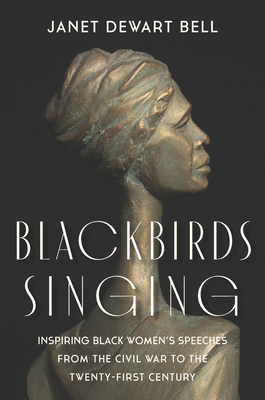
My new book, Blackbirds Singing: Inspiring Black Women’s Speeches From the Civil War to the Twenty-First Century (The New Press), contains speeches and quotations from African American women in the context of the struggle for freedom and justice. Because Black women were prohibited and then inhibited from being involved in the political system, the book expands the definition of speeches to some writings that women did not have the opportunity to present in a public forum. The lives of all of these courageous women are worthy of volumes to capture the fullness of their lived experiences. It is my hope that their words in this collection inspire readers to learn more and to embrace the full meaning of their struggles, leadership, and contributions to this country and the dream of democracy. And, yes, the title of my book was inspired by Paul McCartney’s song Blackbird, a tribute to the American Civil Rights Movement, specifically the Little Rock Nine.
The cover art on Blackbirds Singing features a sculpture of Sojourner Truth, the signature voice for the genesis of this book. She lived from 1797 to 1883 and witnessed America’s growth and turmoil — slavery, the Civil War, emancipation, and the beginning of the fight for women’s suffrage. She changed her name from Isabella Bomfree to Sojourner Truth and became an itinerant wanderer who spoke truth to power. On May 9, 1867, she addressed the first annual meeting of the Equal Rights Association beginning with these words:
My friends, I am rejoiced that you are glad, but I don't know how you will feel when I get through. I come from another field — the country of the slave. They have got their liberty — so much good luck to have slavery partly destroyed; not entirely. I want it root and branch destroyed. Then we will all be free indeed. I feel that if I have to answer for the deeds done in my body just as much as a man, I have a right to have just as much as a man….
So I am for keeping the thing going while things are stirring; because if we wait till it is still, it will take a great while to get it going again.
Because the lives of Sojourner Truth and Harriet Tubman (1822-1913) overlapped, people often confuse them or conflate their stores, but their contributions were distinct, as are the stories of the other women of Blackbirds. Harriet Tubman, an escaped slave known as “Moses,” was a chief conductor of the Underground Railroad. A scout, spy, guerrilla solder, and nurse for the Union Army, she is considered the first African American woman to serve in the military. Tubman worked mostly without pay or pension. When she was in danger of losing her home in 1886, historian Sarah Hopkins Bradford wrote Harriet, The Moses of Her People in a successful effort to raise funds to save it. The following is a direct quote from the book:
“For,” said she, “I had reasoned dis out in my mind; there was one of two things I had a right to, liberty, or death; if I could not have one, I would have de oder; for no man should take me alive; I should fight for my liberty as long as my strength lasted, and when de time came for me to go, de Lord would let dem take me.”
And so without money, and without friends, she started on through unknown regions; walking by night, hiding by day, but always conscious of an invisible pillar of cloud by day, and of fire by night, under the guidance of which she journeyed or rested. Without knowing whom to trust, or how near the pursuers might be, she carefully felt her way, and by her native cunning, or by God given wisdom, she managed to apply to the right people for food, and sometimes for shelter; through often her bed was only the cold ground, and her watcher the stars of night.
There are other women in Blackbirds Singing not so well known, such as Mary Ann Shadd Cary (1823-1893), the first Black woman to edit a weekly newspaper, the Provincial Freeman, devoted to displaced Americans living in Canada. In 1858, she said:
But we are or may be told that slavery is only an Evil not a sin, and that too by those who say it was allowed among the Jews and therefore ought to be Endured. Isaiah sets that matter to rest he shows that it is a sin handling it less delicately than many prophets in this generation. These are the sins that we are to spare not the sin of Enslaving men — of keeping back the hire of the laborer. You are to loose the bands of wickedness, to undo the heavy burdens to break Every yoke and to let the oppressed go free.”
A more famous speech is that of Congresswoman Barbara Jordan, who on July 25, 1974, stated the following in her opening statement to the House Judiciary Committee proceedings on the impeachment of Richard Nixon:
Earlier today we heard the beginning of the Preamble to the Constitution of the United States, “We, the people.” It is a very eloquent beginning. But when that document was completed, on the seventeenth of September in 1787, I was not included in that “We, the people.” I felt somehow for many years that George Washington and Alexander Hamilton just left me out by mistake. But through the process of amendment, interpretation, and court decision I have finally been included in “We, the people.”
Today I am an inquisitor. I believe hyperbole would not be fictional and would not overstate the solemnness that I feel right now. My faith in the Constitution is whole, it is complete, it is total. I am not going to sit here and be an idle spectator to the diminution, the subversion, the destruction of the Constitution.
Maya Angelou (1928-2014) not only knew “why the caged bird sings,” she set free the aspirations of countless people not only in the arts, but in social justice, working with Rev. Dr. Martin Luther King at the Southern Christian Leadership Conference and with Malcolm X. She delivered the poem On the Pulse of Morning at the 1993 inauguration of President Bill Clinton and was awarded the Presidential Medal of Freedom by Barack Obama in 2010. Her poem was an anthem of hope, ending with these words:
For a new beginning.
Do not be wedded forever
To fear, yoked eternally
To brutishness….
Here, on the pulse of this new day
You may have the grace to look up and out
And into your sister’s eyes, and into
Your brother’s face, your country
And say simply
Very simply
With hope —
Good morning.
Maya Angelou’s words epitomize the themes throughout Blackbirds Singing: speaking truth to power, along with calls for decency, compassion, peace, justice, freedom — and love.
More articles by Category: Free Speech
More articles by Tag: Black, African American, Women's history, Women's leadership


