















On Trans Rights, the Pipeline From Media Misinformation to Bad Law
For anyone with a sense of human decency or who believes in the values of freedom, including dignity, self-determination, and care, it may be quite easy to brush off anti-trans articles in major mainstream media outlets like The New York Times and The Atlantic as idiotic, cruel, and factually inaccurate.
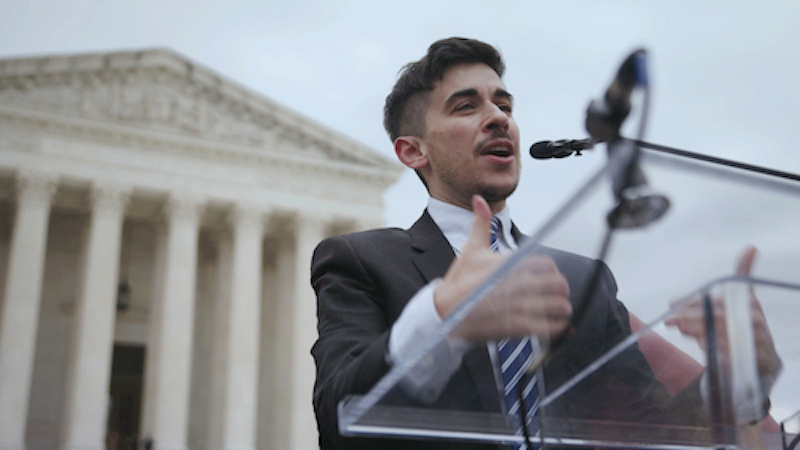
But a new documentary, Heightened Scrutiny, hitting theaters this month, establishes an alarming direct connection between such articles and legal and judicial outcomes. “The coverage is creating the law, plain and simple,” says ACLU attorney Chase Strangio. “The narrative production of trans life is being used to criminalize trans life.”
These deeply unserious articles have an outsized impact in the law and policy that is harming the lives of trans people and their families — and, in fact, the impact is threatening every single person’s ability to live self-determined lives. The documentary thus incites us to action: While the “we don’t go low” logic might compel us to ignore such asinine cruelty, Heightened Scrutiny implores us to engage. It reveals why we must engage with these anti-trans articles — analyze and dismantle their logic, address their lies and biases — in order to reassert control over an increasingly dangerous narrative that has shaped our politics and culture. For feminists, the message couldn’t be any clearer: If you truly believe in gender liberation — if you have fought for bodily autonomy, fought for the right to determine your own health and reproductive care, and fought against oppressive gender norms and roles and the artificial gender binary — you need to rally and fight for the movement to protect trans lives.
Premiering at the 2025 Sundance Film Festival, Heightened Scrutiny couples the media exposé storyline with one that follows Strangio as he prepares his argument on behalf of trans adolescents for United States v. Skrmetti, the 2024 Supreme Court case concerning the legality of Tennessee’s law banning trans youth from accessing hormones and puberty blockers as part of their gender-affirming care. (The Supreme Court upheld Tennessee’s ban in a 6-3 decision last month.) It is the second collaboration between director Sam Feder and producer Amy Scholder, who first partnered for the 2020 documentary Disclosure, which traces the history of trans representation in film and television to highlight how the entertainment industry has manufactured and promoted pernicious stereotypes about trans people. For Feder, the sensationalized trans visibility created by the media has directly informed the anti-trans political agenda and legal outcomes of today.
Disclosure laid the thematic foundation for Heightened Scrutiny, with both projects examining mass media’s prominent role in creating and disseminating most if not all of the disgusting stereotypes of trans people as threats to society.
The documentary consults several journalists and media and legal experts who testify to the media’s biased coverage of trans people and how it has “set the political agenda,” explains Julie Hollar, a senior analyst and managing editor at the progressive media watchdog group FAIR. She mentions FAIR studies with data showing how, for example, The New York Times has more front-page coverage debating trans people’s access to rights and health care than reporting on the worsening social and legal attacks on the trans community. Journalists also call attention to how anti-trans bias literally structured the cover design of the infamous July/August 2018 Atlantic issue, pointing out how the sensationalist story on trans youth (“Your Child Says She’s Trans. She Wants Hormones and Surgery. She’s 13.”) was given the coveted spot on the cover, rather than stories on how “We’re Not Prepared for the Next Pandemic” and “Being Black in America Can Take Years off Your Life.”
Mina Brewer was, in fact, not 13 when he appeared on The Atlantic cover. He was 23, as he reveals in the documentary, adding, “If I had known what the article was about, the contents of it, I would not want my face to be anywhere near that.”
The Atlantic’s editorial decision to choose the anti-trans story as the most important health story warranting the privileged position on the cover holds additional meaning now, five years after the start of the COVID-19 pandemic. “I think about the world where that [pandemic story] was the cover story,” says Sabrina Imbler, a Defector staff writer and 2022 New York Times fellow. “How many lives might have been saved, how many things might we have done differently, had people actually read this incredibly important story?”
What all these experts emphasize is that “the manipulation machine,” to quote Strangio, is not exclusively the province of the right-wing or fringe media. In fact, center and center-left publications like The New York Times, The New York Times Magazine, The Atlantic, and The Wall Street Journal are arguably the worst offenders because they are widely regarded as credible and/or sympathetic liberal media sources. As a case in point, Strangio deftly charts the devastating pipeline from Elinor Burkett’s 2015 New York Times opinion “What Makes a Woman?” to conservative commentator Matt Walsh’s 2022 documentary “What’s a Woman?” While the title recalls classic feminist interrogation of gender norms and roles, these media and stories like them adopt this rhetorical framing to put forth anti-feminist, and blatantly transphobic, arguments through the guise of “asking questions.”
This strategy is part of a larger trove of strategies often employed by bad-faith actors such as gay conservative columnist Andrew Sullivan, whose egregious two-page spread in the Sunday New York Times, earlier this month, was contrived using the standard set of strategies (decontextualization, false equivalence, the bandwagon effect, and other such logical fallacies) utilized by people pushing transphobic ideas. A week later, the Times Magazine cover story, “The Road to United States v. Skrmetti: How the Transgender Rights Movement Bet on the Supreme Court and Lost," continued the publication’s vendetta against trans people where Sullivan left off. The first paragraph alone contains two factual errors (the first intimating that surgery was a part of the Skrmetti case, and the second using the misnomer of “cross-sex” when talking about hormones, since testosterone and estrogen are not sex specific). The story also heavily relies on sources that I call community betrayers as experts; these people are noncredible actors within the communities they are purported to represent to the mainstream society. So, in the context of this story, if you’re not a part of the trans or larger queer community, you might not know that Brianna Wu and the host of the online forum TransNormal (if the name alone doesn’t speak volumes!) are known community betrayers yet deemed community leaders and authorities in the Times. To use writer and activist Sarah Schulman’s own words to Sullivan when describing his platform in mainstream media: “You’re not a leader who has emerged from the community; I think you’ve been selected by the dominant group.”
The years of anti-trans coverage, as Strangio explains, “changed the material reality [of the law],” wherein at the start of 2021 zero states banned gender-affirming care for adolescents. By 2024, the number skyrocketed to 23 states. (Today, the number is 25.)
“There is a direct link to how our care is discussed in the media, how the laws are passed, how they’re defended in court, and how they’re upheld in court. I see it every single day,” Strangio adds. “State legislatures cite The New York Times, state attorneys general cite The New York Times, and judges cite The New York Times.”
In Skrmetti, both the defendants in their brief and the Supreme Court justices in their opinion reference newspaper articles, as if they are the equivalent of medical and scientific evidence or legal precedent. In his analysis of the court verdict, journalist Chris Geidner showed how the conservative strategy of “just asking questions” had sowed the seeds that have bloomed into fields of skepticism that were, in turn, cited by Supreme Court Chief Justice John Roberts to conclude that the case did not warrant heightened scrutiny of sex discrimination because of the so-called “ongoing debate” — that is, the “debate” manufactured by the media.
In his concurring opinion, Justice Clarence Thomas, Geidner explains, “quoted from and cited the New York Times repeatedly for what essentially became its ongoing project to question gender-affirming medical care for trans minors in a way it has not done for other medical decisions with much higher regret rates or for basically anything other nonpresidential topic (besides criminal justice progressives) in recent years.”
Justice Thomas also quotes The Economist in footnote 7 about detransitioners to intimate that the feeling of regret somehow justifies legal discrimination against a minority class of the American population. For the record, people are more likely to regret getting tattoos and plastic surgery than gender-affirming surgery, according to a 2024 study in The American Journal for Surgery. And the 1% who do detransition cite external pressure, discrimination, and finances — and not “regret” — as the primary reasons for doing so. Furthermore, Skrmetti’s purview, on par with that of the Tennessee law, was hormones and blockers, not surgery.
The storyline establishing causality between the media and the law is brought to life by the second storyline, which follows Strangio in preparation to argue Skrmetti, in the process making history by becoming the first out trans person to argue before the Supreme Court. Woven into Strangio’s story is that of Mila, a 12-year-old trans girl who is family friends with Strangio, and who we see advocate for herself and other trans youth in front of school boards and, emotionally, standing before crowds of people in front of the Supreme Court while Strangio is arguing the case inside. The inclusion of Mila is significant, as hearing her voice points to the fact that more often than not trans adolescents are excluded from legal and political conversations about their very lives and welfare. It’s heartrending to witness Mila standing tall and speaking for her human dignity in front of a patronizing school board (some members of which refuse to pay attention to the assembly speakers and instead rudely stare at their phones), and to observe Strangio’s unyielding determination — no matter his exhaustion, no matter his anxiety, no matter threats to his or his family’s life, and no matter the fact that, as he says, his worst nightmare is to argue in front of the Supreme Court — to represent politically powerless youth in front of a majority conservative court to the best of his ability. And it is absolutely heartbreaking to watch this documentary a month after the Skrmetti ruling.
Despite this outcome, the silver lining of Heightened Scrutiny is its meticulous examination and exposure of the media’s political and judicial power.
The Strangio/Mila storyline is a potent counter to the media’s relentlessly cruel and dehumanizing narrative. Bigots can theologically pontificate about “gender ideology,” pundits can feign their concern and wring their hands about bullshit fears of regret and recruitment — mind you, they do not voice any of these fears or concerns about cisgender kids taking hormones, or puberty blockers, or getting plastic or reconstructive surgery.
We are talking about people’s lives, here. Or, in the words of Mila’s mom, we are talking about humanity. Period. The government can try to erase, legislate against, and outlaw trans lives. But trans existence is historically irrefutable (in large part because the gender binary is a modern invention). As Strangio poignantly says to the supportive crowd after the Skrmetti hearing, “We are a collective refutation of everything they say about us.”
More articles by Category: Arts and culture, LGBTQIA, Media
More articles by Tag: Transgender, LGBTQAI, Film, Media, Supreme Court


