








Intensified Repression for the Women of Iran Amid Renewed Hostilities
My phone vibrates before dawn. It’s M — a friend and feminist advocate in a provincial city of Iran — replying to a message I sent days ago on an encrypted app from my home in the U.S. to ask if she was safe. Since February 28, when Israel and the U.S. attacked Iran, I have had only sporadic updates from M. Given the internet shutdown, most of my texts showed a single gray check: sent but unretrieved. “Thank you dear, we are still alive,” she wrote. I jolted fully awake. A rare window of connectivity. I hearted her message and dared to call before the signal vanished.
Hearing her voice, even with the delays caused by an unstable internet connection, was a relief. After quick pleasantries, we quickly realized that the same topic was on both our minds: the “Islamabad Memorandum of Understanding (MOU) between the United States of America and the Islamic Republic of Iran,” which had just been announced. Given our shared concerns about the conflict, state repression, and its human consequences, we were both eager to hear each other’s thoughts on what many were calling a historic agreement, comparing our impressions with the news coverage emerging from our respective contexts.
Unable to contain my curiosity any longer, I asked for her thoughts first.
“Since the MOU’s announcement, the price of eggs dropped by almost a third overnight,” she said. “I have growing children. They need eggs.”
Her answer surprised me. Our conversations usually revolve around high-level politics and our shared research and advocacy on women’s rights in Iran. Yet by framing the significance of a potential peace agreement in terms of everyday survival, she revealed what was truly at stake for ordinary Iranians.
She went on: The price of gold and the U.S. dollar had steadied “at least a little.” Then came her worry. “I don’t know if the deal will hold. These crazies could go at it again. People are exhausted by unpredictability; there is a de facto pause on normal life.” Unfortunately, concerns about the fragility of the MOU proved well-founded, with the resumption of hostilities between Iran and the United States by early July.
Her biggest concern, though, was “repression” (sarkoob), especially of feminist advocates. “The hardliners want revenge and to reassert dominance,” she said. “They will go after anyone they consider a threat.”
While repression and violent crackdown on dissent and civil society activism have been long-term tactics of the Islamic Republic of Iran since its foundation, such violence has clearly intensified in recent months. Human rights organizations have documented at least 746 executions since the beginning of January, including 52 executions since the beginning of June 2026 alone. Such violence has been unleashed on national-security pretexts like alleged espionage or membership in banned groups, with the goal to terrorize, deter, and silence civil society.
The Lingering Power of Woman, Life, Freedom
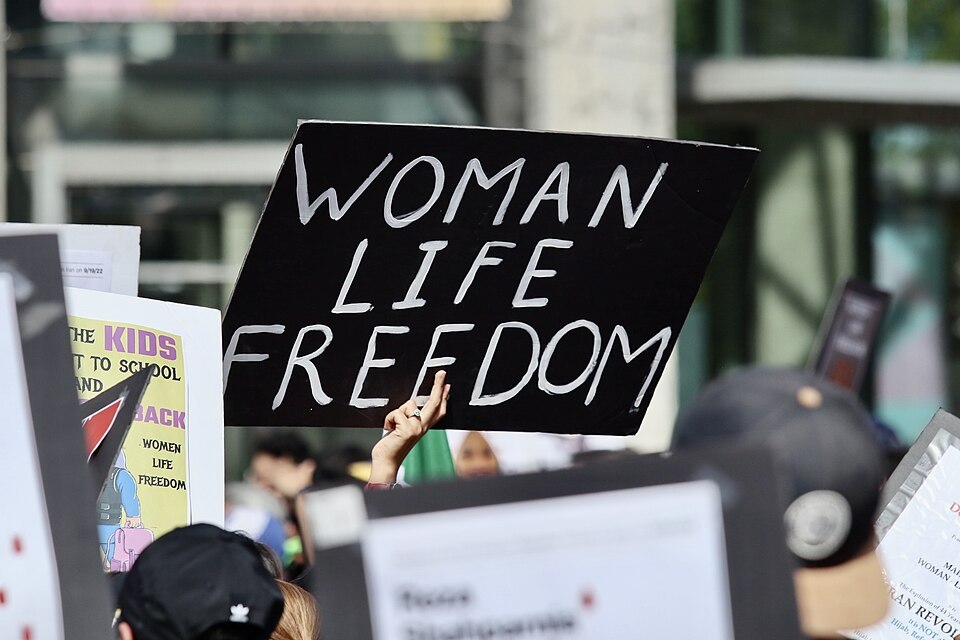
The “Woman, Life, Freedom” protests that erupted across Iran in 2022 unleashed a level of boldness among Iranian women never seen before. After the killing of Mahsa (Jina) Amini over alleged “improper hijab,” women and girls poured into the streets, burned their veils, cut their hair, and demanded radical democratic change. The regime ultimately forced people off the streets with mass arrests, lethal force, and a surveillance dragnet. But the boldness — especially among younger women — did not recede.
In response to brutal state crackdown, many women opted for civil disobedience. The most visible act has been women’s refusal to wear the mandatory headscarf despite the risks to their freedom or lives, as apparent from Amini’s killing merely for her attire. Peaceful civil disobedience has been one of the most effective tools for demonstrating the public’s resilience and exposing the regime’s violence. When a state meets peaceful defiance with batons, fines, and prison, the contrast makes its brutality undeniable, for audiences both at home and abroad.
Another powerful example of nonviolent civil disobedience was the hypothetical concert organized by singer Parastoo Ahmadi and her small team of fellow artists. In December 2024, Parastoo, unveiled and dressed in an elegant black gown, boldly stood on a makeshift stage in a disused caravanserai near Tehran and sang for nearly thirty minutes without any audience present. She released the recording of her concert on her YouTube channel with the opening statement that, “I am Parastoo; a girl who wants to sing for the people she loves ... this is a right I could not forsake.”
The video of her concert quickly went viral across Farsi-language media. Its artistic — and unapologetically political — expression resonated widely because it openly defied Iran’s longstanding ban on women singing solo as well as its mandatory dress code. Yet the concert did more than challenge the status quo: it imagined an Iran in which women, dressed as they choose, can sing and perform freely. Authorities arrested Parastoo and the musicians three days later, then released them on bail. For nearly two years this act of imagining a radically different future lived online as testament to Woman, Life, Freedom’s lingering courage.
Iran’s hardliners, namely its judiciary, however, could not tolerate such open defiance and the imagined power of this act. On the day that the U.S.-Iran agreement was announced, the Iranian officials handed Parastoo and her fellow musicians the maximum sentence: 74 lashes, two-years ban on any artistic activity, and a two-years ban on leaving the country.
The timing of this punishment, made nearly two years after the viral performance, felt deliberate and fitting to M’s hypothesis of repression: that Iran’s hardliners seek to maintain their grip on power by instilling fear and intimidation (zehre cheshm gereftan) among activists, journalists, lawyers, and artists, making examples of those who dare to challenge the state’s discriminatory and oppressive rule.
Reacting to this brutal punishment, the female director of a Tehran arts institute publicly declared: “Now that the horrific war with America and Israel has paused for the moment, it’s time to ‘discipline’ the country.” Many other high-profile figures across Iran have also boldly condemned the sentence as “backward.”
As in many other authoritarian contexts, repression in Iran is marked by hypocrisy and double standards. Authorities condemned Parastoo’s alleged “obscenity” and “immodesty” because she appeared unveiled and sang solo as a woman. At the same time, they broadcast videos of the Lebanese singer and Hezbollah supporter Julia Boutros performing unveiled and solo during nightly rallies in Tehran to rally public support against foreign military aggression. In other scenes the government featured unveiled Iranian women condemning foreign aggression; elsewhere women straddled pink tanks or posed by pink-painted missiles, smiling and waving the Islamic Republic’s flag. The message is clear: women’s images, bodies, and even voices are instrumentalized for political ends. Compulsory veiling is not simply a patriarchal obsession; it is a tool of state control, enforced at home and selectively relaxed when it serves the regime’s external image.
The Price of “Peace” Without Rights
Women in Iran are pressed from multiple directions: by laws and enforcers who cast them as second‑class citizens; by economic mismanagement and corruption; and, for the past decades, by sanctions and the broader machinery of economic warfare that hinders affordability and normalcy.
Unfortunately, these dynamics — and their toll on human life — are rarely discussed in mainstream media. Attention is instead fixed on the Strait of Hormuz and global economic flows, while ordinary Iranians’ limited access to food, medicine, and freedom of expression are ignored. Despite long-standing evidence that durable peace requires attention to feminist demands, negotiations with Iran have repeatedly excluded even the most basic references to human rights, women’s rights, or fundamental freedoms. The sense of abandonment is real. Yet one consequence of these crises is a growing recognition among Iranians that liberation cannot be outsourced to external actors or savior figures; it must come from within.
What Feminist Peace Would Require
It is understandable why a mother like M welcomes cheaper eggs. Children need protein more than statements. But diplomacy that stabilizes markets while enabling crackdowns is not peace.
At this moment, a radical shift in our approach toward oppression, war, and inequality is warranted. Feminists of Iran have already laid much of the groundwork for a democratic future. It is time to consider them a source of authority on such matters.
At a recent conference on Feminist Foreign Policy in Madrid, Iranian feminists gathered to articulate their basic demands in response to the ongoing crises facing the country. At a minimum, these included:
- Intentionally integrating human rights concerns into any agreements and sanctioning human rights abuses, including crimes against humanity, with the same scrutiny granted to Iran’s nuclear program. A concrete example is demanding release of political prisoners and halting surveillance of civil society.
- Supporting independent monitoring and public reporting so violations cannot be buried in the fine print of “national security.”
- Prioritizing humanitarian channels that actually reach people — medicine, medical supplies, and connectivity — while reducing the blunt‑force harm of broad sanctions that punish civilians more than officials.
- Expanding emergency visas and fellowships for at‑risk activists, journalists, artists, and lawyers, and supporting digital security and safe communications for those who remain.
M’s last message before the connection dropped was simple: “We keep going.” That is the through‑line of Woman, Life, Freedom. The street protests were crushed, but the defiance adapted — unveiled walks to the shop, a singer’s camera‑only concert, a student’s refusal to self‑censor, a lawyer’s quiet casework, a mother’s choice to spend the savings on music lessons anyway.
The least the international community can do is refuse to barter away their rights for the illusion of calm. The people of Iran are doing the hardest part themselves. The rest of us should stop making it harder.
More articles by Category: International, Politics
More articles by Tag: Iran, International, Politics, War


