















Book Bans on the Rise in the US; Librarians, Writers, and Others Fight Back
U.S. government institutions and conservative, moneyed interests are leading a multipronged effort to ban books as part of a nationwide strategy to seize control of American society by first controlling education and the dissemination of ideas.
What is unfolding in America is more than just a battle over books; it is the conflagration of two warring visions of freedom for the soul of the nation. What is at stake is nothing less than democracy itself.
And their effort is proving successful. In the United States, book bans — the targeted removal of books from school libraries and classrooms — have skyrocketed in recent years. According to a 2025 PEN America report, there were “6,870 instances of book bans across 23 states and 87 public school districts” during the 2024-2025 school year, a significant uptick from the 2,532 bans documented just three years prior. The books of LGBTQ+ and racially marginalized authors that explore themes of gender, sexuality, race, and racism “are overwhelmingly targeted” by censors, PEN America noted. Consequently, a chilling effect has spread throughout the publishing industry, disproportionately affecting women, queer, and racially marginalized authors the most. Furthermore, the impact of soft-banning effects — fear-based, early compliance measures, such as not ordering books and scaling back on book contracts — are incalculable.
The conservative-led states of Florida, Tennessee, and Texas created the roadmap for these bans. “Florida led the nation with 2,304 instances of book bans for the 2024-2025 school year,” according to PEN America data, resulting from “multiple vague laws, direct pressure from local groups and elected officials, and threats to educators’ professional licenses if they fail to comply.”
“Florida has always been a proving ground for a lot of these initial bills about book bans,” explained Kristen Arnett, a queer Floridian author who is a former librarian and currently serves as the chapter lead of the state’s Authors Against Book Bans. “Conservative parties have already long-established ways to infiltrate and put people in leadership positions inside of school boards and into higher administrative roles. That makes it a million times harder to fight these bills (and these bans), because the legislation is set up to protect the people who are doing the attacking.”
Florida’s 2022 “Parental Rights in Education” law — more generally known as the “Don’t Say Gay” law — provided the language of “parental rights” that became the template for both the federal government and the courts. “Parental rights” in the United States has a long history, rooted in white supremacist and patriarchal values, most notably emergent in the backlash to the Supreme Court’s 1954 decision in Brown v. Board of Education to desegregate public schools and, within the last decade, to resist vaccine and mask mandates during the height of the COVID-19 pandemic.
In its most recent iteration, under the domain of “parental rights,” anyone living in a school district — not only parents of students attending a district school — can challenge books and other learning materials deemed “pornographic,” including those which discuss gender identity and sexual orientation. This language is characteristic of what writer and biologist Julia Serano has called the stigma-contamination mindset, whereby “stigmatized outsiders (whether they be immigrants, people of color, people with disabilities, Jews and other non-Christians, and, of course, gender and sexual minorities) [are] an imagined ‘contaminating’ force that is insidiously ‘corrupting’ society.” And books have functioned as an effective conduit of such contamination.
The throughline from the pandemic to the current book bans is the nonprofit Moms for Liberty, founded in 2021 as a campaign against mask and vaccine mandates, and which has morphed into a powerful conservative political organization aimed at eradicating diverse and inclusive curricula and materials in schools and public libraries. The group has strong ties to — and significant funding from — the Heritage Foundation, the conservative think tank behind Project 2025. The organization also recently published an updated agenda, which seeks to “ultimately eliminat[e] the U.S. Department of Education.”
“Today’s book banning phenomenon,” explained Sabrina Baeta, senior program manager of Freedom to Read at PEN America, “is the result of a well-funded campaign to dismantle public education, backed by a coordinated network of groups that largely espouse white supremacist and Christian nationalist ideology.”
The language proffered by the states as well as by the Heritage Foundation and its allies has been adopted by President Trump’s administration, largely through the form of executive orders, beginning with the March 2025 executive order “Improving Education Outcomes by Empowering Parents, States, and Communities.” The framework of parental rights has been expanded through executive orders targeting LGBTQ+ and racially marginalized people, including “Ending Radical Indoctrination in K-12 Schooling,” “Defending Women From Gender Ideology Extremism,” and “Ending Radical And Wasteful Government DEI Programs And Preferencing.” While these executive orders do not have the force of legislation, they do function as official directives to the government and federal officials about how to implement the law.
Despite the undisputable racist, misogynist, homophobic, and transphobic intentions of “parental rights” laws, the U.S. Supreme Court, loaded with four Trump selections, has bulwarked the legality of this language. In Mahmoud v. Taylor, the Supreme Court declared this past June that parents have the right, under the guise of “religious freedom,” to opt their children out from reading books with any queer character or acknowledgement of LGBTQ+ life. And in December the Supreme Court upheld the Fifth Circuit’s verdict in Little v. Llano County, which upholds book bans in public libraries in Texas, Louisiana, and Mississippi. This year, there are several crucial cases being heard in state courts, in which most of the Big Five publishers — most prominently, Penguin Random House — represent their writers, their books, and constitutional rights in general.
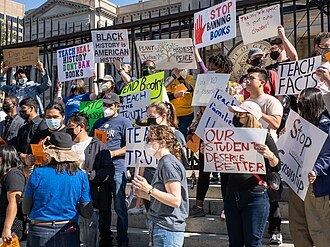
Along with publishers, writers, editors, educators, and students are at the frontlines to protect Americans’ First Amendment rights. They have formed coalitions like Authors Against Book Bans and state-specific organizations like Massachusetts’ Mass Freedom to Read to rally their communities, protest book bans, and champion anti-censorship policy.
“What I think is really important for people to know is that there are groups who work nearly 24/7 in Florida to try and slow the relentless tide,” Arnett said. “One of those groups is Florida Freedom to Read. I've worked with them for the past several months, and I have to say that they are out in front of every bill [and] every political event. There is a real, grassroots, DIY effort going on here. It's all very heartening—even in the midst of so much frustration and despair.”
In the United States, librarians like Arnett have been the vanguard of the fight against censorship since World War II. “It’s not the first time in history that librarians have been brave and bold and acted in the capacity as patriots,” explained director Kim A. Snyder, whose 2025 documentary, The Librarians, showcases librarians’ unwavering commitment to the First Amendment despite unceasing harassment and death threats in their advocacy of books in school board and town hall meetings. She noted that the profession became majority female in the early 20th century, with the 2022 U.S. Department of Labor estimating that more than 82 percent of librarians were women.
Snyder elaborated that, in the process of making her documentary, she learned about the importance of grassroots organizing in countering conservative efforts and “how critical down-ballot voting is in local politics” because “censorship comes down to hyper-local policy.” She has been energized by the hundreds of screenings across the country and internationally, because each screening has served as “almost like a town hall meeting,” where people gather to watch the film, discuss issues of freedom and censorship, and organize future actions “to keep censorship out of their communities.”
Organizing is imperative for the collective resistance movement, especially as organizers anticipate an increasing deluge of censorship bills this year. “We're preparing to be as prepared as we can,” Arnett said. “That means phone trees, ongoing letter campaigns, boots on the ground during active sessions, and school board meetings.”
Arnett’s sentiments about the power and promise of collective action in the face of so much hatred echo those shared by Baeta: “People from all walks of life are standing together to protect libraries from those who seek to empty them. … Hope can be found in the increasingly brave and growing movement to defend libraries from book bans.”
A condensed version of this piece was first published in the Norwegian feminist magazine Fett, issue #1/26, in March 2026.
More articles by Category: Arts and culture, Free Speech, Politics
More articles by Tag: Book banning, Censorship, Activism and advocacy, Women's leadership


