















Bay Area Gallery Places Women Front and Center

With a federal administration determined to leave large swaths of people out of both history and public life, resisting the erasure of women and marginalized people’s achievements feels both risky and more important than ever. This sort of resistance is happening in arenas such as sports, religion, popular culture, academia, and in the arts.
Julia Li and Callie Jones founded COL Gallery in San Francisco in August of 2023, with the explicit purpose of having a female-dominated program, and the gallery’s current exhibition, Built on the Backs of Women, seeks to reclaim the “rightful place of women in art history.”
Growing up in Texas, Jones loved art and visiting museums. After getting a degree in art criticism from the University of Virginia in 2014, she moved to New York and worked in galleries for eight years. What she found discouraged her.
“I was shocked that most of the galleries were owned by men and run by women, and most of the programs at the time were all male artists,” Jones said. “It’s changed a lot, and programs have become more diverse and include more women artists, but I still think there’s a long way to go.”
Studying art at Washinton University in Saint Louis, where she grew up, Li was one of the few students of color. Most of her teachers were male, and they were often dismissive of the women students. Her only female professor took a stand in an unusual way.
“She was so angry about how there was a lot of attention to the few male artists in the program versus the many female artists that she actually wore a third boob to all her lectures and all her classes,” Li said. “It was like ‘Oh, now you’ll see me, because now I have a third boob.’ I really admired her.”
Several years ago, Li and Jones met at the Asian Art Museum in San Francisco where Li was the director of inclusion and belonging. Over some fried food, Li, who got an MBA at the University of California, Berkeley and is now the CEO of her family business, Lulu Restaurant Group, asked Jones if she was interested in starting a gallery. It was something Jones had been thinking about since she was a teenager. In their first conversation, they talked about wanting a program that focused on women artists.
“It was always my goal, but I wasn’t sure if it would ever materialize,” Jones said. “When I met Julia, she said, ‘We can do it’ and we did. Julia is a huge inspiration to me because she’s so entrepreneurial. It was a huge shift in my mindset that we can do this, and we can do it in a different way.”
With Li’s business background and Jones’ experience in and connection to the art world, they opened COL Gallery in August of 2023. Fittingly, the gallery’s location is downstairs from a statue by the late Ruth Asawa (whose first retrospective is at the San Francisco Museum of Modern Art) in San Francisco’s Ghirardelli Square.
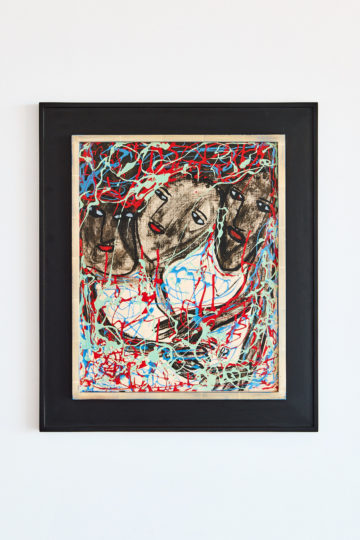
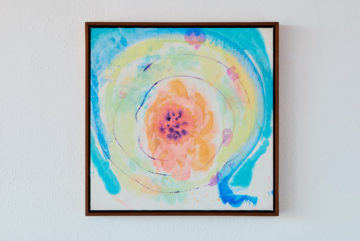
Built on the Backs of Women, looking at the erasure of women’s art, is on view through July 6. Curated by Kelly Cahn, it features four artists — Janet Sobel, who did drip paintings; Lynne Drexler, known for her fields of color; Vivian Springford, who made stain paintings; and Bernice Bing, an abstract expressionist in the Bay Area.
Going to museums while growing up, Jones says she saw work by Jackson Pollack, Willem de Kooning, and Mark Rothko. She knew women must have been working at the same time, but she didn’t see them in museums, in galleries, or in her college art history books.
“We started doing some digging and realized there is a whole generation of these female painters and artists that were working at the same time, but they didn’t have the same institutional support as their male contemporaries,” Jones said. “Janet Sobel, for instance — it’s documented that her work was shown at Peggy Guggenheim’s gallery. It’s documented that Jackson Pollock went with [critic] Clement Greenberg and saw the work, and that it made an impression on Pollock, and this was several years before he started his drip painting technique.”
Bing also didn’t get credit during her life, Li says.
“It wasn’t until after her passing that Abby [Chen, contemporary art curator] from the Asian Art Museum did a retrospective on her life,” Li said. “She was such a powerful figure in Chinatown, and the first openly queer artist in that generation in the Asian American community. I would say these women are powerhouses, and it’s almost like their legacy is now being celebrated, and we want to celebrate it even more.”
Galleries like COL seem particularly necessary now, and of course, Li and Jones aren’t alone. They have colleagues trying to broaden the field, such as Jonathan Carver Moore, whose eponymous San Francisco gallery currently has a show of Black and queer artists, To Be Seen, and Cecilia Chia, who founded Glass Rice, which shows mostly women and people of color.
Another inspiration is Jayne Drost Johnson, whose gallery JDJ is in New York. Earlier this spring, COL had a solo show of the 95-year-old Susan Weil, who went to the alternative Black Mountain College, where she was a good friend of Asawa’s. If people have heard of her, it was mostly for her brief marriage to Robert Rauschenberg, and the cyanotypes they collaborated on, which she showed him how to make.
Johnson changed that, having three solo shows of Weil’s work since visiting her studio in 2019. When Jones learned that Johnson represented Weil, she contacted Johnson about a show in San Francisco.
“It was such a privilege that we could work with her and that she could come for the exhibition too,” Jones said. “She’s such an inspiration, and she continues to innovate and create at 95 and to make work now as well as at that time when women, especially women with children, were practically invisible to the art world. She actually started a women artists’ group and has been a lifelong champion of women in the arts. The point of that group was to find female artists alternative spaces to show because they weren’t given the opportunities to show at galleries at the time.”
More articles by Category: Arts and culture
More articles by Tag: Art, Women's leadership, Women's history


