















Afghan Women’s Newsroom in Exile
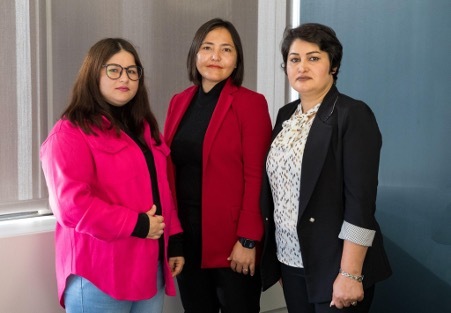
For 25-year-old journalist Sana Atef, reporting a story involves navigating several hurdles at once. Every time she leaves the house to interview someone, she needs a male family member to accompany her. Next, she needs to invent a made-up but valid reason for being outside, and she must hide her identity as a reporter for the most part.
Sana Atef isn’t her real name, and neither her readers nor her colleagues know what it is.
“I cannot carry my phone with me because it has messages and emails from my editors, so I take my mother’s phone,” she says. “Even receiving my salary is tricky because I can’t use formal banking channels.”
Atef, who lives in southern Afghanistan, works for Zan Times, a women-led newsroom in exile that reports on human rights violations in Taliban-controlled Afghanistan. She was studying political science before the Taliban took over the country in 2021 but switched to journalism when she realized how important it had become to tell the stories of women from her region. Now, she reports in clandestine ways to document the Taliban’s abuses and the impact of their restrictive laws on girls, women, and LGBTQ+ people in Afghanistan.
“My colleagues and I go through so many struggles, but it feels worth it when we see these stories come out in the world. Through our work, people get to know about the erasure of basic rights for women in Afghanistan,” she adds.
Zan Times was founded by journalist Zahra Nader in 2022, a year after the hard-line Islamist group returned to power, two decades after being overthrown by a U.S.-led invasion in 2001.
Nader, who had previously worked as a journalist in Afghanistan, moved to Canada in 2017 and had started a Ph.D. in women’s and gender studies. She hadn’t planned to return to journalism. But that changed in May 2022, shortly after the Taliban issued a decree requiring women to wear full-body coverings. By that point, the Taliban had effectively banned girls from attending school beyond the sixth grade and were systematically excluding women from public and professional life, including limits on work, movement, and social participation.
“At that time, I woke up with this dread every morning that I was doing nothing,” Nader says. “I wanted to ensure that we were covering the truth of the Taliban’s crimes as they were committing them.”
A few months later, she built a small network of women journalists in Afghanistan and those in exile. Atef is one of them.
Nader began by reaching out to some women she had interviewed in her previous reporting and asking them to write for Zan Times. She kept building on the network using her contacts in the country and advertising for reporting roles on social media.
To ensure the safety of their team, Zan Times uses pseudonyms for their on-the-ground reporters, none of whom know each other’s real identities. They collaborate with international newsrooms including The Guardian, the Fuller Project, Women’s eNews, The Indian Express, and Lighthouse Reports to ensure their reporting reaches people globally.
“When reporting from Afghanistan, the skills you need as a journalist are different from other parts of the world,” says Khadija Haidery, an editor at Zan Times, who is currently a refugee in Pakistan. Like other editors in the team, part of her job is to help reporters in the country navigate the restrictions of an authoritarian regime while doing their work effectively and safely.
“It includes how to protect your data, how to talk to people so they can’t find out that you’re a journalist, how to record conversations, how to take photos, and how to protect yourself from the Taliban.”
The risks are not abstract. About a year after Zan Times began publishing, the Taliban questioned members of Nader’s family in Afghanistan, seeking details about her work and how the newsroom operated. She had never shared such information with her family, but the visits were enough to prompt renewed warnings within the team.
“I told my colleagues that they could face similar risks,” Nader says. “I wanted everyone to be clear about how dangerous this work was. But most of them said they wanted to continue reporting.”
For Atef, those risks are constant, and personal. She says the pressure often takes a psychological toll.
“I’m often concerned that I’m putting my family in danger; they may face the consequences,” she says. “But I need to do this work for the women of my country.”
Since its inception, the online newsroom has published more than 200 stories — many reported by journalists like Atef — and has covered issues including women’s sexual abuse in Taliban prisons, the rising number of suicide cases among young women in Afghanistan, the Taliban’s intensified hijab crackdown, and the country’s housing crisis. Their journalism has been cited, translated, or republished in more than 15 languages in 25 countries.
Behind that reach, however, lies a constant struggle to keep the newsroom afloat.
“Initially, I thought that my role was going to be managing the journalists and writing stories,” says Nader. “That was the fun part.”
“But I found out pretty soon that I would have to go find money and support for this organization because the $30,000 that I had invested from my student savings was not going to last, and I couldn’t ask journalists on the ground to work for free.”
For Nader, who at that point didn’t know anything about running an organization, finding funding for sustained existence has been especially hard. When the nonprofit received its first grant of $20,000 from an international donor organization, it felt like a win.
“But I had to make so many reports, accounting for every dollar, every cent we spent,” says Nader. She found the extensive paperwork quite frustrating.
Over the years, Zan Times has received project-based funding for individual projects. But Nader says getting long-term, flexible financing has been a challenge, even more so after the U.S. cut most of its funding toward foreign humanitarian aid. Additionally, international donor restrictions often do not reflect the ground reality of working with people based in Afghanistan.
Many donors prefer funding NGOs formally registered inside the country, which puts women-led or feminist organisations operating from exile at a significant disadvantage. At the same time, the flow of international money into Afghanistan remains heavily restricted after the country’s central bank was cut off from much of the global financial system following the Taliban takeover.
But one of the most significant challenges Nader faces is that she can’t send money from Zan Times’ account to an individual’s account in Afghanistan.
“The appearance of Zan Times’ name or my name on bank transactions are absolute red flags. That would identify the people working with us,” she adds. Instead, they use the hawala system, an informal cash transfer network, to pay their reporters. When money is sent via this system, the Taliban cannot track where the money came from or who it is going to.
“But some donors are insistent that we send money through bank transfers,” Nader adds, pointing out clauses that consider use of the hawala system “money laundering.”
Amid these struggles, Zan Times has increasingly turned to its readers for support. After losing more than half of its budget following U.S. aid cuts last year, the newsroom began raising funds directly from individuals.
“I’ve learned that if we want to build sustainable, independent journalism in Afghanistan, we must build it with the people who believe in it, and who care for it,” Nader adds.
For those who work at Zan Times, their journalism is part of a broader movement against authoritarianism and a fight for women’s rights. Beyond reporting, the newsroom also runs underground online training programs for girls and women, teaching the basics of journalism in a country where more than 2.2 million girls have been denied access to basic education.
“What we are doing is a form of resistance,” says Haidery. “Every story we publish becomes part of Afghanistan’s history.”
For Atef, June 2025 brought one of the most fulfilling moments of her career, when she received the International Women’s Media Foundation Courage Award for her reporting on women’s rights in Afghanistan. But she could not share her joy on social media or post about the award on LinkedIn.
“That makes me sad sometimes, but it’s OK,” says Atef. “One day people will know my real identity. For now, the most important thing is to raise the voices of women who are living in complete darkness.”
Reported by Nikita Mandhani in collaboration with Restless Development as part of the Walking the Talk program
More articles by Category: Free Speech, International, Media
More articles by Tag: Afghanistan, Media, Women's leadership, International


