















2026 Women’s Media Awards Recognize Leaders in Workers’ Rights, Immigration, Abortion Rights, Freedom of the Press, and More
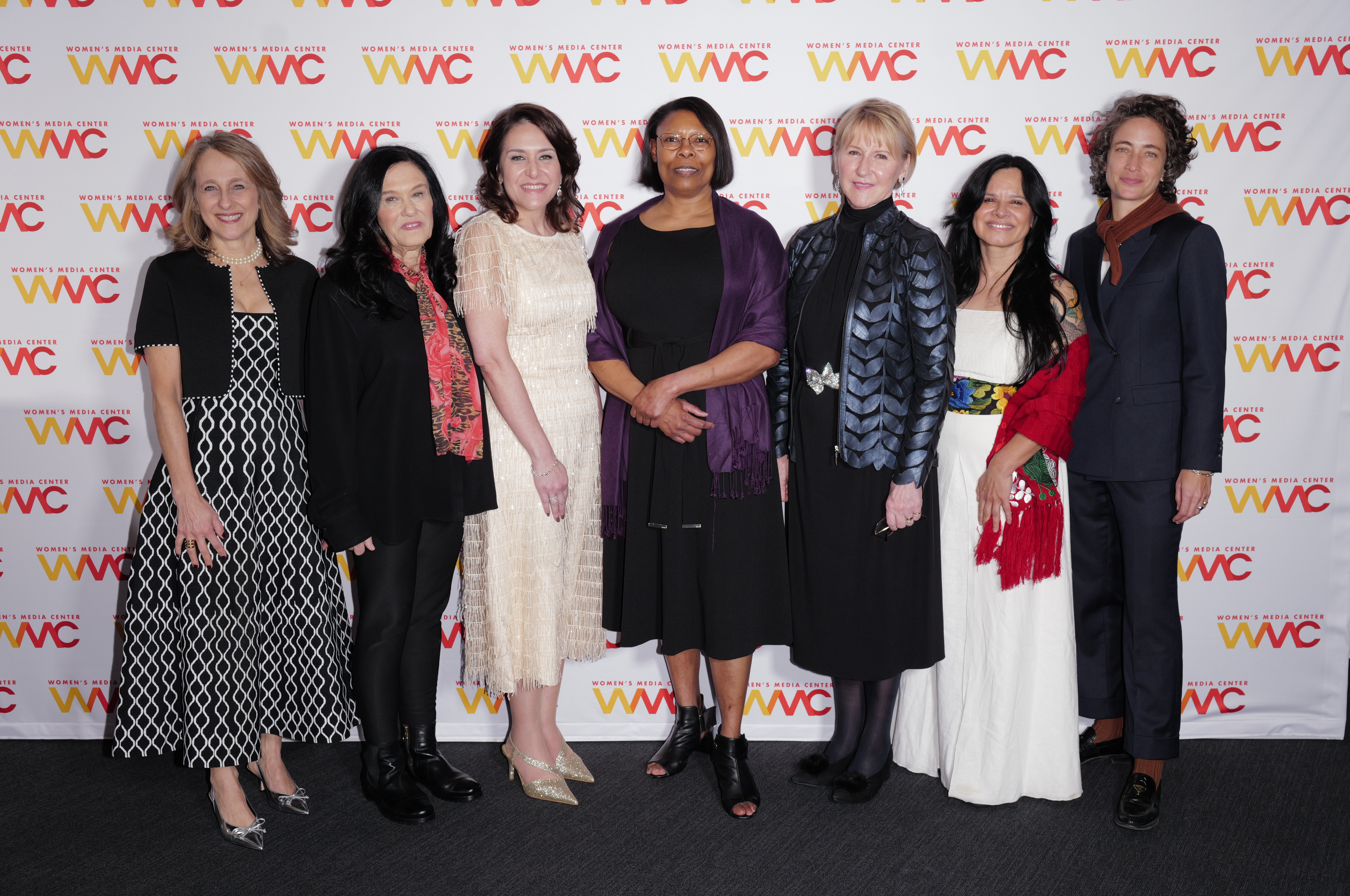
Women’s activism and influence in media must not be weakened from attacks intended to oppress and silence, according to several recipients of the 2026 Women’s Media Awards, which were presented on March 5 at Tribeca Rooftop in New York City. The annual ceremony gives recognition to “outstanding leaders and champions for women in media.” Workers’ rights, immigration, reproductive rights, safety against sexual violence, and freedom of the press were some of the crucial issues spotlighted by the work of the awardees.
The honorees this year are Knight Foundation president/CEO Maribel Pérez Wadsworth (WMC Pat Mitchell Lifetime Achievement Award); Margot Wallström, a former deputy prime minister and minister of foreign affairs of Sweden and the United Nations’ first special representative on sexual violence in conflict (WMC Robin Morgan Sisterhood Is Powerful Award); journalist/author Paola Ramos (WMC Carol Jenkins Award); Oscar-winning documentarian Barbara Kopple (WMC Ahead of Her Time Award); and three recipients of the WMC Progressive Women’s Voices Impact Award: Economic Policy Institute senior policy and economic analyst Chandra Childers, Reproductive Futures founder/CEO Julie F. Kay, and Voces de la Frontera executive director Christine Neumann-Ortiz.
WMC president Julie Burton greeted attendees by thanking participants, colleagues, and everyone who worked on the event. Burton then led the ceremony’s attendees in a toast to co-founder Gloria Steinem. She said: “March is her birthday month … so let’s raise a toast to the woman who for all these years, decades, has always been where she was most needed … to build the movement for equality and social justice. How appropriate that her birthday is in Women’s History Month.” Burton also thanked WMC co-founders Jane Fonda and Robin Morgan for being equally important to WMC and its work.
Burton also commented on the legacy of WMC, which was founded in 2005: “From day one, our goal has been to shake up all parts of the media … so that we can see, hear, and read works created by women, across all media platforms. When we started, there were very few women experts featured in news stories and talk shows. Now, because of WMC Progressive Women’s Voices and WMC SheSource, we see diverse women experts every day on most media platforms. And we trained and promote many of them.”
Former U.S. first lady Michelle Obama sent a prerecorded video to join in on the celebration. In the video, Obama said: “I am so inspired by the incredible award winners we’re celebrating, from combating sexual violence and fighting for reproductive freedom, from lifting up marginalized voices, to advancing economic opportunity. Your vital work drives forward the remarkable mission of the Women’s Media Center to make women not just more visible but more powerful.”
WMC Pat Mitchell Lifetime Achievement Award recipient Pérez Wadsworth, the first woman president/CEO of the Knight Foundation, was given an introduction by WMC co-chair emerita Pat Mitchell, who said, “Protecting independent journalism, particularly at a local level, is one of the essential tenets of a free society. … The Knight Foundation really does the good work of providing millions of dollars of research to make sure that independent journalism continues to thrive.”
Pérez Wadsworth, a former president of USA Today Network, said, “Throughout my life, I have been very lucky to learn from extraordinary women who have blazed trails and created opportunities for others.”
Pérez Wadsworth shared how her mother had a profound influence: “But I owe who I am to the first of these women [in my life]: my mother. Her courage, her sacrifice, her irrational belief that nothing would be impossible for her daughters — even when we doubted ourselves. My mother’s ambitions were cut short when she became a refugee at 15. She arrived in the [United] States from Cuba, without her parents, but with a 9-year-old sister to look after. A new country, no map, no safety net.”
Pérez Wadsworth said: “My grandparents sent their daughters here because they believed the freedoms that were being dismantled in their beloved Cuba would be guaranteed here, in the United States of America. They’d seen what happens when a government silences speech, arrests journalists, exiles artists, and destroys trust in society. So many of us in this room have devoted our careers to championing the First Amendment, democracy’s firewall. Today, that fight couldn’t be more vital. We’re witnessing restrictions on the press, crackdowns on protesters, an erosion of checks and balances that threatens the foundation of the republic.”
She concluded: “I’ve devoted my career to journalism because I believe that informed citizens are the ultimate check on government power. In one sentence, the First Amendment guarantees five freedoms that ensure power in our country rests with the people. And this is what we owe the next generation: to honor the belief that in America, liberty will always endure. So, we keep fighting, we keep speaking, we keep publishing. Because the freedoms my grandparents sent their daughters toward are not a given. They must be defended, again and again and again. … Let’s stay in this fight together.”
WMC co-founder Morgan introduced WMC Robin Morgan Sisterhood Is Powerful Award recipient Wallström by saying, “Margot has fiercely advocated for equal rights for women and girls for decades. In 2014, as Sweden’s Foreign Minister, she introduced the first-ever Feminist Foreign Policy. Despite the fact that diplomatic critics openly mocked her, by 2023, 16 countries had adopted a feminist foreign policy. They invested in gender parity in politics, addressed sexual violence against women, or shifted their approach to peace.”
Morgan commented on Wallström’s tireless advocacy for women who experience sexual violence and other forms of abuse: “Margot makes sure the blame is not placed on women, reminding us all that sexual violence against women is not cultural. It is criminal. It is not a women's issue. It is a human rights issue.”
Wallström delivered her acceptance speech in the form of a poem that said in part: “This is my homage to you who write, report, and tell the story about women everywhere, often far from this glory. About shame that turns to anger, to resolve, then to action. About women’s destinies and female lives, lived on a fraction of what we have, lucky as we are but now under political leadership more and more bizarre. About sisters in Iran and Afghanistan, struggling for basic rights. They mobilize, march in the streets, educate daughters in darkness during nights.”
Wallström concluded her poem with these words: “They are so many, our sisters who struggle and fight, especially now when might equals right. A feminist foreign policy could still become the norm. Wise women ‘round the tables change both direction and form. And experience shows: More women means more peace, so let’s remove the autocrats and keep democracy, please. To have met and learned from Robin, Jane, and Gloria has definitely put me in a state of euphoria. Thank you for giving me this award. Like the pen for a girl, it’s more powerful than a sword!”
Before introducing WMC Carol Jenkins Award honoree Ramos, WMC chair Dr. Janet Dewart Bell serenaded the crowded with a short rendition of the civil right anthem “We Shall Overcome.” Dewart Bell introduced Ramos as “a tenacious journalist speaking truth to power — should I say questioning power — relentlessly, with sharp insight, historical context, and deep knowledge of the Latinx and queer communities.”
Dewart Bell added, “Brimming with energy and passion, Paola often looks where others have not, with an uncanny ability to find and report stories that might not otherwise be told. … She uses her voice — in English and in Spanish — to amplify the range of experiences of Latinos from different generations, countries, religions, identities, and political beliefs.”
Dewart Bell ended the introduction by saying Ramos was receiving the award “for her groundbreaking investigative journalism in our changing media landscape; for ensuring that the public discourse includes the perspectives and concerns of women; and for traveling the country to challenge assumptions and shatter stereotypes about the diverse Latinx communities’ many contributions to this country.”
Ramos noted that although her father, former Univision anchor Jorge Ramos, is her more high-profile parent, she wanted to thank her journalist mother, Gina Montaner, for being an extraordinary inspiration to her.
Paola Ramos also thanked WMC and Jenkins and then said: “Part of Carol’s legacy is the way in which she’s captured voices, stories, and moments of history that would have otherwise been forgotten, overlooked, or even erased. And today, we are witnessing a country that is becoming both unrecognizable and yet somehow reminiscent of a recognizable past.”
She said, “I often find myself asking the same set of questions these days. Thirty, 40 years from now, when we look back at this time, what exactly will the history books remember? How exactly will they honor the thousands of voices that were forced to live in the shadows or too scared to speak up, too fearful to demand justice?
Ramos continued, “And that’s why, lately, my reporting has led me not just to the loud moments — the protests and the ICE raids, the immigration courthouses — but to the quiet moments, to the edges of the action — which, in my opinion, hold the complexity and the nuance of the moment we’re in. It holds the beauty, the resilience but also the danger and the trauma.”
Ramos added, “In the midst of mass deportations, the self-deportations, the detentions, the hidings, it’s easy to miss the quiet moments. It’s easy to miss the voices that seem to be rapidly disappearing around us. In fact, global history reminds us that at times of authoritarian governments seek to erase memories, to corrupt them, distort them, replace them with new, fabricated versions of history.
Ramos concluded her speech by saying: “And so, at a time when I ask myself, ‘How will this moment be remembered? Who will likely be forgotten?,’ I go back to a principle that I think Carol Jenkins and this institution has always believed in, which is: There is no understanding the present or future without an accurate, truthful documentation of our past. As journalists, I encourage us to understand that we suddenly carry so much weight on our shoulders to not just report the truth but to piece together memories and testimonies and moments of history that could otherwise be buried 20 to 30 years from now. That’s the engine of accountability.”
Emmy-winning filmmaker Donna Deitch presented the WMC Ahead of Her Time Award to Kopple, an influential documentarian who has won Oscars for 1976’s Harlan County, U.S.A. and 1990’s American Dream.
Deitch said: “Barbara Kopple is the very definition of cinema vérité. This phrase is meant to describe a style. But with Barbara, it’s actually literal because ‘vérité’ means truth. And Barabra is a truth teller. That’s at the heart of her work.”
Deitch said that Kopple’s WMC award is “for her fearlessness and integrity as a filmmaker to tell stories of others, for telling these stories with honesty and empathy, for her commitment to uplifting women’s stories and voices, for her legendary, truthful storytelling contribution, and for being the most charmingly tenacious filmmaker of all time.”
Kopple thanked WMC in her acceptance speech: “I can’t think of a greater honor than to have my name connected, even for one evening, with the work Gloria [Steinem] and the Women’s Media Center have doing for so long They have been able to remind the world of women’s voices are essential to how our history is told and how we imagine our future.”
Kopple continued, “If I ever call myself ‘ahead of her time,’ I think it’s because some of us have been lucky enough to have started out in the documentary field when very few women were doing this type of work. And quite frankly, not many men weren’t doing it too much because there was no money to be made.” Kopple mentioned documentary filmmakers Albert Maysles, David Maysles, D. A. Pennebaker, and Frederick Wiseman as “great mentors” to her.
Kopple concluded, “When I think about this award … I know the truth is that I was surrounded by women who were ahead of their time: women who were bold, funny, stubborn, fearless, and generous to pull all of us along with them. …Now is this the time that we cannot be silent. We have to make films, sing songs of protest, march, do whatever we can to be heard against all the injustices in our country and in the world.”
WMC board member Soraya Chemaly introduced WMC Progressive Women’s Voices Impact Award recipient Childers, by noting, “Her current focus at the Economic Policy Institute is on the Rooted in Racism project, which documents the negative impacts of the Southern Economic Development Model. This strategy ensures that workers and families across the region suffer while the wealthy and powerful benefit.” Chemaly said that WMC is awarding Childers “for her unwavering commitment to economic justice; for ensuring that workers can experience real economic security, independent of race, sex, or economic status; and for empowering women workers across the Southern region.”
Childers said she’s grateful be an alum of WMC’s Progressive Women’s Voices training. She added, “My work focuses on job quality and the economic well-being of workers and families across the Southern United States. These are states that share a Southern economic development strategy that originated at the end slavery to continue to extract labor from Black men and women. Today, it impacts workers of all backgrounds. It doesn’t just keep wages low, but it provides workers with few protections and ensures that they lack power in the workplace, and it provides little safety.” She noted that the Economic Policy Institute has been successful in getting progressive policies in place, including higher minimum wages, higher levels of union coverage, paid family and medical leave policies, and child care.
Childers added, “However, we are at a point where both the federal and state governments are coming in to undo the gains that we have made. We have seen the fight against reproduction rights … the efforts to make sure that workers are not able to form unions and not able to fight for their rights and not able to fight for themselves, the efforts to make sure that wages remain low and that workers cannot demand safer workplaces.”
WMC vice chair Erica Gonzáles Martinez introduced WMC Progressive Women’s Voices Impact award recipient Kay, a human rights attorney, by describing Kay’s work at Reproductive Futures, as “the legal frontline of reproductive health care working to make telemedicine abortion, emergency room and post-abortion care safe and legal throughout the U.S. Reproductive Futures is also aiming to bolster and expand legal protections for clinicians who prescribe abortion pills remotely and mail them to patients in states with bans.”
Gonzáles Martinez added that WMC is awarding Kay “for decades of working to protect and advance abortion rights for all women; for playing a vital role in the legalization of abortion in Ireland; and for her pioneering leadership in promoting telemedicine abortion.”
In her acceptance speech, Kay said: “My work to help legalize abortion in Ireland informs my strategies and gives me cause for great optimism. The biggest source of progress now in the U.S. is, without a doubt, telemedicine abortion. …My organization Reproductive Futures is working hard to safeguard and expand that number of states and the number of providers offering services. We make sure clinicians have the necessary laws and policies, and legal and technical support to be able to offer telemedicine care. We stand strong to protect these new virtual services and providers from attacks by abortion opponents. Telemedicine is winning. But the risks are real. The anti-abortion movement is lobbing state and federal lawsuits, targeted legislation, and FDA hostility on a weekly basis.”
Kay concluded, “We are not going back. We are building forward. I have witnessed what happens when women organize, when movements stay steady, when we refuse to accept injustice as inevitable. Together, we will meet this moment. Together, we will protect access. And together, we will build a reproductive future worthy of the next generation.”
WMC co-founder Fonda began her introduction for WMC Progressive Women’s Voices Impact award recipient Neumann-Ortiz with this rousing statement: “Si se puede! Si se puede! Yes, we can!” Fonda continued: “As Christine Neumann-Ortiz demonstrates: Yes, we can make a difference for immigrants who are under attack in this country. Yes, we can raise our voices in protest of illegal treatment of our neighbors. Yes, we can build coalitions and a loving community in the face of cruelty and chaos. In this era of resistance, building community is an act of defiance. But it is also what sustains us and gives us hope.”
Fonda then described Neumann-Ortiz: “A self-styled organizer, Christine developed her skills working on women’s rights and anti-racism campaigns while a student at the University of Wisconsin-Madison. Through her passionate leadership, Voces de la Frontera has grown from a small, grassroots worker center to a state and national leader in the immigrant rights movement. She has been on the frontline of some of the most defining policies and politics of our time, demonstrating how to harness our anger and turn it into action.”
Fonda said that the WMC is awarding Neumann Ortiz “for her unflinching devotion to the immigrant community; her savvy, strategic leadership that serves as a role model for other organizations and movements; and her actions to change statewide policies for the betterment of the immigrant community.”
Neumann-Ortiz said: “We all know we are living through a defining moment in this country. We have witnessed a white nationalist administration stage a cruel, violent and escalating war against nonwhite immigrants and civil society. Children are being zip-tied and jailed. Immigrants are falsely accused, denied due process, kidnapped and deported to torture jails. People are being deported to countries where they face death.”
Her speech also came with this warning: “These federal agencies are violating constitutional rights every day. The assault on immigrants is the tip of the spear to a larger authoritarian assault on our democratic rights. The DOJ arrest of Milwaukee County Judge Dugan is an attempt to intimidate other judges who stand up for due process. The murders of Alex Pretti and Renee Good by federal agents brought sharply into national focus the use of violence and lethal force against peaceful protestors.”
Neumann-Ortiz continued: “But this administration did not count on the resiliency and compassion of immigrants and their neighbors. Immigrant organizations across this country have created community defense networks, so people know their rights, document abuses, litigate violations, protest peacefully, and create legal defense funds and mutual aid networks.”
She said, “Even when enforcement agencies attempt to make their actions less visible in response to public backlash, the harm does not disappear. It simply moves out of sight. That is why vigilance, storytelling, and feminist leadership matter. The question before us is not just what we are resisting. It’s what we are creating. We have opportunities to redefine safety and security as families staying together, fairness, and belonging.
In conclusion, Neumann-Ortiz said: “When I recall the voices of the children and parents shouting to us for ‘libertad’ or freedom from within the walls of the Texas jail, I say: ‘We hear you. We will not be silent. We will not rest until everyone is free. We will keep organizing, and we will keep building the future our communities deserve.’ And as we see the administration shake up because of strong public condemnation, let’s remember the North Star: Abolish ICE! Citizenship for all!”
Maria Hinojosa, S. Mitra Kalita, Maysoon Zayid, and Lauren Embrey were among the previous Women’s Media Awards honorees who attended the ceremony. Other attendees included Susan Pritzker, Sheryl Sandberg, Cynthia McFadden, Arianna Huffington, Vanessa Vadim, Christy Tanner, and Georgia Levenson Keohane. The 2026 Women’s Media Awards co-chairs in 2026 are Deitch, McFadden, Mitchell, Sandberg, Pritzker, Regina K. Scully, Loreen Arbus, Michelle Mercer and Bruce Golden, Mellody Hobson, Cindy Holland, Kiehl Friedman Family, Carlene C. Laughlin, Alexandra Shiva, and Mary and Steven Swig.
WMC co-founder Steinem sent a prerecorded video message, which was played near the end of the event. Steinem congratulated the award recipients and thanked WMC’s supporters. She commented: “In a just world, these kinds of feminist storytellers and leaders and activists would be already fully and accurately in the media. But until we see that just world, we need the Women’s Media Center, where truth matters.” Steinem also said she’s “so proud” to “stand shoulder to shoulder” with co-founders Fonda and Morgan and WMC’s staff in WMC’s mission. “To do so, we need your continued support,” Steinem added. “That is why each and every one of you matters.”
More articles by Category: Media
More articles by Tag: Women's Media Awards, Women's Media Center


