















“107 Days” Documents Kamala Harris’ Glass Cliff
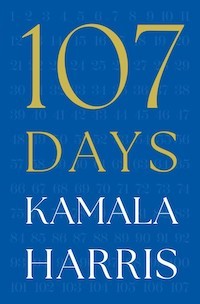
Vice President Kamala Harris faced an insurmountable challenge in the 2024 U.S. presidential election. She had to contend with not only the nation’s history, born and enriched from centuries of the enslavement of Black people and the genocide of indigenous and tribal people and institutionalized in the electoral college, but also a tech billionaire’s $290 million infusion into the opposition party. Not to mention the exceptional circumstances of her candidacy.
Notwithstanding my grave reservations about her positions on some issues, most significantly that of her refusal to oppose the genocide in Gaza, I voted for Harris because of her intellect, expertise, respect for our democratic institutions, and specifically for her promise to secure and expand our freedoms.
Freedom, indeed, was Harris’ campaign theme. Beyoncé’s “Freedom,” the soundtrack. And it was the chorus of this soundtrack — “freedom! Freedom! Where are you? / ‘Cause I need freedom too!” — that echoed throughout my head while reading Harris’ memoir 107 Days, which provides a startling contrast between the campaign theme and Harris’ freedom, or lack thereof, both as vice president and as the Democratic presidential nominee. Turn to the definition of the “glass cliff” in the dictionary, and you’ll see a picture of Kamala Harris: The brilliant and charismatic Black woman who was handed the impossible task of cleaning up a mediocre white man’s mess — of having less than four months to “right the ship” on a sinking presidential campaign helmed by a fragile white man, insulated by an inner circle of self-serving yes men — in order to save American democracy from an autocratic narcissist who now sits in the White House.
In an inspired nod to both the movement for Black freedom and President FDR’s famous “four freedoms” speech, Harris adopted “freedom” as her campaign’s theme — as part of a strategic effort to reclaim it from the ideological right, which champions freedom as the unfettered license to do whatever one pleases, without consequence or accountability. However, Harris’ “freedom” lacks precise definition. Rather, it is delimited in terms of relation, of “freedom to” and “freedom from,” as conceptualized in the work of Isaiah Berlin. Take her DNC convention speech, for example, in which she mentioned the word a dozen times: “The freedom to live safe from gun violence in our schools, communities and places of worship. The freedom to love who you love openly and with pride. The freedom to breathe clean air, and drink clean water and live free from the pollution that fuels the climate crisis. And the freedom that unlocks all the others: the freedom to vote.”
In her memoir, the same construction appears, such as in her reference to her first speech as the presumptive Democratic nominee: “I was born into a fight for freedom and stood in that tradition. Freedom to vote, to control one’s own body, to breathe clean air and drink clean water, to be free from fear of weapons of war on our city streets and in our children’s classrooms. Freedom from anxiety about health care costs, childcare costs, a retirement spent in poverty. Freedom to afford a home, build wealth, provide our kids a good education. The freedom not just to get by but to get ahead. And the freedom to simply be.”
It is precisely this “freedom to simply be” — what can be understood in terms of agency and self-determination — that Harris is denied, first by the Biden administration, and then by his campaign. As the calendar winds down to election day, Harris’ justified frustration about her lack of freedom builds on the page. Of course, she is too politically astute to portray her feelings so bluntly — at least in her own words. She was, she says, “well aware of my delicate status,” as the sitting vice president whose duty is to serve the president. “The vice president serves the president’s agenda,” she explains, “she does not have the power to forge her own.” Her situation is her conundrum, since, in becoming the Democratic presidential nominee, she must forge her own path in order to persuade voters that she is different from the increasingly unpopular president — something that neither she nor Democratic party operatives seem aware of or willing to acknowledge throughout the campaign.
Instead, in the book she lets others speak for her or allows for the reader to intuit meaning in the silences. Strangely, she turns to white men — CNN’s chief national correspondent John King and her husband, Doug Emhoff — to offer the most pointed criticism of the administration and of her circumstances. “‘I think one of the greatest acts of political malpractice I have seen in my lifetime doing this is that they kept her under wraps for three years,’” King says, speaking on a panel after CNN host Anderson Cooper interviewed Harris after Biden’s disastrous debate against Trump. “‘Now she’s on the road, she has great appeals … She also has potential star power. And on issues like reproductive rights and in the Black community, she is a great asset to this team, and they have kept her under wraps.’”
Harris quotes King at length, and ends the chapter there — with no words of elaboration or qualification. Likewise, she quotes her husband at length, with no words added, when he vents to her about being accosted by Jill Biden about their support for her husband during a 2024 Fourth of July event: “‘They hide you away for four years, give you impossible, shit jobs, don’t correct the record when those tasks are mischaracterized, never fight back when you’re attacked, never praise your accomplishments, and now, finally, they want you out there on the balcony, standing right beside them. Now, finally, they know you are an asset, and they need you to reassure the American people. And still, they have to ask if we’re loyal?’” The chapter ends. The silence is deafening. And revealing — she has positioned these white men as authoritative voices in her book. Does she suspect that her words would not be interpreted at the same level of authority as these men? Racism is alluded to, but it mostly remains unaddressed, not only in these instances but throughout the memoir, save moments when Harris comments on Trump’s derogatory language toward her (whether questioning her Blackness or refusing to pronounce her name correctly).
Harris is not the only Black woman to self-censor when encountering misogynoir in a professional setting; in her case, not only from conservatives but from Biden loyalists and more conservative stakeholders within the Democratic Party. But because she is a Black woman, she cannot speak plainly about this because pointing out these occasions would render her the problem. Her sentiments, especially about the dynamics of identity politics in the United States, largely make their presence known in their absence. There is one occasion where she does make a brief reference to how identity politics operates in America — when she discusses not choosing Pete Buttigieg as her running mate (“He would’ve been an ideal partner — if I were a straight white man.”) because she is aware, as a Black woman married to a Jewish man, of the power of racism, misogyny, and antisemitism in this country. And this account has resulted in bad-faith public criticism, as if she is the homophobe rather than pointing out how homophobia exists in our society, no matter how heteronormative Buttigieg has made his life (military, married, Christian, children).
There has arguably been a glass cliff of no greater magnitude than that experienced by Harris: The increasingly unpopular sitting president, who is her boss, drops out of the presidential race against a one-term president, who not even four years prior attempted a hostile takeover of the government, 107 days before election day.
When Fox News launched racist and misogynistic attacks on her — from criticizing the tone of her voice to calling her a “DEI hire” — the White House did not defend her. But they weren’t just silent. Harris explains how they actively undermined and sabotaged her: “I often learned that the president’s staff was adding fuel to negative narratives that spun up around me …. And when the stories were unfair or inaccurate, the president’s inner circle seemed fine with it. Indeed, it seemed as if they decided I should be knocked down a little bit more. ‘The VP should take on irregular migration.’ … I shouldered the blame for the porous border. … No one around the president advocated, Give her something she can win with.”
Harris’ presidential campaign was severely restricted by the circumstances — having less than four months to create a campaign infrastructure and make herself and her political agenda known to the American public, for whom she had been mostly hidden for the past three years. Not only that, but “it was a Joe-shaped organism,” she says of the campaign, “that would need to adapt very fast. There was no way to know if it could. … I didn’t have time to build a new plane; I had to fly the aircraft available. It would have been a self-inflicted disaster to blow it up, 106 days from the election.”
It wasn’t only that Harris had to adopt Biden’s campaign, including his infrastructure, strategy (or lack thereof, especially in swing states), and staff. As she details, Biden did less than the bare minimum to support her candidacy, from giving her less than an hour’s notice before he dropped out of the campaign to failing to include “personal stories about working with [Harris] and what qualities he had seen that led him to endorse [her]” in his hour-long convention speech. Perhaps most infuriating of all, Biden called Harris shortly before her debate with Trump not to offer her a pep talk but to ramble about his own debate performances and interrogate her about political powerbrokers in Philadelphia. “The pressure I was under before I would step onto that stage was immense,” Harris reflects. “I had to be completely in the game. I just couldn’t understand why he would call me, right now, and make it all about himself. Distracting me with worry about hostile powerbrokers in the biggest city of the most important swing state.”
Harris’ and Democrats’ effort to reclaim “freedom” is a good and essential one to preserve and, arguably, help to rebuild America’s democracy. But they must redefine it, too, and with specificity. What the Berlinian construction that Harris relies on overlooks — and what, ironically, Black freedom fighters and feminists have understood for generations — is that freedom is mutually co-created and exists in relation. It is collectively realized, as Audre Lorde told us: “I am not free while any woman is unfree, even when her shackles are very different from my own.” Thus, as Simone de Beauvoir explained, we must want freedom for all people, since their freedom is “the condition of my own freedom,” and it is through our encounters and relationships that we can surpass the limits of our freedom. Our freedoms are interconnected and interdependent. Contrary to another line in Beyoncé’s “Freedom” — “I break chains all by myself” — we need other people to be free.
Nowhere is this definition clearer than in 107 Days.
More articles by Category: Politics
More articles by Tag: Kamala Harris, Politics, Elections, Books


