















Unidos We Stand?
As one of the millions of people to hold dual nationality, I’ve witnessed an especially volatile time for both of my countries of citizenship: the United States, where I’ve lived the majority of my life; and Peru—where I was born during the military dictatorship of President Juan Velasco. Each is a democracy, though Peru’s is obviously the more fragile of the two, underlined by seven coups d’état in the past century alone, and four of its more recent leaders having faced serious corruption charges that resulted in impeachments, exile, prison terms, and even a suicide among them. But for the very first time, I’m feeling a deep unease about where things stand. Not there, but here.
In the lead-up to Election Day, some U.S. media circulated articles on “what to do in the event of a coup”—a heretofore unimaginable prospect until President Trump, defying the expressed will of the nation’s electorate majority, refused to concede defeat—even signaling right-wing white militia groups to “stand by.” During these same weeks, Peru’s President Martín Vizcarra was, in one fell swoop, impeached by that nation’s Congress, removed from office in a “legislative coup,” and replaced by the head of that very same Congress, Manuel Merino—a successor the Peruvian people did not ask for, and resoundingly rejected.
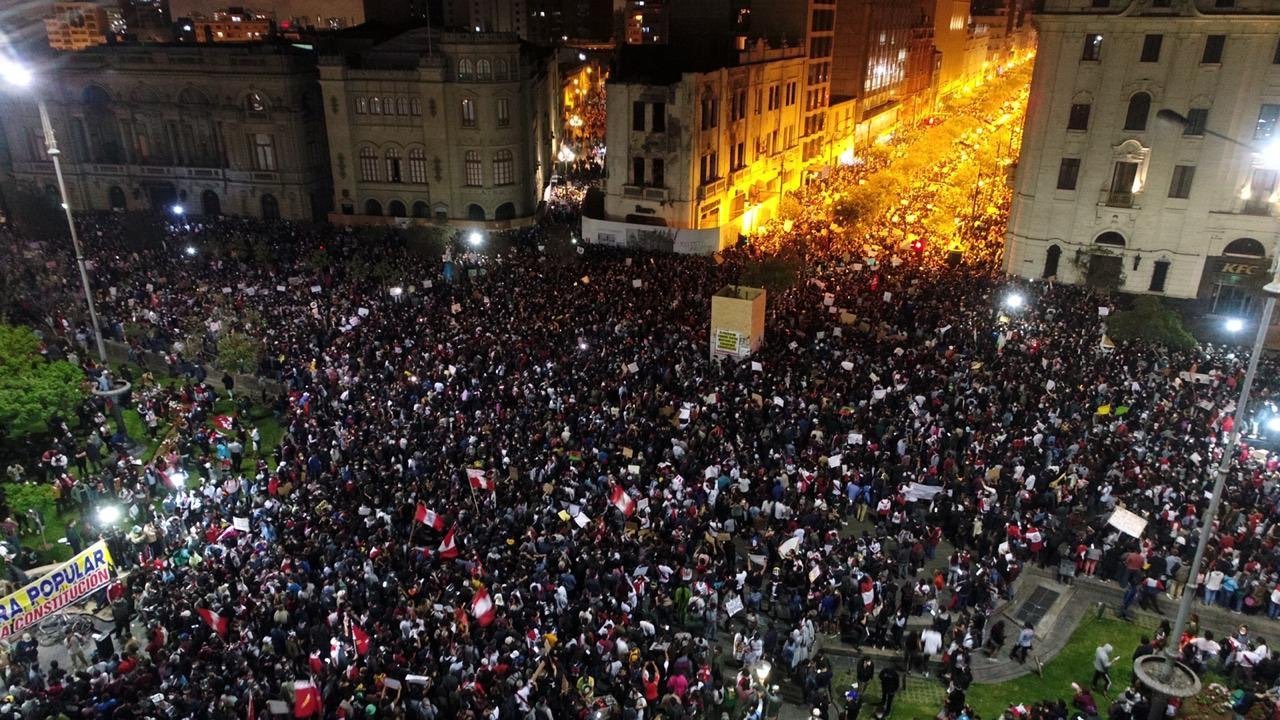
What unfolded in an instant was breath-taking: outraged citizens across the political spectrum —not simply “leftists,” for example—took to the streets in protest, in every city and town across Peru. Those living en extranjero showed solidarity in gatherings around the globe, such as the one I joined across from United Nations headquarters. After more than a year of popular uprisings in neighboring Chile, Peruvians have surely taken note of their neighbor’s most impressive outcome: a 78% supermajority of Chileans voting to create a new Constitution altogether. While for Peru such broad systemic changes are not yet in play, its protestors succeeded in their immediate objective: the appointment, until April 2021 elections, of a more widely acceptable interim leader, Francisco Sagasti.
A new fervor and hopefulness has seemingly burst from Peru’s venas abiertas—that is, open veins, as Uruguayan writer Eduardo Galeano once described a South America shackled by a 500+ year legacy of colonization that codified and enshrined power for its corrupt elites. Peruvians, as encapsulated in yet another viral hashtag, are asserting in no uncertain terms, #SeMetieronConLaGeneraciónEquivocada — You’ve messed with the wrong generation. And so in this, for my traditionally cynical homeland, I do feel optimistic.
Given Peru’s myriad political parties (10 presented candidates in the most recent presidential election), it’s rare for voters there to find one that speaks to all their concerns about government and governance—especially through a candidate whose personal and political ethics they can trust. At the forefront, the country has been one of the worst hit by COVID-19, in both infections and deaths; it has the hemisphere’s highest rate of sexual violence against women and girls, as highlighted by the #NiUnaMenos (Not One More) anti-femicide movement; reproductive choice remains non-existent—abortion is criminalized, even for victims and rape and incest; the Amazon is being stripped of its riches; and the rights of *Indigenous Peoples continue to be violated with impunity.
Like a defensive chess game, the goal of different political camps seems perpetually focused on blocking the opposing king or queen (as the anti-Keiko forces seeks to keep el clán Fujimori from returning to the throne—a democratically elected one, that is) rather than proactively cultivating the kind of virtuous, visionary leaders Peru’s future so desperately needs to make any lasting, transformative leaps forward.
“How can the people...recognize when the very foundation of our union is endangered if only nine states (plus Washington D.C.) require even a single year of civics taught in school?”
Time will tell if Peru’s protests will have amounted to a singular moment or sustainable movement. Here meanwhile, the mythos of U.S. exceptionalism is fracturing; tumult and division once ascribed to only “those people out there” is happening to us, right here. Though a new president has prevailed, 74 million U.S. voters undeniably endorsed the kind of autocratic “strongman” that Latin America knows—both right and left wing—all too well. What remains uncertain is this: where do we go from here? Trump and his millions of supporters are not going away; in fact, he’s reportedly planning to run again, unless one of his children picks up the proverbial baton. Left behind, in any case, is an effective playbook for harnessing an ugly truth: nearly half of U.S. voters believe the rest of us should not be included in that “we the people” our Constitution holds sacred. And once people stop believing in democracy for all, autocracy is just one white nationalist goose-step away.
For those of us who see the fulfilment of this country’s greatest promise in progressive values, with liberty and justice, dignity and prosperity for every American, our policy agenda must address this widening gulf. In a democracy comprising a wide range of voices and views, how can the people know what this truly means—and recognize when the very foundation of our union is endangered—if only nine states (plus Washington D.C.) require even a single year of civics taught in school? Democracy is, above anything else, one special interest, we all must share.
*Note from writer: While the overwhelming majority of Peruvians are, at least in-part, of Indigenous Andean lineage; people from and/or living in more traditional rural communities and speaking their original languages are those officially identified by the term Indigenous.
More articles by Category: Politics
More articles by Tag: Peru, Democracy, coup, protests, Trump, Civics, Politics, South America


