















Under His Eye

The surveillance of social justice movements has a long, dark history in the United States, where federal agents and local police have tracked activists, and used that information to intimidate people, undermine organizations and set up leaders for imprisonment and far worse.
Drones are their latest surveillance tool. While there are regulations governing the private use of drones, those regulating police forces, like the New York City Police Department (NYPD), pale in comparison. A group of grassroots activists and elected leaders are trying to build momentum for changing this.
Last July, New York State Senator Jessica Ramos, working with police watchdog group El Grito in Brooklyn, introduced a bill that bans law enforcement from using drones for recording or collecting data on the general public in open spaces and at demonstrations or other First-Amendment protected events. The bill also bans the use of facial recognition, which Ramos says is unreliable, and would restrict the use of drones without a warrant.
Through a Freedom of Information Act request, the Legal Aid Society found that the NYPD used drones in 2019 at the Women’s March, National Puerto Rican Day Parade and the Pride Parade. This wide reach and the lack of transparency by the NYPD concerns New Yorkers like Iris Morales. “It’s a serious problem and with this heighted technology, it’s even more serious.”
A history of police surveillance
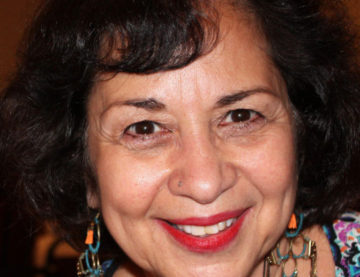
A former member of the militant Young Lords Party (YLP), Morales has had dossiers kept on her by both federal agencies and local police departments. Surveillance, she said, tends to go hand-in-hand with undercover agents putting out fake information or provoking in-fighting and with police entrapment, as was the case when the NYPD set up the Panther 21 on false charges.
In the late 1960’s and early 70’s, Morales served as the deputy education minister for the YLP, which demanded better services for Puerto Ricans, advocated for the rights of women and challenged police violence in New York, Philadelphia and elsewhere. She flipped through pages in the files kept on her as she talked to WMC IDAR/E, pausing at many lines of text that had been blackened out. The documents spell out who she associated with and details of both her personal and political life.
Morales explained that break-ins into her home were par for the course of intimidation by “special agents” and designed to discourage activism. “You’d come home and you’d see documents all over the place,” she said. “So it did deter people from getting involved, as did the assassinations of Black Panthers."
"This is not a walk in the park," Morales added. You have to expect that if you are going up against the ruling class, they will be vicious.”
Morales was hardly alone in being followed and harassed. In 2016, the NYPD discovered 520 boxes of files and photographs of surveillance information that it had for years claimed it could not find. This came after Dr. Johanna Fernandez, a professor at Baruch College, sued in 2014 to access these files.
Fernández, the author of a book on the Young Lords, said the files reveal an Orwellian climate.
“What was fascinating about these files was the amount of resources poured into surveilling New Yorkers,” she said. The people watched were not simply individuals perceived as “radical,” but also the elderly neighbor, bodega owner or the local church, Fernández explained. “This is about social control in a so-called democracy.”
“This is about social control in a so-called democracy”
The implications of mass surveillance
These practices continue. While the NYPD unit in charge of surveillance has gone through several name changes—Red Squad in the 1950’s to now the Intelligence Division— it still has come under fire in recent decades for the same activities around the Muslim community, anti-war protestors during the Republican convention in 2008, and Black Lives Matter.
Mass surveillance, Fernández said, is a part of the increased militarization of the police in the name of supposedly controlling crime and is dangerous considering today’s blatant neofascism and that white supremacists are embedded in police departments.
The public safety cover for the use of drones was also criticized by Guadalupe Correa, associate professor for politics and government at George Mason University. “Where are the metrics that tell us that the country is safer because of this technology?” she said. “That’s the idea that politicians are trying to sell.”
Correa also pointed to the incentive for increased use of drones and other tech – government contracts for the multi-billion dollar mass surveillance industry.
From New York City to Baltimore to the southern border, the surveillance sprawl and intrusion is alarming. As Sidney Fussell wrote for the Atlantic, the special privileges granted to immigration authorities "are becoming untethered from the geographic border, eroding the rights of people on the ground and, of course, those visible from the air."
The NYPD claims that it doesn’t interfere with Constitutionally protected activities. But local activists and news media have reported that the Department regularly violates and tries to circumvent guidelines that are known as the Handschu decree, designed to prevent police disruption of political work and First Amendment protected demonstrations.
Ramos said law enforcement organizations, which have big war chests to back them, oppose her bill. But she is counting on this era of change to open up an opportunity to check the NYPD.
The absence of restrictions in New York and across the country would not bode well, as Fernández put it. “Do we want to live in a society that addresses 'social problems' through militarization?” she posed. "Because if we do, then the logical conclusion of that is a society without rights, an authoritarian society, which is increasingly what we are moving towards.”
More articles by Category: Free Speech
More articles by Tag: NYPD, Drones, surveillance, Jessica Ramos, New York


