















Chile is a Beacon of True Grassroots Democracy

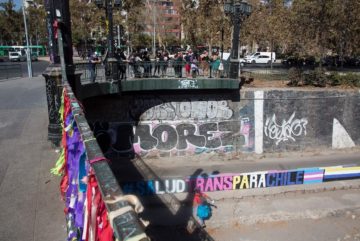
We arrived in Santiago de Chile on a Friday night. On the road to Providencia, we marveled at walls full of protest graffiti and murals. It was a different country from the orderly, mechanized Chile, with its neoliberal marrow, that I had visited in the past. The country we witnessed that night was a rebellious Chile.
We began our International Meeting of Peoples in Struggle—an exchange comprised of 40 people from Puerto Rico and different parts of the United States—with a guided tour of Villa Grimaldi, located in the Peñalolén, a working-class neighborhood. The tour guide was Roberto Merino Jorquera—father of the famous rapper Anita Tijoux—but more importantly, a survivor of the dictatorship of Augusto Pinochet. Don Roberto explained that hundreds of people had been tortured there and that, in the end, the survivors decided to organize a park for tranquility and reflection, where memory could be rescued.
“Felix and the neighbors of Lo Hermida said they were inspired by the organizational model of Rep. Alexandria Ocasio Cortez”
At our next stop, in nearby Lo Hermida, we talked with Councilman Félix Bezares, who shared with us how his community had organized to elect him as an independent candidate in the last municipal elections. With individual donations, Bezares organized three events where more than 20,000 people from the neighborhood attended. Felix and the neighbors of Lo Hermida said they were inspired by the organizational model of Rep. Alexandria Ocasio Cortez and the documentary about her campaign, "Knock Down the House." Bezares was the first person of Lo Hermida to represent the neighborhood in the municipal council—a historic achievement given that the needs of Lo Hermida have been neglected by that body.
In Peñalolén, Lo Hermida, La Victoria, La Faena, all peripheral communities in the metropolitan area of Chile's capital city Santiago, we saw the same thing: organized, militant, combative communities against the dictatorship, and now, against the recent embodiment of Pinochet—President Sebastián Piñera. These communities mobilized in the social explosion of October 2019 that forever transformed Chile. These same communities also were subjected to the worst consequences of the police violence and political repression by the Piñera government.
We listened again and again as mothers told us about their children, mortally wounded by the police—the Pacos, as they are called in Chile—simply for going out to protest. The main spark of the protests? A 30-cent increase in the subway fare. But as Victor Chanfreau of the Coordinating Assembly of High School Students (ACES) explained to us, students called for a national strike not for the 30 cents, but for the 30 years of neoliberal government exploitation of the Chilean working class.
The students were the face of the uprising, but trans feminist women and LGBTQIA+ people were also a part of the Chilean dissidence that made itself felt in the streets for several weeks in the former Plaza Italia (now Plaza Dignidad) until Piñera finally agreed to a process to change the Constitution of Chile, which had been written in the 1980s under the Pinochet regime. During these massive protests, thousands of young people were arrested. Hundreds were left wounded and blinded and severely injured by the police force unleashed by the Piñera government.
With a Constitutional Convention underway, and in the context of a Chile completely immobilized by the strict quarantines imposed by Piñera, a 35-year-old former student leader, Gabriel Boric, was able to win the presidential elections in a second round against a far-right candidate. Once installed in the Palacio de la Moneda, Boric appointed a cabinet with women in the majority, including the granddaughter of Salvador Allende, the democratically-elected president who was a victim of Pinochet's 1973 coup.
The progressive groups we met with are cautiously hopeful with Boric, whom leaders like Felix call a "woke elite." However, there is a general consensus that the constitutional process is building positive momentum and that it has a lot of room to include the issues of those who have not been heard before in Chile’s political process.
This change in the politics can be seen in the opportunity for independent candidates to run and represent their communities, thus undermining the domination of traditional political parties. Many of the independent candidates are the most representative of marginalized communities, including queer and Mapuche indigenous Chilenos.
The Constitutional Assembly has approved several important initiatives, including declaring Chile a plurinational state, with legal recognition of the Mapuche community and the Afro-Chilean community; a new definition of a family not limited to a cisgender men and cisgender women and children; the right to self-identify so that trans and non-binary persons can choose on their identification cards; education with a gender perspective; and finally, the elimination of the senate, to be replaced by a much more representative and autonomous regional legislative body.
What are the lessons that Chile can teach us in Puerto Rico and in the United States? That protesting can be effective, that you cannot toy with a people tired of abuse, and that by creating truly representative democratic processes you can make change from the grassroots for the common good. In Puerto Rico, after the massive 2019 protests to oust the governor, we understood some of these lessons. But in Chile, the masses took it a step further, to systemically change the definition of a country to respond to the current realities.
Not everything was perfect on our trip. We were a diverse group of queer people, Black people, or people who were sometimes perceived as immigrants, subjected to instances of discrimination. This showed us that, although the aspiration is to have a fairer country, Chile still struggles with racism, xenophobia and homo/transphobia. But the other truth is that the Constitutional Assembly has brought these issues up for debate and has prioritized the dignity of the Chilean people, in all their diversity.
It remains to be seen what the results will be on a plebiscite to accept or reject a new Constitution, but it’s clear that the spirit of the people is in leaving behind the framework of the dictatorship and opening the way for a more equitable, plurinational nation responsive to the needs of the most marginalized communities.
If Chile's walls were to vote, there are clear indications that the Constitutional Assembly will triumph.
Translation by Juana Ponce de León.
More articles by Category: International
More articles by Tag: Chile, Democracy, Pinochet, Transgender, Mapuche, Constitutional Assembly, Karina Claudio Betancourt


