















Will Anything Change in The Wake of the Uvalde School Shooting?
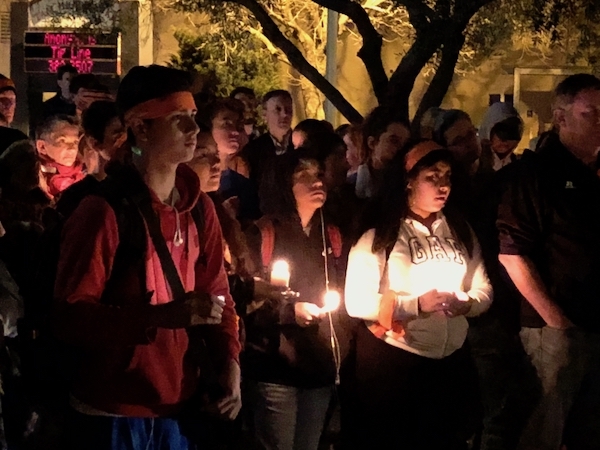
On Tuesday, May 24, at 11:33 a.m. CDT, a gunman walked into Robb Elementary School in Uvalde, Texas, with an AR-15-style rifle and began firing on students and teachers. The attack left 21 dead and 17 injured; it’s the deadliest school shooting since 26 people were killed in the 2012 Sandy Hook Elementary School massacre.
I first saw the news at around 5:45 p.m. EDT, while eating dinner at my school cafeteria. A notification flashed across my phone screen from a New York Times briefing, stating that “fourteen children and a teacher were killed in a shooting at an elementary school in Uvalde, Texas.” I had to reread the caption, shocked that an elementary school, where students are typically between 5 and 11 years old, would be the target of such horrific violence. My friend and I looked up at the same time across the table — his own cell phone had also lit up, his alert was from CNN. He asked everyone else sitting at the table if we had heard about the shooting. I felt nauseated.
The next day, my mom told me to be careful since a shooting could happen anywhere, especially near my school, which is in Pennsylvania, a state where gun laws allow for the open carry of firearms in public spaces. I nodded, acknowledging my mother’s worry, but my first reaction was doubt that a shooting would ever happen on my campus. Then I realized that students at schools where shootings have happened were probably just as unsuspecting, just as incapable of believing such a thing could happen. Those students had gone about their classes expecting to learn about gravity or Shakespeare or conjugating irregular verbs, not to be confronted with a gunman.
This year, 27 school shootings have already taken place. With each one, I am confronted with what feels like an increasingly real risk that school is not always a safe place. I’m not alone in that feeling, either — a 2018 Pew Research study found that a majority of teenagers worry that a shooting could happen at their school. That fear was, in fact, realized by over 311,000 students who experienced actual school shootings at their own schools, according to a Washington Post article which reviewed the 331 school shootings that have occurred since 1999.
The communities that survive school shootings often experience lasting trauma with a significant deterioration in mental health and school participation. A 2020 PNAS study analyzed the aftereffects on student mental health of 44 school shootings on that and surrounding schools, and found a 20% increase of antidepressant use in the student communities following the event.
The sad truth is that gun violence is a very real threat for teens today. In May, a CDC data report found that firearm injuries are now the leading cause of death for adolescents, overtaking the number of fatalities from motor vehicle accidents, which had previously been the leading cause.
Like many shootings before it, the Uvalde school shooting has prompted politicians to address the mass shooting epidemic in the U.S. In remarks made the night of the shooting, President Joe Biden called for more gun control laws, saying “we have to act” and pointing out that common sense gun laws “work and have a positive impact.” Republican Senator Ted Cruz, in an MSNBC interview, cited a greater police presence around schools to be “the most effective tool for keeping kids safe” and emphasized the importance of only “one door that goes in and out of the school” as a safety measure, although data has not shown a correlation between greater police presence in schools and stopping mass shootings and OSHA asserts that only one entry in a public building is a notable safety hazard. At the NRA’s annual convention on Friday, former president Donald Trump defended gun rights, stating that “the existence of evil in our world is not a reason to disarm law-abiding citizens,” but rather “one of the very best reasons to arm law-abiding citizens.” Trump’s 2016 presidential campaign was notably supported by $31 million in donations by the NRA.
Certain Democratic states are attempting to impose in-state firearms safety measures. On May 25, the day after the Uvalde shooting, New Jersey Governor Phil Murphy encouraged raising the legal age of purchase to 21 for long guns and, similarly, New York Governor Kathy Hochul attempted to ban people under 21 from buying AR-15-style rifles. Such proposals are likely to be met with significant resistance. For example, in California on May 11, two weeks prior to the Uvalde shooting, a panel from the U.S. Court of Appeals for the Ninth Circuit ruled that it was unconstitutional for a state to ban the purchase of semiautomatic rifles to adults under 21. On a federal level, Congress currently appears gridlocked, disorganized, or simply unwilling to make federal decisions on gun control.
While certain Republicans, including Cruz, claim that Democrats were trying to politicize the Texas tragedy against gun rights, Rebbecca Fischer, executive director of New Yorkers Against Gun Violence, said, “We are not only leaning heavily on state legislatures now, but we have been for the past 10 years, particularly since the Sandy Hook massacre.”
So, what has changed since that 2012 deadly school shooting?
The short answer: not much. Despite the initial outrage after mass shooting events, the efforts in Congress to address the crisis have failed time and time again. In 2012, following the Sandy Hook massacre, a bill was proposed to strengthen criminal background checks when purchasing firearms but failed on the voting floor. Similar bills failed after San Bernardino in 2015, Pulse Nightclub in 2016, and El Paso and Dayton in 2019, to name a few, and gun control advocates are not optimistic that gun control bills will be able to pass in Congress this time around following the Texas shooting.
But the worst part is that when the next school year comes around, I know more casualties and more pain and more headlines will arise, because our system allows virtually anyone to own a gun, and despite public sympathy and outrage for the unthinkable choices of the gunman and innocent lives of the students, nothing has changed.
I want to remain hopeful. I hope that enough politicians will stop blaming mass shootings on lack of school security, immigration, lack of religion, mental health, or video games, but finally recognize that these shootings would not be possible without easy access to a firearm.
More articles by Category: Politics
More articles by Tag: Gun violence


