















What #BelieveWomen really means
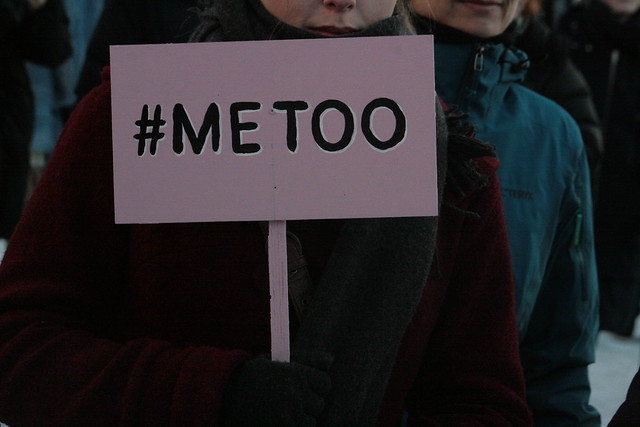
“Believe women” has long been a rallying cry for #MeToo supporters — and a point of attack for the movement’s opponents. In a recent article for The Cut, Rebecca Traister dug into the criticisms wielded against this phrase, arguing that the powerful ideas behind this slogan are hindered by problematic interpretations of it. “The very idea of believing women doesn’t have to be an imperative,” Traister writes. “At its most radical, it is a long-overdue corrective to the benefit of the doubt that powerful men are given over and over and over again.”
Traister is right. “Believe women” is due to be reinvented from a mandate into a mindset. To do that, we have to examine the roots of the phrase — namely the fact that it didn’t spring from a culture that heard women’s allegations of assault with impartiality. “Believe women” is predicated on the understanding that the cost of women speaking out about sexual assault and misconduct is high, and, as a result, accusations should be taken seriously and examined from a place of open-mindedness instead of automatic skepticism.
Even since the #MeToo movement gained cultural prominence, multiple powerful men have received less backlash over allegations of misconduct and assault than their accusers have. Take Christine Blasey Ford’s allegations that then-Supreme Court nominee Brett Kavanaugh sexually assaulted her. After her name and address were publicly shared without her consent, Blasey Ford received a deluge of death threats and was forced to leave her home. The onslaught of hate continued for months after her September 2018 testimony. Business Insider reported that Blasey Ford’s family had to move four times in two months and, as of November 2018, Blasey Ford was unable to return to her job as a professor at Palo Alto University.
The Republican narrative of these allegations, on the other hand, was that Kavanaugh’s life would be ruined if Blasey Ford’s allegations were believed. And, of course, Kavanaugh’s life was never ruined: he was ultimately confirmed to a lifetime appointment on the highest court in the country.
Blasey Ford’s experience exemplifies how coming forward with assault claims has a higher cost for victims than for alleged perpetrators. Ford had to publicly prove that the worst night of her life occurred all while having her story picked apart and facing the wrath of online trolls. Because women like Blasey Ford must put their life and reputations on the line by calling out powerful men, their courage demands that we treat their accusations with the gravity they deserve.
Traister also argues that treating women’s accusations with legitimacy can “advance how we understand and correct abusive power dynamics.” The sentiment behind “Believe women” compels us to reckon with the reality that systemic sexism still leads some people to view the facts of a case separately from their ability to believe women’s experiences.
Chanel Miller’s courtroom experience perfectly illustrates this. Miller’s rapist, Brock Turner, was caught in the act, chased down, and tackled by two Stanford grad students. There was no doubt an assault had occurred, and Miller detailed her trauma after the assault in a viral victim impact statement. Yet, Judge Aaron Persky sentenced Turner to only six months in jail. This insultingly lenient sentence was not the result of murky facts but lack of empathy. Anyone who truly listened to Miller’s account would understand that Turner’s assault merited a much more severe punishment than six months jail time. Persky’s ruling shows that it’s not enough to just believe that an assault occurred. We must also believe women when they articulate the emotional trauma of assault and respect that trauma.
Incorporating an understanding of trauma into evaluations of sexual assault claims would create a total shift in how our society views women’s allegations. We saw the beginnings of this shift in Harvey Weinstein’s New York trial. Miriam Haley, one of two key victims at the center of the Weinstein trial, stayed in contact with the former producer even after he assaulted her. This had the potential to complicate the case, since this type of behavior isn’t in line with the public perception of how an assault victim should behave.
However, in a 2017 New York Times article, writer Sheila Dawn detailed how emotionally complex experiences of assault can be. In a case like Haley’s, Dawn explained “the victim may have little choice but to stay in contact if the offender is a boss, teacher, coach or relative.” According to The Daily, Haley said she continued to be friendly with Weinstein to “put [the assault] away in a box and pretend that it didn’t happen.” It would be deeply misguided to dismiss an allegation of assault by evaluating the victim’s behavior based on an ignorant interpretation of post-trauma behavior. In this case, the Harvey Weinstein jurors didn’t do that. Because the jury believed in these nuances of trauma, the court found him guilty of two felony sex crimes.
Ultimately, though, Traister acknowledges that the argument that all women should be believed has “enfeebled the far more important argument that we should encourage them to speak more, and listen to them more seriously when they talk.” Believing everything a woman says does nothing to address the injustices and biases that make speaking out so hard in the first place. In its strongest, most productive interpretation, “Believe women” is about believing that women who accuse men of sexual assault continue to face enormous obstacles. It compels us to see the emotional cost of sexual misconduct and stretch our empathy to factor the psychology of trauma into the process of verifying sexual assault claims. “Believe women” asks us to do the hard work of eliminating our biases and questioning our assumptions to make the verification of sexual assault claims as just and respectful as it can be.
More articles by Category: Feminism, Violence against women
More articles by Tag: Rape, Sexual assault, Sexual harassment, #MeToo


